AMD Radeon RX 9000 Series Fit in Current Build Budgets
Memory costs have pushed every RX 9000 card above its launch price tier.
The RDNA 4 launch built a reputation for the RX 9000 series as the price-to-performance line in AMD's stack, and that reputation is now out of date. AMD's AIB partners are paying more per 8GB of VRAM for the GPU and memory kits that go into every card in the lineup, and those costs are being passed directly to consumers, with further hikes already signaled. This isn't a one-quarter blip that corrects itself by the next earnings call. Micron's investor documents state that strong demand and supply constraints are expected to continue beyond calendar year 2026, with conditions forecast to be even tighter in calendar 2027 and 2028. Every card in the RX 9000 lineup has drifted from the budget bracket it launched in, and the relationships between the cards have shifted enough that the lineup needs a new map.
What drives GDDR6 prices up for AMD cards
The GDDR6 memory market is now the single largest variable determining where each RX 9000 card lands in a build budget, and the pressure behind it is structural. In concrete terms, 16GB of GDDR6 memory priced at a moderate level in spring 2025 had roughly doubled by May 2026, the largest single jump in the GPU bill of materials for this generation. TrendForce's press release illustrates the scale of the shift: the quarter-over-quarter increase in conventional DRAM contract prices was revised upward from a previous estimate of 55 to 60 percent to a new estimate of 90 to 95 percent. PC Partner, the AIB manufacturer, has stated that prices are being increased to offset additional graphics memory costs, with further increases intended to compensate for reduced GPU allocation. Every RX 9000 card uses GDDR6 rather than GDDR7, so the entire lineup absorbs this cost, and the real question for any given card is not whether it's affected but by how much, a figure that varies sharply by VRAM tier. AMD's graphics cards have not escaped the current price increases, but those increases generally have not matched the severity seen across much of NVIDIA's lineup. AMD's reliance on GDDR6 instead of GDDR7 sets a cost floor under the RX 9000 series, and at the same time it gives the lineup a relative advantage over cards built on the pricier memory standard.
The 8GB vs. 16GB VRAM Split and the Budget Floor for Every Tier
The VRAM variant a builder chooses now carries as much weight for build longevity as the card choice itself, and the GDDR6 surge has widened the practical gap between 8GB and 16GB options at every tier. At the RX 9060 XT level, the 8GB variant launched at $299 and is now widely flagged as a card to avoid in build guides, while the 16GB variant, at a slightly higher MSRP, is the one recommended for purchase. Street prices for both the RX 9060 XT 8GB and the RX 9060 XT 16GB have risen considerably since late 2025, and the 8GB model's long-term value keeps shrinking even as its price climbs alongside its sibling. More GDDR6 costs more to produce now, and that fact narrows the street price gap between 8GB and 16GB variants even as both rise, so the dollar premium for future-proofing a build is smaller today than it has ever been at this tier. The RX 9050's MSRP sits just below the original MSRP of the RX 9060 XT 8GB despite carrying half the compute units, and that compression makes the 8GB 9060 XT's position in the lineup difficult to justify at any street price above its original MSRP. The practical rule that follows: plan for 16GB at every tier where a 16GB variant exists, and treat the 8GB options as worth considering only if found at or below their original MSRP, a condition that is close to impossible to meet in the current market.
The RX 9060 XT 16GB as the entry point for a build worth keeping
At current street prices, the RX 9060 XT 16GB is the lowest-tier card in the RX 9000 lineup that makes sense to build a system around, and it earns that position on performance merits as well as on price. A low TDP keeps the PSU budget modest, a 2-slot footprint preserves case flexibility for smaller builds, and 16GB of GDDR6 gives the card a longevity buffer the 8GB variant simply cannot match. These attributes matter most to a builder working with a mid-tower case and a mid-range CPU, where the RX 9060 XT 16GB pairs naturally with a six-core or eight-core processor without creating a bottleneck on either side of the system. The card's street price has moved up from where it launched, and that increase is real money for anyone budgeting a first build or a long-overdue upgrade. Even at that higher price, the RX 9060 XT 16GB remains the entry point worth building around rather than a compromise to settle for, because the alternative at this budget level is an 8GB card whose value keeps eroding under the same cost pressure.
The RX 9070 GRE as the new value anchor of the lineup
The RX 9070 GRE, which launched globally in June 2026, has become the card in the RX 9000 lineup whose street price has held closest to its MSRP, and that stability makes it the de facto value anchor in a stack where every other card has drifted higher. Its specifications place it deliberately between its stablemates: 48 Compute Units, 12GB of GDDR6, and roughly 220W TDP, positioning it between the RX 9060 XT and the RX 9070 in both compute units and memory capacity. Price stability matters more in this market than it would in a stable one, because every other card in the lineup is a moving target relative to its original positioning, while the GRE has largely stayed put. That stability is the reason it functions as a pivot point for the whole budget map: a builder can treat the GRE's price as a fixed reference and measure every other card's drift against it. The GRE's 12GB VRAM buffer is smaller than the 16GB carried by the RX 9070 and RX 9070 XT, and that's a longevity trade-off worth weighing seriously against the price advantage. For 1080p gaming and moderate 1440p settings, 12GB holds up comfortably; for high-resolution texture workloads, the buffer gets tighter, and a builder planning around demanding 1440p or 4K texture packs should budget for that ceiling. The GRE earns its place as the right call for a build centered on 1080p or mainstream 1440p gaming where price stability and value density outweigh headroom for the most VRAM-hungry workloads.
The RX 9070 and RX 9070 XT as 1440p and 4K cards under pressure
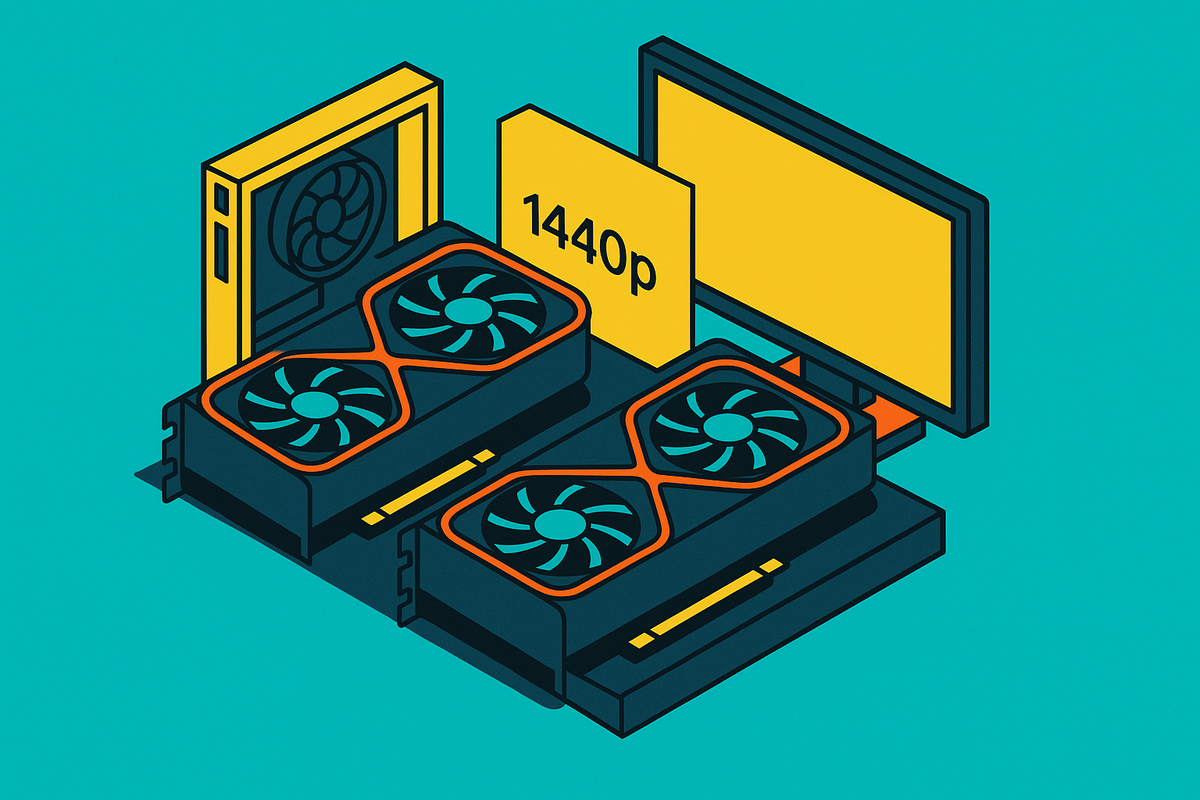
The RX 9070 and RX 9070 XT remain capable 1440p cards, and the XT variant pushes into genuinely strong territory at higher resolutions, but at current street prices both are more expensive bets than their launch positioning suggested. The RX 9070 launched at a competitive price and now runs roughly $650 at street, carrying 56 Compute Units, 16GB of GDDR6, and a 220W TDP, which makes it a strong 1440p high-settings card for builders who can absorb the higher cost of entry. The RX 9070 XT's competitive position against NVIDIA still holds in meaningful ways: a recent online retail price check found it priced meaningfully below both the RTX 5070 Ti and the RTX 5080, and below the RTX 5070 by a smaller margin, while 12-game testing put the RX 9070 XT within a few percent of the RTX 5070 Ti in raster performance and comfortably ahead of the RTX 5070. That comparison deserves an honest caveat rather than a dismissal: the RX 9070 XT's raster value holds up well against those NVIDIA cards, but it loses ground on path-tracing workloads, where NVIDIA's architecture carries a clear advantage. Builders prioritizing frame rates in traditional rasterized titles get strong value from the RX 9070 XT at its current street price; builders who lean heavily on path tracing in supported titles should weigh that gap before treating the price comparison as the whole story. The visible U.S. street price for both cards does not yet fully reflect the new GDDR6 cost floor across every market, which is part of why they still read as comparatively attractive even though neither is objectively cheap anymore, and further increases are expected as memory costs continue working through the supply chain.
Choosing AIB variants: cooling, size, and aesthetics at each tier
Once a builder has settled on a tier, the AIB variant decides whether the card fits the case, how loud the system runs under load, and whether the build's aesthetic holds together as a finished product. The 2026 memory market has made some of these variants scarce or markedly more expensive than others, so the choice of board partner now carries real budget weight alongside the choice of GPU tier. For the RX 9070 XT, the Gigabyte Radeon RX 9070 XT Gaming OC stands as the overall recommended buy: it carries a factory overclock, triple-fan cooling, dual BIOS for switching between performance and quiet profiles, conventional 8-pin power connectors that simplify PSU cable planning, and a 288mm length that builders need to check against case clearance before buying. For builders prioritizing aesthetics or working in a compact case, the ASUS Prime RX 9070 XT White OC Edition offers a triple-fan cooler in a 2.5-slot design, with improved compatibility in mid-tower cases and more clearance around neighboring PCIe slots, making it the better fit for builds where a white-and-silver color scheme or tighter slot spacing matters as much as raw cooling capacity. The right AIB pick at any tier in this lineup now depends on matching the physical card, its cooling solution, and its finish to the specific case and build goals in front of a builder, not simply on picking whichever variant is cheapest at the register.