PSU Wattage Selection Trends Amid High-TDP GPU Adoption
Flagship GPUs now demand power budgets that old sizing rules no longer support safely.
The rule that generations of builders learned, match the power supply to the spec sheet and add some headroom, was built for a hardware era when flagship GPUs drew under 200W; the current era has moved the goalposts so far that the rule now produces dangerously wrong answers at the high end. Average tracked desktop GPU power rose from 132W in 2016 to 253W by 2025, roughly doubling over the course of a decade, a shift visible clearly in the aggregate numbers. That trend holds within a single generation, not just as a multi-year average across a handful of outlier cards.
This climbing power budget has not been matched by proportional gains in efficiency. The RTX 5090 ranks 104th of 131 GPUs in performance-per-watt despite being the fastest card, meaning raw performance gains are being funded almost entirely by power budget, not architectural efficiency gains. Performance gains at the top of the stack are being bought with power budget, not with architectural efficiency improvements, and a builder planning around the flagship tier is planning around a card that spends watts to win benchmarks rather than one that is getting more efficient over time.
That trajectory is not universal across the industry, and AMD's RDNA 4 lineup demonstrates as much. AMD's RDNA 4 approach, with the RX 9070 XT at 304W board power, shows the halo-power trajectory is a choice, not an inevitability, but NVIDIA's flagship defines what PSU the market has to plan around. The existence of a well-regarded card at roughly half the wattage of the RTX 5090 makes clear that high TDP is a design decision aimed at a specific market segment, not an unavoidable law of silicon. Still, because NVIDIA's flagship defines the top of the market that enthusiast builders aspire to, it is NVIDIA's power curve that PSU manufacturers and PSU buyers alike have to plan around. Everything that follows in this piece, about transient spikes, wattage tiers, and efficiency curves, is a consequence of that one fact: the ceiling has moved, and it has moved further and faster than the old rule of thumb ever anticipated.
Why rated TGP understates what a PSU has to survive
A GPU's total graphics power rating describes a sustained average, not the worst moment a power supply will be asked to handle. The real constraint on PSU selection is the transient spike, a millisecond-scale surge well above rated TGP that the PSU has to absorb instantly or risk a shutdown. This is the mechanism that makes simple spec-sheet matching insufficient, and it deserves to be understood in some operational detail rather than taken on faith.
Consider the RTX 4090. Its average draw under gaming load is 450W. But the card hits transient peaks above 500W, and those spikes last only milliseconds. A power supply does not get to average out its response over the following second; it has to respond to that instantaneous demand the moment it occurs. The RTX 5090 pushes this problem further: an Igor's Lab analysis of the card's power behavior found peak consumption at 10 to 20 millisecond timescales, and higher still at sub-millisecond timescales, running well above the card's rated 575W TGP. Those figures are high enough to overload the voltage regulation of older ATX v2.51 power supplies, units that can be overwhelmed by voltage overloads from peaks this far above rated TGP.
The ATX 3.1 standard was written specifically to answer this problem. A compliant power supply is specified to absorb transient spikes up to twice its continuous rating for very brief durations, so a 1000W unit can, in principle, survive a momentary spike far beyond its nameplate wattage, though this safety margin erodes if average load already runs near the PSU's ceiling. That margin erodes as a system's average load creeps closer to the PSU's continuous ceiling, because a unit already working near its ceiling has less room left to absorb a sudden additional demand. A PSU sized exactly to a GPU's TGP, with no margin built in, is a PSU with the least capacity to do the one thing ATX 3.1 was designed to let it do.
The tools builders have historically used to size a power supply have not caught up to this reality. In one documented case, a popular online wattage calculator recommended an 850W unit for an RTX 5090 workstation configuration, while actual bench testing on a near-identical build measured 850W at peak gaming load alone, before any sustained stress testing was applied. A calculator's recommendation and a system's actual worst-case demand landed on the same number for entirely different reasons, one from a formula and one from a bench, and that coincidence should not be mistaken for the calculator being right. Together they define the baseline a 2026 PSU purchase should meet, and they set up the question every builder actually has to answer: how many watts, at which tier, for which GPU.
Wattage by GPU Tier in 2026
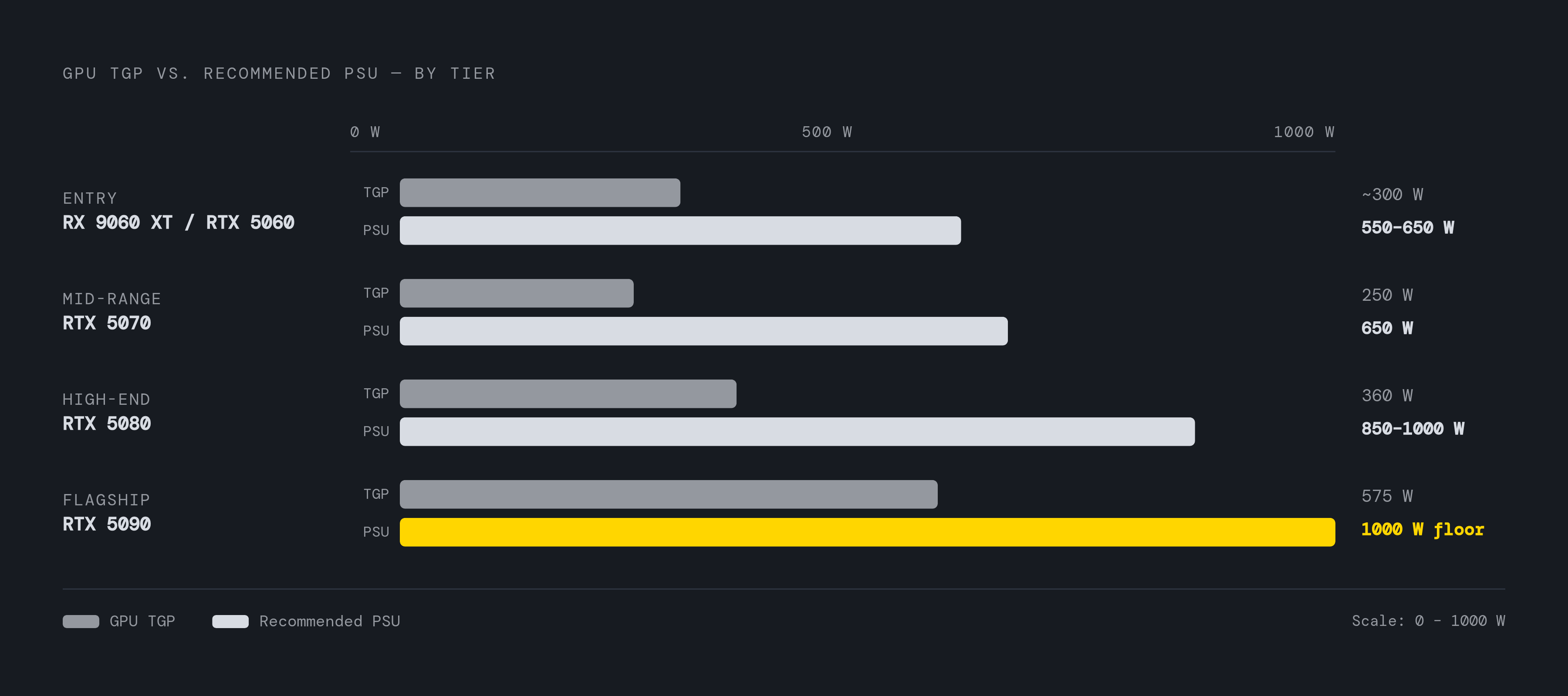
Applying that formula across four GPU tiers, the recommended wattage climbs in ways no single rule of thumb captures.
At the entry level, covering the RTX 5060 and RX 9060 XT class of cards, typical system load under gaming runs 250W to 350W. The recommended PSU sizes reflect that modest draw: 550W for the RTX 4060, a 550W minimum with 650W recommended for the RTX 5060, and 450W for both the 8GB and 16GB RX 9060 XT variants. Community trend: shifting from Bronze non-modular units toward 650W Gold modular options, driven by upgrade headroom awareness.
The mid-range tier, built around the RTX 5070 and RTX 4070 class, is where an RTX 5070 at 250W, paired with a Ryzen 7 9700X rated at 65W TDP but with an 88W maximum PPT, plus 150W for the rest of the system, produces a baseline of roughly 465W. With the 25% headroom figure applied, a 650W PSU is comfortably within range. NVIDIA's own guidance is in the same neighborhood, recommending 650W of system power for the RTX 5070 and stepping up to 750W for the RTX 5070 Ti.
The high-end tier, built around the RTX 5080 and RTX 4080 class, is where the formula produces the most contested number in the entire 2026 market. An RTX 5080 at 360W, a Ryzen 9 9950X at a 230W maximum PPT, and 150W of system overhead sum to 740W before any headroom is applied at all. NVIDIA recommends 850W of system power for this tier, a figure that a strict reading of the formula supports. Yet a meaningful share of the enthusiast community argues for 1000W regardless, on the theory that more margin is simply safer. The practical counterargument, raised directly in a Linus Tech Tips forum thread on the subject, cuts against that instinct: if a builder wants a more efficient power supply, the answer is to buy a more efficient power supply, not a higher-wattage one. Wattage and efficiency are separate purchasing decisions, and conflating them is how 850W-adequate builds end up with 1000W units that never run anywhere near their rated capacity.
The flagship tier settles the question that the high-end tier leaves open. The RTX 5090 carries a 575W TGP, and NVIDIA officially recommends a 1000W system power supply for it, with factory-overclocked AIB variants pushing effective TDP higher still. Pairing that card with a genuinely high-power CPU, such as an Intel Core Ultra 9 285K at 250W maximum turbo, pushes the system total before any headroom is applied already past 900W. At that point, 1000W is not a comfortable ceiling with margin to spare; it is the floor a builder needs just to clear the formula's starting line. That is why 1000W has become the de facto standard for flagship single-GPU builds in 2026, a recommendation born out of the arithmetic rather than out of caution for its own sake.
The efficiency curve and the calculus for mid-range builders
The instinct to buy more wattage than a build strictly needs is understandable, especially after reading a tier breakdown as contested as the one above. But buying headroom beyond what the math calls for does not make a system safer or faster. It moves the power supply's operating point further from its efficiency sweet spot, which can make the unit run less efficiently and the extra spending a waste.
The industry baseline for 2026 is 80 Plus Gold certification, which guarantees 90% efficiency at 50% load, and that baseline is the practical minimum any new build should accept. Platinum and Titanium units push efficiency higher still, but that premium only pays for itself over years of continuous, heavy use. The reason wattage and certification tier are separate decisions comes down to how a power supply's efficiency curve actually behaves: a unit delivers its best efficiency near the midpoint of its rated load, so a PSU that is oversized for the system it's powering spends its life running well below that midpoint, outside the band where it was designed to perform best. A correctly sized unit, by contrast, sits closer to that optimal band under the same real-world load.
The strongest argument against reflexive over-provisioning is simply what most systems actually draw. A mainstream build with a single GPU rarely exceeds 550W of total system power, and a mid-range system built around a Ryzen processor and an RTX 4060 typically pulls under 350W under load. The entire 1000W conversation that dominates enthusiast forums applies to a narrow slice of builders buying the most power-hungry cards on the market, not to the typical buyer. Forum data backs this up directly: an analysis of more than 35 threads on a PSU buying guide found a recurring pattern of builders purchasing 1000W units for systems that needed 650W, sitting alongside an equally persistent pattern of other builders choosing dangerously undersized budget units, with confusion about actual wattage requirements running through both groups.
The mid-range tier rewards the builder who resists both failure modes. Efficiency and modest power requirements compound rather than trade off against each other at this tier, the pattern the wattage tables in the previous section describe in numeric form.
Specific PSUs that earn their place at each tier in 2026
Sizing a power supply correctly answers only the wattage half of the purchase. Sizing a power supply correctly also requires checking whether the specific unit's internal components, its ATX 3.1 compliance, its connector standard, and its warranty terms hold up under the loads described above, because a unit that looks adequate on a spec sheet can still fail the test that matters.
At the budget and mainstream tier (around $60 or under for 650W of rated capacity), be quiet!'s Pure Power 13 M 650W is fully modular, 80 Plus Gold certified, equipped with a 450W-rated 12V-2x6 connector, and achieves Platinum-level efficiency despite its Gold certification, 93.3% average at 230V, backed by a 10-year warranty and priced at roughly $100. The previous-generation Pure Power 12 M 650W remains a recommended option as well, offering 80 Plus Gold certification, full modularity, and quiet operation for budget and mid-range builds.
At 850W, Seasonic's Focus GX-850 is 80 Plus Gold certified and fully modular, built by a company that manufactures its own units rather than rebadging someone else's design, a distinction shared by only a handful of other OEMs in the industry, and it earns consistent marks for voltage stability, ripple suppression, and overall build quality.
At 1000W and above, the tier the RTX 5090 now effectively requires, the field broadens into several distinct approaches. The NZXT C1500 Platinum delivers 1600W and is listed among the top picks on Tom's Hardware best PSU guide. The MPG Ai1600TS matches that 1600W capacity with Titanium certification, ATX 3.1 and PCIe 5.1 compliance, silicon carbide MOSFETs, a Safeguard+ protection system, and a 12-year warranty. ASUS's ROG Thor 1200W Platinum III uses gallium nitride MOSFETs and includes a magnetic OLED display for real-time wattage monitoring, a feature aimed squarely at builders who want to watch the transient behavior this piece has described rather than take it on faith. For builders working in small-form-factor cases rather than full towers, Corsair's SF750 extends high-wattage capacity into the compact segment.
The spread across these tiers makes the central argument concrete: the right power supply in 2026 is not the one with the biggest number on the box, but the one whose rated capacity, transient response, and certification match the actual load the GPU and CPU inside the case will put on it.