Intel vs AMD CPU Market Share Among Enthusiast Builders
AMD dominates DIY retail while Intel leads global shipments, a gap that matters for builders.

Global CPU market share data says Intel wins, comfortably. Both numbers reflect actual measurements, not a fabrication. Only one of them tells a builder anything about what to buy.
Why global CPU market share numbers mislead enthusiast builders
Start with the headline figure, because it's the one that gets quoted everywhere.
It's also mostly beside the point for anyone building their own desktop. OEM relationships lock in bulk orders years in advance. QuickSync makes Intel silicon the default choice for thin-and-light laptops that need battery life more than frame rate.
Blend all of that into one shipment number and the DIY signal disappears entirely. A builder reading "Intel 67.4%, AMD 32.6%" and concluding that's the enthusiast consensus is reading a number built out of overall x86 client shipments reported by Mercury Research via Tom's Hardware. None of this means Intel makes a bad desktop chip, and nothing here argues otherwise. It means the headline number needs context before it's useful for the one decision a builder is actually trying to make. Those global numbers include laptops, OEM, and enterprise segments where Intel has structural advantages such as OEM relationships and QuickSync for thin-and-light devices, with Intel holding dominant laptop share above 70% per Statista.
What the enthusiast-channel data shows
Look at the channels where builders actually buy their own parts, and the ratio doesn't just narrow, it reverses. German etailer Mindfactory, whose DIY retail channel is closely tracked, puts AMD's share at roughly 85%, almost the mirror image of the global headline. That's close to a mirror image of the global x86 number, and it's the single clearest data point in this entire story.
Steam's Hardware Survey backs the direction, if not the exact magnitude. It's a voluntary, randomly sampled survey, not a census, and it pulls from roughly one-twelfth of active Steam users in any given month. Treat every figure from it as a strong signal, not gospel.
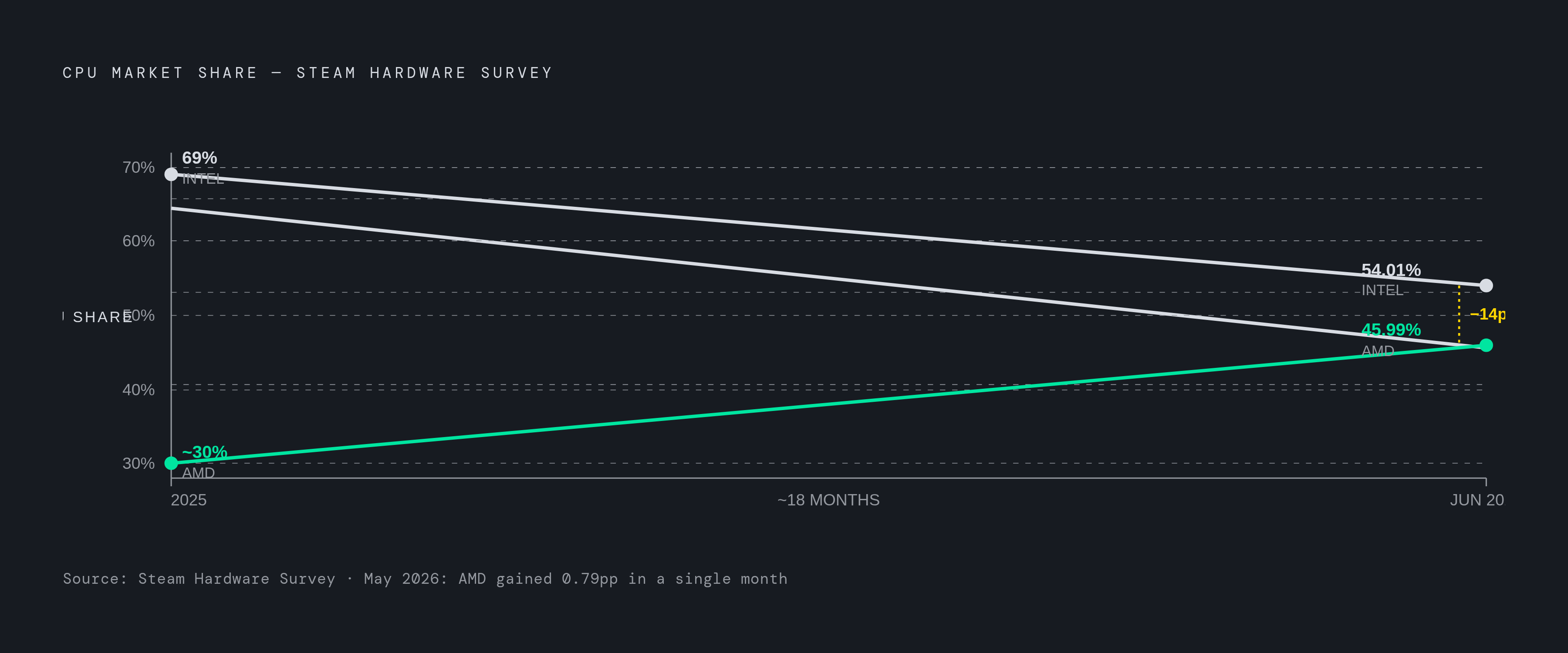
With that in mind, the trend line is hard to argue with. Intel sat near 69% in January 2025. By June 2026, AMD had climbed to 45.99% against Intel's 54.01%, a swing of roughly 14 percentage points over about a year and a half. May 2026's numbers, the most recent full-platform figures available, showed AMD at 46.06% overall and 44.97% among Windows users specifically, gaining 0.79 percentage points in a single month, a channel actively reallocating itself. That's a sharp, sudden shift. That's a channel actively reallocating itself.
A piece that only reports the trend that flatters its own thesis isn't reporting much of anything. January 2026 showed Intel gaining 0.25%, a small bump that analysts didn't read as a reversal. Tom's Hardware tied part of it to discounted DDR4-compatible Intel platforms landing at a moment when DDR5 RAM prices were climbing, which is a value story, not a performance one. Passmark's desktop tracking adds a second, independent confirmation of the broader direction: AMD outpaced Intel in desktop market share there for the first time last year. Whether AMD crosses into outright Steam majority by the end of 2026 remains genuinely open. Sources describe it as "a very live possibility," not a foregone conclusion, and that's the right way to hold it.
How 3D V-Cache created the enthusiast preference gap
The mechanism behind that shift has a name: 3D V-Cache, and it produced the shift by cutting memory latency, as later benchmarks show. AMD stacks a large block of L3 cache directly on top of (or, in the newer generation, below) the compute die, cutting memory latency in a way that shows up as higher, steadier frame rates rather than just higher peak numbers. It's an unusually direct piece of engineering, in that the benefit is exactly what the marketing claims, no interpretation required.
The scale of that benefit is the number that actually moves buying decisions. Independent testing cited by Major Custom Computing has the Ryzen 7 9800X3D beating Intel's Core Ultra 9 285K by around 35% on average across modern game titles Intel vs AMD: Which CPU Should You Choose in 2026? Tom's Hardware. That's not a rounding-error win.
Push the resolution up and the story changes. At 1440p ultra settings or 4K, the GPU becomes the bottleneck and CPU brand differences compress substantially. A builder assembling a 4K-first rig shouldn't weight the 35% figure the same way a 1080p competitive gamer should Intel vs AMD: Which CPU Should You Choose in 2026?. Context matters as much here as it did with the market share numbers.
Intel's answer to all this isn't a failure to compete; it's a different bet. Arrow Lake's hybrid design, mixing performance cores and efficiency cores under Thread Director scheduling, dropped Hyper-Threading in favor of better performance-per-watt. That's a legitimate engineering philosophy aimed at efficiency and multi-threaded workloads rather than raw gaming throughput, not a worse chip dressed up as a different one.
There's a cultural layer here too, so it should be stated rather than danced around. In the DIY retail channel tracked by German etailer Mindfactory, AMD's share runs at roughly 85%, almost the mirror image of the global headline. Builders remember which platform gave them a scare. The gap appears most at 1080p and 1440p gaming, the resolutions the Steam Hardware Survey confirms are where most builders actually play, with 1920×1080 remaining the choice of just over half of all Steam users. Intel's trust deficit among DIY builders stems in part from the 13th- and 14th-generation processor degradation crisis, in which CPUs became unstable over time and required voltage and BIOS fixes that measurably damaged confidence in the Intel platform in the enthusiast community, cultural context that helps explain why the Mindfactory 85% figure exists beyond pure benchmark math.
CPU tiers for builders in 2026
Everything below applies to what's actually on shelves now, since Zen 6 and Nova Lake have both slipped to 2027, and the chips named here are what most builders will be buying through the rest of 2026 and into next year.
For a roughly $1,000 build aimed at 1080p or light 1440p gaming, the AMD Ryzen 5 9600X is the standout at $189 as of June 2026, and because it sits on the AM5 platform, a future upgrade to an X3D chip won't require a new motherboard Tom's Hardware. Intel's DDR4-compatible platforms, B760 paired with older-generation chips, remain attractive for builders who already own DDR4 RAM and want to minimize total spend, and Tom's Hardware notes these remained in stock and often discounted through 2025 and into 2026.
Move up to the mid-range gaming sweet spot and the AMD Ryzen 7 9800X3D is the value pick, topping essentially every serious gaming benchmark according to both Major Custom Computing and Tom's Hardware. Intel's Core Ultra 7 270K Plus earns its place too: Tom's Hardware describes it as massively faster than AMD's competing Ryzen 7 9700X at the same price point in multi-threaded productivity work, which makes it a sound choice for a builder splitting time between gaming and streaming or light editing.
At the high end, for builders chasing no-compromise 1440p performance, the AMD Ryzen 9 9850X3D is the fastest gaming CPU on the market per Tom's Hardware's own review, and Club386 confirms it displaced the 9800X3D as the top pick when it launched. The X3D advantage stays sharpest at 1080p and 1440p; push into 4K and the GPU bottleneck narrows the gap, so weigh that against your actual monitor before paying the premium.
For productivity-first builds, rendering, compiling, heavy content creation, the AMD Ryzen 9 9950X leads in both Cinebench and Blender multi-thread benchmarks at $489 as of June 2026, running 16 Zen 5 cores Tom's Hardware. Intel still has a real card to play here: QuickSync gives it a genuine edge in Adobe Premiere Pro and video encoding workflows, which matters if the Adobe suite is where the day actually gets spent.
At the flagship tier, where gaming and heavy productivity both matter, the AMD Ryzen 9 9950X3D runs $659 as of June 2026, and Tech Insider's retesting has it beating the Core Ultra 9 285K by roughly 4% in aggregate Passmark scoring (70,421 versus about 67,710) and 3.9% in Cinebench 2024 multi-core. Intel's chip claws back ground in energy-per-task efficiency and specific productivity workloads, and it carries a lower street price, which makes it a legitimate pick for builders who weight streaming and rendering as heavily as gaming. As a BuildCores 3D configurator note, all of these chips can be visualized in a full build before a single component ships, letting builders see case airflow clearance, cooler fitment, and aesthetic coherence in three dimensions, which is especially useful when choosing between two platforms at this tier, where the $100–$150 price difference between AMD and Intel flagships can redirect budget toward cooling or GPU.
Platform decisions that outlast the CPU you buy today
The CPU is the part everyone researches. Global CPU market share numbers heavily favor Intel, but among enthusiast builders the picture is nearly inverted, and understanding why that gap exists helps any builder make a more informed CPU decision for their next rig.
AMD's AM5 socket now carries a commitment through 2029, extended from the original 2027 pledge at Computex 2026. Buy an X870 or B850 board today, and it should accept Zen 6 desktop chips (codenamed Olympic Ridge, expected sometime in 2027) without swapping the motherboard. Intel's path looks different. LGA1851, the Arrow Lake socket, gives way to LGA1954 for Nova Lake, currently tracking toward late 2026 or Q1 2027 in a staggered rollout. A builder buying LGA1851 today should go in knowing the next Intel generation will very likely mean a new board, not a drop-in chip swap.
Cooling carries over more easily on the AMD side too. AM5 kept the same mounting hole spacing as AM4, so most existing coolers fit without modification, though builders should check whether the manufacturer still wants an updated mounting kit before assuming a straight carryover. And regardless of platform, memory doesn't travel: DDR4 and DDR5 aren't interchangeable, and CPUs don't move between AM4 and AM5, or between Intel's LGA1700/1200 and LGA1851. That trips up more first-time builders and upgraders than almost any other compatibility mistake.
Intel's motherboards tend to offer stronger support for the fastest CUDIMM DDR5 speeds, which matters to builders chasing extreme memory overclocks. On the thermal side, AMD's Ryzen 7000 and 9000 chips run hot under sustained load, and that's by design, not malfunction: 95°C during a stress test is normal, while 90°C mid-game is the number that should actually raise concern. Ryzen 7000 and 9000 series run hot under load, and most mid-to-high-end AMD CPUs warrant at least a quality air cooler or a 240mm/280mm AIO, with 360mm AIOs or custom loops for overclocked flagships.
None of this appears on a benchmark chart, and it doesn't need to. Checking socket roadmap, cooler mount, and RAM type against the actual board being bought, before the cart fills up, closes off exactly this category of mistake. This section carries no performance benchmarks; its job is synthesis and planning logic, knowledge that prevents a builder from making a $200 mistake six months after the initial purchase.
The next-gen roadmap's implications for builders deciding right now
Both next-generation desktop platforms have pushed into 2027, and that's confirmed as of mid-September 2026. Intel's Nova Lake-S, marketed as Core Ultra Series 4, is a 52-core successor to Arrow Lake now tracking toward early 2027, correcting Arrow Lake's thread-scheduling issues and targeting Intel 18A as the primary process, with TSMC N2 as a minority fallback, on the new LGA1954 socket. AMD's Zen 6 desktop chips, codenamed Olympic Ridge, are tracking toward a CES 2027 announcement with retail availability projected between March and June 2027, staying on the AM5 socket, scaling up to 24 desktop cores, and built on a mix of TSMC's 2nm and 3nm processes.
What that means practically: the current lineup, Ryzen 9000X3D on one side and Intel's Arrow Lake Refresh on the other, is what builders will actually be buying through most of 2026 and into early 2027. Waiting for next-gen is well over a year from today. It's well over a year from today.
The pricing angle deserves close tracking. Intel is reportedly preparing to raise CPU prices by around 10% ahead of its March 2027 launch cycle. If AMD holds its pricing steady through that same window, the Steam survey momentum documented earlier in this piece has every reason to keep moving in the same direction. Meanwhile, core count preferences are already settling: eight-core chips are now the single most common configuration on Steam, at 28.04% of users as of August 2026, up 0.19 percentage points month over month, which is useful context for anyone weighing a 6-core budget chip against an 8-core mid-range part today Tech Insider.
For anyone with an actual, near-term need to build, the current generation is mature, thoroughly reviewed, and stable on pricing in a way the GPU and RAM markets have not managed to be lately. Next-gen platforms like Zen 6 and Nova Lake have slipped to 2027, so the chips named here are what builders will actually be buying through most of 2026 and into next year.
Global market share numbers will keep favoring Intel through the rest of 2026, because laptop and OEM volume dominates that count and isn't going anywhere. The enthusiast channel will continue to look closer to the Mindfactory 85% picture. Both numbers are true at the same time, measuring different populations of buyers with different priorities. Knowing which population a given builder actually belongs to, gamer, content creator, budget-conscious first-timer, is what turns a confusing statistic into a straightforward decision. As a BuildCores closing note, builders weighing any of these platforms can model the full build in 3D (case, cooler, board, and CPU) with real-time compatibility checking and live price comparison across retailers, so the planning is as informed as the purchase.
Sources
- Intel clawed back CPU market share from AMD in the Steam Hardware survey for the first time in months — PC component crisis could be pushing builders to value-for-money builds | Tom's Hardware
- Intel vs AMD: Which CPUs Are Better in 2026? | Tom's Hardware
- Intel/AMD x86 computer CPU market share 2026| Statista
- AMD vs Intel CPU 2026: 17% Gaming Gap [Tested]
- Intel vs AMD: Which CPU Should You Choose in 2026?
- AMD Continues to Gain on Intel & Nvidia In the May 2026 Steam Hardware Survey - TipRanks.com
- AMD Reaches 46% Steam CPU Share as Intel Lead Continues to Shrink
- AMD Computex 2026: 10 Years of AM4, AM5 Support Through 2029 and Expanded RDNA 4 Gaming