Most Popular GPUs Among PC Builders by Budget Tier
GPU prices have jumped 45% above launch, forcing builders to buy one tier down with their budget.

This article maps the most popular GPU choices to distinct budget tiers, anchored in real community purchasing behavior and current street pricing.
What the 2026 GPU market costs builders right now
That's the plain fact underneath this whole piece, sitting there before getting into which cards people are actually buying. Prices spiked again after a stretch of relative calm in late 2025 and early 2026, and whatever discipline the market showed then is mostly gone now.
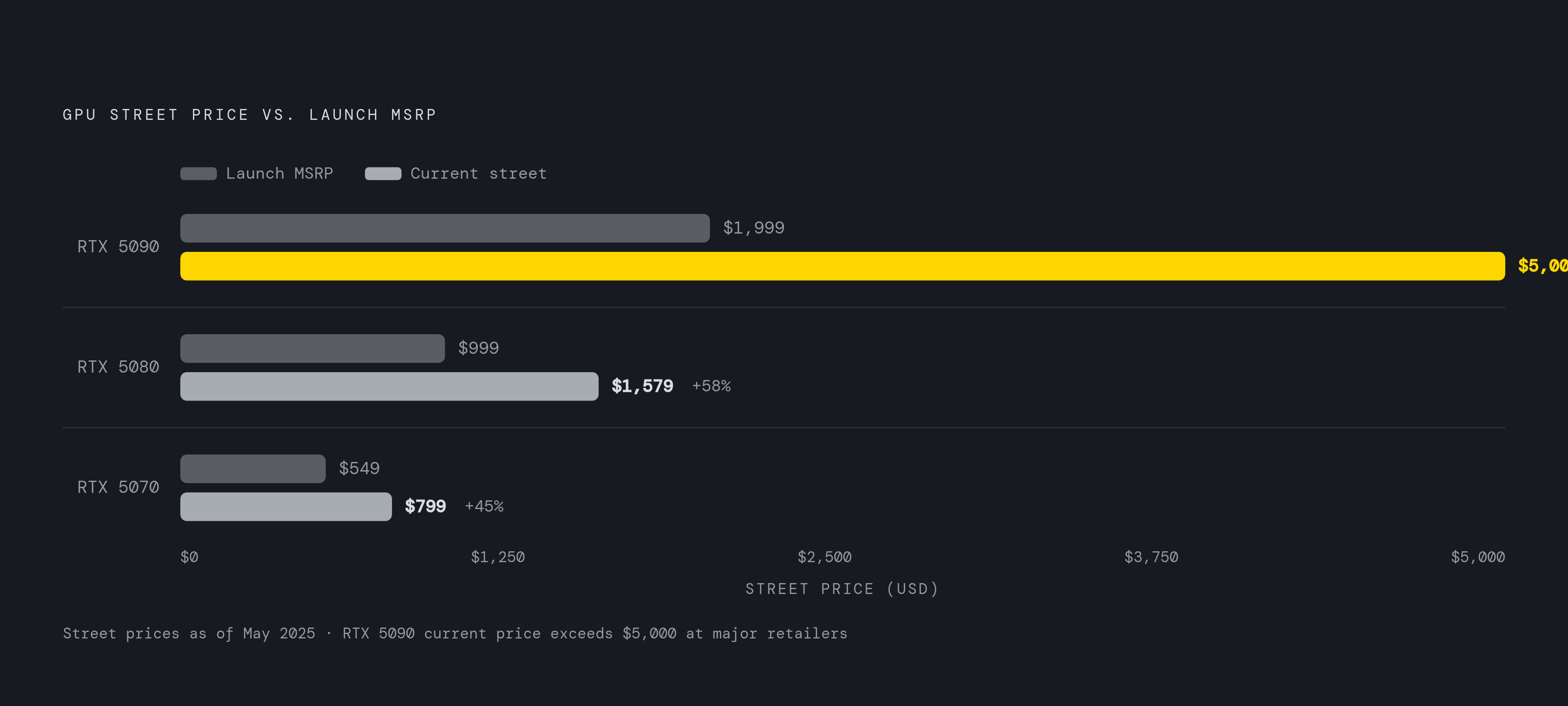
The flagship end shows the spiral in its starkest form. The RTX 5090 launched at $1,999, and Nvidia told its board partners to expect a further $300 increase on the 5090 and 5090D V2 SKUs, citing rising GDDR7 costs https://www.techspot.com/bestof/gpu-25-26/. Tom's Hardware's pricing archive put it bluntly: Nvidia's top-end gaming GPU now costs at least $5,000 https://www.techspot.com/bestof/gpu-25-26/. The RTX 5080 tells a similar story at a smaller scale, launching at $999 and now fetching as much as $1,579 at the best available U.S. price, and even the non-Ti RTX 5070, which launched at $549, now sells for up to $799, a 45% premium over MSRP https://www.techspot.com/bestof/gpu-25-26/. None of this is happening because Nvidia faces real competitive pressure. GPU prices have ballooned again after a brief period of relative calm in late 2025 and early 2026, and much of that decent pricing is now gone. Practical effect: every budget now buys roughly one tier less GPU than it did a year ago, the framing that makes budget tiers worth defining clearly.
Reading Steam Hardware Survey data in August 2026
Valve's Steam Hardware Survey is opt-in, not a census, and its numbers skew toward gamers engaged enough to let Steam poll their rigs in the first place. Read every percentage in this piece as a directional signal about mainstream habits. Even with that caveat, it remains the best window available into what builders actually run, as opposed to what a reviewer recommends this week or what a retailer is pushing to clear inventory.
August 2026's numbers are worth anchoring to. Windows 11 sat at 70.97% of surveyed systems, the least surprising figure here but a useful baseline for how current the sample is https://www.techspot.com/bestof/gpu-25-26/. 16GB configurations reached 26.92% of Steam systems in August, up 1.02 percentage points from July's 25.90%, marking the first month 16GB pulled ahead of 8GB https://www.techspot.com/bestof/gpu-25-26/. That doesn't mean 8GB collapsed. It grew too, hitting 25.75% and landing in second place, with 12GB at 12.99% and 4GB trailing far behind at 5.69% https://www.techspot.com/bestof/gpu-25-26/. Every tier of the market covered below is being shaped by this shift. Newer, more affordable cards including the RX 9060 XT and RTX 5060 Ti now ship with 16GB standard, and that decision at the mid-range is what's dragging the whole distribution upward. It's a mid-range story. It's happening in the $300 to $500 band, which is exactly where budget-conscious builders live. Windows 11 reached 70.97% of surveyed systems.
The RTX 3060 at the top reveals builder inertia
The RTX 3060 is still the single most common GPU on Steam in 2026, holding roughly 3.99% of the market by the April 2026 survey and reclaiming the top spot https://www.techspot.com/bestof/gpu-25-26/. That fact alone says something about how slowly PC gaming hardware turns over once a card hits a low enough price point to become the default recommendation for years running.
June 2026 delivered a genuinely new wrinkle. The RTX 4060 Laptop GPU appeared in 3.81% of surveyed systems that month, edging past the desktop RTX 3060's 3.73%, the first time in the survey's history that a laptop GPU claimed the top position outright https://www.techspot.com/bestof/gpu-25-26/. It's a reminder that "most popular GPU" increasingly means "most popular GPU shipped inside a laptop nobody thinks of as a gaming rig," and that population is large enough now to swing the entire chart. The desktop RTX 4060 had already had its own moment at the top, hitting an 8.57% share in February 2025 on the strength of steady gains since its mid-2023 launch, which appealed to esports players and anyone building on a tight budget https://www.techspot.com/bestof/gpu-25-26/.
Behind all of that, the RTX 5060 was already registering at 2.66% in the Steam survey, early traction for a card that had barely been on shelves https://www.techspot.com/bestof/gpu-25-26/. It won't dethrone the 3060 or 4060 lineage overnight; inertia at the bottom of the market runs deep, because builders replace GPUs on a slower clock than the industry replaces GPU generations. But the early number suggests it's on the same track its predecessor walked.
Entry tier (under $300): the RX 9060 XT 8GB, Arc B580, and the RTX 5050
Under $300 is where the VRAM story from the Steam data plays out most directly, and where Intel's Arc lineup has the clearest case to make, even if that case is weakening in real time.
The 16GB RX 9060 XT moves the needle even at entry level as the stronger 2026 longevity choice over 8GB, though street prices on this card have drifted above where it was originally positioned. For builders who can't stretch to that pricing, the XFX Swift Radeon RX 9060 XT OC 8GB carries the same current RDNA 4 feature set and solid 1080p chops in a cheaper trim.
Intel's Arc B580 remains a name-check in this tier, but with an asterisk. At its $250 MSRP it offered 12GB of GDDR6, a 192-bit bus, and 456GB/s of bandwidth across 20 Xe-cores https://www.techspot.com/bestof/gpu-25-26/. PC Gamer once called it the best budget GPU on the market https://www.techspot.com/bestof/gpu-25-26/. By August 2026 its price had climbed enough that the recommendation got a lot harder to make. The Arc B570 has a $219 MSRP, 10GB of GDDR6, a slower 160-bit interface, and a hard requirement on Resizable BAR to perform at its best https://www.techspot.com/bestof/gpu-25-26/. PC Gamer dropped it from budget recommendations entirely by August 2026, noting flatly that the value argument had disappeared. Both Arc cards run best on modern systems with Resizable BAR enabled, in games built on current DirectX 12 or Vulkan, and builders maintaining an older game library are safer sticking with AMD or Nvidia.
On the Nvidia side, the Gigabyte GeForce RTX 5060 Windforce OC 8GB brings current Blackwell features and full DLSS 4 support to a compact 1080p card, delivering roughly 30% more performance than the RTX 4060 at the same price point https://www.techspot.com/bestof/gpu-25-26/. Its street price around $380 arguably pushes it out of this tier and into the next one https://www.techspot.com/bestof/gpu-25-26/. RTX 5050 ($299 at Walmart): PC Gamer's current pick as best budget GPU, replacing the Arc B570 in that slot (cited for reliability and relative performance). BuildCores angle: builders visualizing this tier in the 3D configurator can check case clearance (the Gigabyte RX 9060 XT ICE is 281mm, which rules out some compact cases) and confirm Resizable BAR compatibility before buying, preventing the Arc gotcha.
Entry mid-range ($300–$500): essentially two cards, and one of them is overpriced
Moving up into the $300 to $500 band narrows the field sharply. There are really only two cards builders are choosing between here: the Radeon RX 9060 XT 16GB and the GeForce RTX 5060 Ti 16GB.
Its pricing tells the tier's whole story in miniature. Street prices sat at a midpoint of $459.99 in mid-2026, described as the highest this card has ever traded for, which dulls its old reputation as the value-minded builder's default https://www.techspot.com/bestof/gpu-25-26/. It costs more than it should. It's still the better buy of the two.
On paper it's a competitive part. In the market, it isn't. Tom's Hardware's GPU Hierarchy calls the 16GB model "hopelessly overpriced for the performance it offers," and notes the 8GB variant is selling at similarly inflated prices, enough that the entire 5060 Ti family gets described as impossible to recommend.
So the verdict for this tier isn't close. The RX 9060 XT 16GB carries its own price inflation, but the RTX 5060 Ti asks for meaningfully more money and doesn't return proportionally more performance at the resolutions builders in this band are actually gaming at. Gigabyte Radeon RX 9060 XT Gaming OC ICE 16G (16GB variant). Strong 1080p performance with sensible entry-1440p headroom; 16GB GDDR6, 128-bit interface. TechSpot's mid-2026 guide names the RX 9060 XT 16GB as its pick for the $300–$500 mainstream tier. PC Gamer price tracking: RX 9060 XT 16GB at $470 on Newegg. ASUS Dual GeForce RTX 5060 Ti OC 16GB (best 16GB Nvidia option); ASUS Prime RTX 5060 Ti 16GB OC (best entry-level GPU). GPU: GB206-300, 4,608 CUDA cores, 16GB GDDR7, 128-bit bus, 180W TBP (PCGuide specs). PC Gamer price tracking: RTX 5060 Ti 16GB at $780 on Walmart, RTX 5060 Ti 8GB at $389 on Walmart, both well above MSRP.
True mid-range (from roughly $500 to somewhat higher): where the RX 9070 XT earns its community reputation
This is the band where AMD's RDNA 4 lineup does its best work, and where the reputation the RX 9070 XT carries in builder communities holds up against the numbers.
The ASUS Prime RX 9070 XT OC runs on the Navi 48 XT die with 4,096 stream processors, 16GB of GDDR6 on a 256-bit bus, boost clocks to 2,970 MHz, and a 304W TBP, listed at $720 on Amazon. Below it, the plain RX 9070 delivers what amounts to the best performance-per-dollar available to most PC gamers right now: strong 1440p results, ray tracing that's genuinely improved over AMD's earlier generations, and 16GB of VRAM, all at $650 on Newegg. Further down, for about $250 more than the RX 9060 XT, at $500 on Newegg, the RX 9070 GRE delivers a meaningful jump in 1440p performance, and it's fair to call it the single upgrade in AMD's lineup with the biggest impact per dollar spent.
Nvidia's answers cost less favorable prices. The RTX 5070 Ti fares worse: Tom's Hardware's September 2026 tracking puts its best U.S. price at $1,149 against a $749 launch MSRP, a confirmed 53% markup, with PC Gamer's own tracking landing close by at $1,088 on Amazon.
Setting the RX 9070 XT against the RTX 5070 Ti directly makes the trade-off concrete. In raw rasterized performance, the 9070 XT delivers between 85% and 88% of what the 5070 Ti puts up, while costing roughly 80% of its price, and frames-per-dollar clearly favors AMD. Switch on path tracing, though, and the picture flips: the 5070 Ti's lead widens to around 15%, driven almost entirely by its fourth-generation RT core throughput. Builders who care about path-traced lighting in the handful of titles that support it well are paying for something real when they choose Nvidia here. Nvidia RTX 5070: PC Gamer tracking puts it at $763 on Amazon; TechSpot mid-2026 guide places the Radeon RX 9070 or GeForce RTX 5070 in the $500–$600 band. Nvidia controls roughly 90% of the discrete GPU market (Jon Peddie Research) https://www.techspot.com/bestof/gpu-25-26/. AMD's overall share of Steam GPUs was 16.4% in early 2025 (Digital Foundry) https://www.techspot.com/bestof/gpu-25-26/. AMD's overall share of Steam GPUs climbed to 19.1% in early 2026 (Digital Foundry) https://www.techspot.com/bestof/gpu-25-26/. 16GB VRAM configurations represent 26.92% of Steam systems (Valve Steam Hardware Survey) https://www.techspot.com/bestof/gpu-25-26/. The RTX 5080 delivers roughly 75 to 80% of 5090 performance (75%, techspot.com) https://www.techspot.com/bestof/gpu-25-26/. The RTX 5080 delivers roughly 75 to 80% of 5090 performance (techspot.com) https://www.techspot.com/bestof/gpu-25-26/. Nvidia's second-fastest Blackwell card is anywhere from 8% to 16% faster than the 5070 Ti (techspot.com) https://www.techspot.com/bestof/gpu-25-26/.