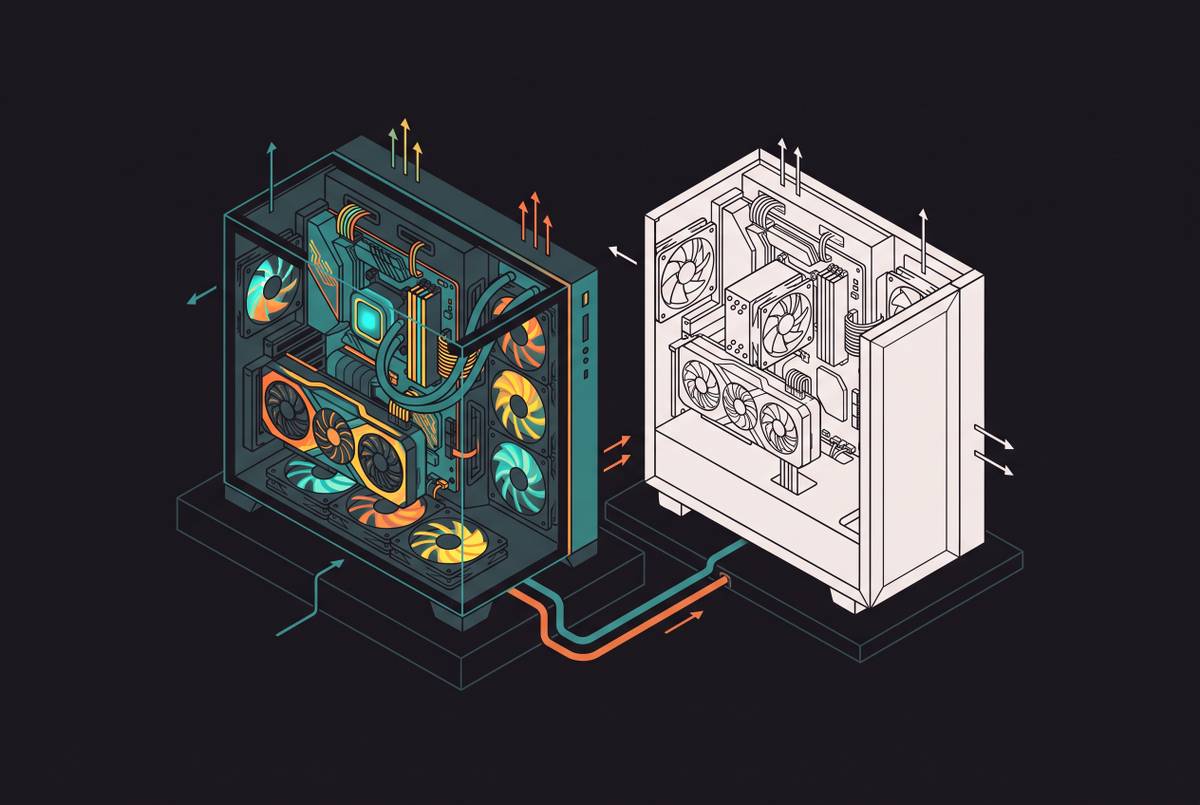
Cooling Solution Preferences in High-End PC Builds
Thermal density, not raw power, drives which cooling approach works best for extreme builds.
High-end builds in 2026 create a cooling problem that is qualitatively different from what mid-range hardware produces, and that difference is why cooling preferences at the top end cluster the way they do. Cooling preferences at the top of the market aren't a matter of taste dressed up as engineering. They follow a specific physics problem, and once you understand the problem, the choices builders make start to look less like brand loyalty and more like triage.
High-end cooling decisions that mid-range builds don't face
The pressure comes from thermal density rather than raw wattage. The driver is thermal density, not raw wattage alone. Modern chips pack more cores into smaller dies, raising localized hotspot temperatures even when total TDP looks comparable to older generations. A spec sheet showing comparable wattage to an older part can mask a much harder cooling problem, concentrated in a smaller physical area with less surface to shed heat from.
GPUs make the problem worse, not better. Next-generation GPUs such as NVIDIA's RTX 50-series push 380 to 420 watts, and the RTX 5090 reportedly draws up to 650 watts under sustained rendering loads, with heat concentrated near the memory modules and VRMs. A mid-range build, running a CPU in the 65 to 105-watt range paired with a mid-tier GPU, never encounters this kind of compound load. A high-end build routinely runs a 230-watt-plus CPU alongside a 400-watt-plus GPU at the same time, solving an entirely different problem than scaling up the mid-range setup.
The three main cooling approaches in the high-end market
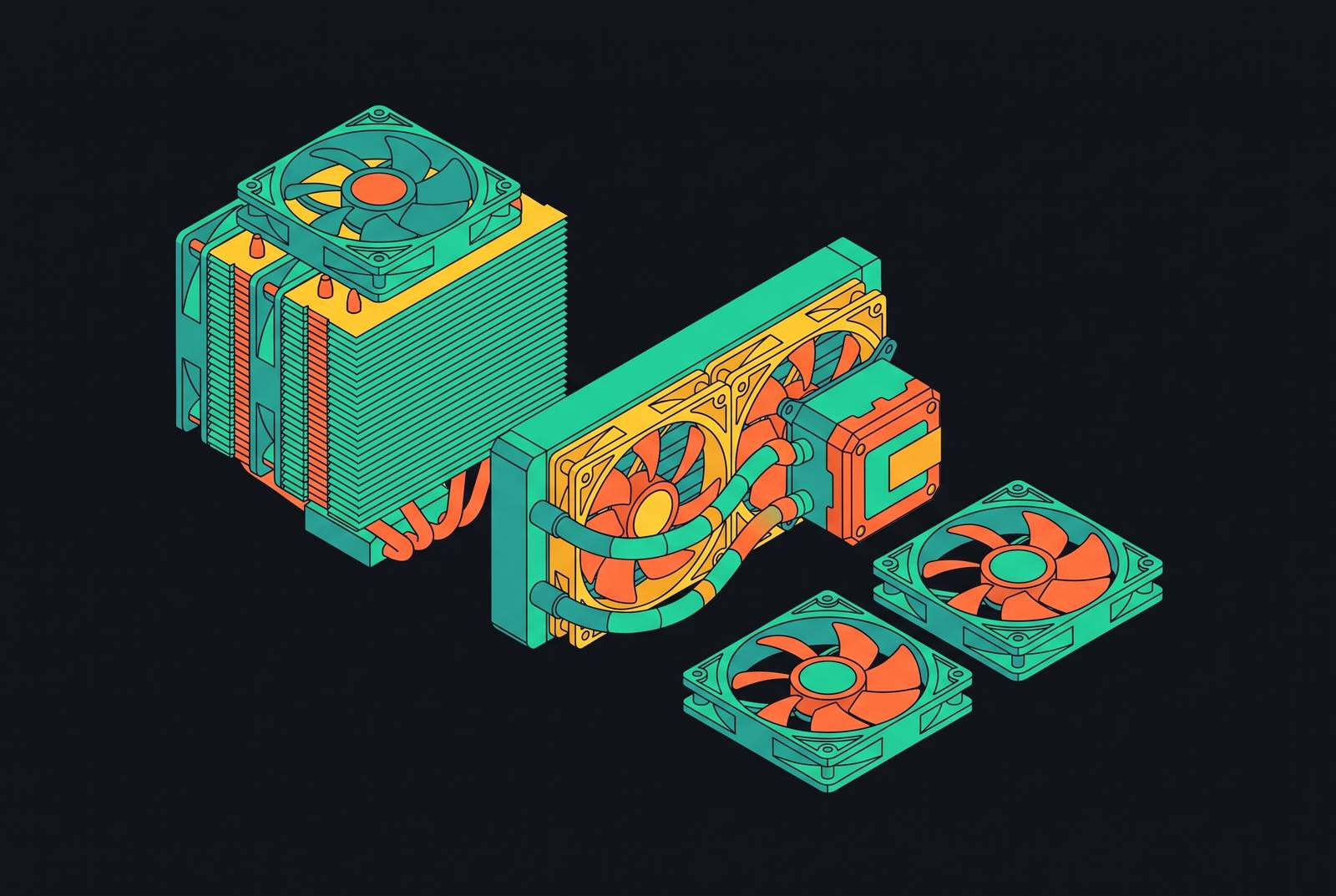
Three structural approaches dominate the high-end market: air cooling, AIO liquid cooling, and custom loops. Each trades off performance ceiling, reliability, cost, and complexity differently, and those trade-offs sort builders into distinct profiles rather than producing one universally correct answer.
Air cooling remains a legitimate high-end contender, not a budget fallback. In 2026 testing on the Ryzen 9 9950X, the best air coolers held delta-T under 52°C at 230 watts, matching the performance of many 360mm AIOs. The Noctua NH-D15 G2, rated at roughly 240 watts of measured capacity and built around revised asymmetrical fin stacks paired with NF-A14x25r G2 fans, functions as the benchmark product in this category, while the Thermalright Peerless Assassin 120 SE has been shown to compete with AIOs costing three times as much under real gaming loads. Air cooling's ceiling is set by geometry rather than thermal capacity. Tall dual-tower designs can collide with RAM height or case clearance, and small form factor builds frequently can't fit a tower cooler taller than 155mm at all. Air cooling's simpler heat path is a genuine long-term advantage for overall system temps when case airflow is well-configured, directing exhaust out the back of the case rather than recirculating warm air near the VRMs and RAM.
AIO liquid cooling occupies the mainstream position at the high end. Liquid solutions show up in a large share of newly built gaming PCs, and most gamers building in 2026 chose liquid over air. That popularity comes with real costs attached. A 360mm AIO represents a meaningful upfront expense, pump lifespan typically runs three to five years (some sources put it as high as five to seven), and because the unit is sealed, any internal component failure means replacing the whole cooler rather than repairing it. The format keeps evolving to meet the new GPU thermal loads described above: newer AIOs now add dedicated micro-fans aimed at motherboard VRMs, a feature that used to be exclusive to custom loops, and the Arctic Liquid Freezer III Pro builds this in as an on-board VRM fan.
Custom loops sit at the far end of the spectrum, and they're resurging for a specific reason: GPU thermal loads concentrated near the VRAM and VRMs on a card like the RTX 5090 can challenge even a top-tier AIO. Entry cost has come down meaningfully. High-quality kits from EKWB and Bitspower saw their average entry cost drop between late 2024 and mid-2026, though a full loop, with its radiator, pump, reservoir, tubing, and fittings, still represents a substantial outlay, and it adds an ongoing annual cost in coolant and maintenance that sealed units don't carry. YouTube tutorials, communities like r/watercooling, and modular toolkits have lowered the skill floor for building one, but the complexity and the recurring maintenance commitment are genuine barriers, not perception problems. Triple-radiator layouts in the 360mm and 420mm range are now standard across a meaningful share of enthusiast custom builds managing dual high-TDP dies. The Lian Li O11D has become the dominant chassis for this kind of build, and EKWB's EK-Mana G2 DDC Distribution Plate, also available with a D5 pump variant, was designed specifically to turn that case into a custom water-cooling showcase. Custom loops matter to a smaller slice of the builder population than air or AIO cooling does, but for the audience chasing dual high-TDP components, the category serves a real and growing need. It's the only approach built to keep pace with that specific load.
Cooler quality and radiator size over the AIO-versus-air label
The most consequential finding from 2026 testing is not which category wins, but how much the gap within each category varies. It's that the gap within each category often outweighs the gap between categories, and a builder who treats "AIO" as shorthand for "better" is making a measurable mistake.
Gamers Nexus clocked the roughly $41 Thermalright Peerless Assassin 120 within a couple of degrees of the Noctua NH-D15 G2 in a noise-normalized test, which compresses the apparent advantage of spending several times more within air cooling alone. The same pattern appears on the liquid side, where PC Gamer's 2026 AIO roundup found one 360mm unit trailing the Arctic Liquid Freezer III Pro 360 by 4 to 6°C under sustained load, proof that a 360mm radiator badge doesn't guarantee the thermal performance of a leading 360mm product.
That finding raises an uncomfortable question for anyone treating liquid cooling as a default upgrade. If the spread within the AIO category runs several degrees wide, and a well-built air cooler can match plenty of AIOs on thermal output, then some of the industry's tilt toward liquid at the high end is driven by perception as much as by necessity. At sustained CPU loads above 230 watts, or in any build where GPU water-cooling is already part of the plan, liquid cooling's higher thermal ceiling and greater flexibility remain real advantages worth paying for. The claim is that the label alone, printed on a box or a spec sheet, doesn't guarantee that any particular liquid cooler will outperform any particular air cooler, though liquid can still win.
What actually separates a good cooler from a mediocre one, regardless of category, comes down to a short list of specifications. Radiator thickness matters in a literal, measurable way: a 38mm-thick radiator moves meaningfully more heat than a 27mm one, and that's a real performance gap, not a marketing distinction. Fan static pressure matters too, with a minimum of roughly 2.0 mmH₂O generally needed for a fan to push air effectively through a radiator's fin stack. Pump noise at load is another place where the numbers on the box mislead. And cold-plate-to-socket fit varies enough between products to matter on its own. EKWB's EK-Quantum Velocity² is built specifically around the AM5 socket and works with X3D processors through a cooling engine tailored to that platform's particular thermal layout. Judge coolers on these four measures, and radiator thickness, fan static pressure, pump noise, and socket fit matter more than whether the cooler is an AIO or air cooler. A specific cooler, at a specific radiator size and fan spec, needs to clear the thermal bar the build actually requires.
Aesthetics and form factor when thermals are close
Once two well-matched cooling solutions land within a couple of degrees of each other, the decision moves, correctly, to build intent, case design, and physical fit. High-end builders in 2026 are making that move on purpose, not settling for it as a consolation prize.
Cooling choice at this level stopped being a thermals-only calculation some time ago. AMOLED and LCD screens mounted directly on pump blocks let a builder monitor temperatures in real time or display static artwork instead, folding utility and personalization into the same piece of hardware. The Tryx Panorama 360 and the NZXT Kraken Elite 360's 2026 Edition, which pairs a customizable IPS display with its companion software, are both concrete examples of the trend. DeepCool's LT360 Vision ARGB takes the same idea further with a 4.5-inch LCD screen built specifically for showcase builds, backed by the company's sixth-generation pump and closed-wheel ARGB fans. None of this changes the underlying thermal math from the previous section. It changes what a builder is optimizing for once the thermal math is already settled.
Case design has followed the same logic. Fractal's Torrent and Lian Li's Lancool III have become popular chassis choices for mid-range showcase builds, while the Lian Li O11D remains the dominant chassis for custom loop builds specifically. Dual-glass cases with mesh fronts now dominate what might be called the 2026 "cool PC" aesthetic, balancing full visibility of the internals against airflow that isn't badly restricted by the glass panels. Cooling infrastructure, radiators, tubing, pump heads, used to sit hidden behind a solid panel. Now it's part of the visual design of the machine, on display rather than tucked out of sight.
None of that means every builder needs an LCD pump head or a glass-walled case. The practical guidance holds up well: pick a display-equipped pump only if the case will actually show it off and real-time telemetry or visual personalization is a genuine goal, not an afterthought. For most builders prioritizing performance and value over showcasing the internals, ARGB lighting delivers most of the visual payoff without the substantial premium that display-equipped units carry over something like the Arctic Freezer III 360.
Form factor imposes a harder kind of constraint, one that has nothing to do with taste. Small form factor builds make up a meaningful share of the enthusiast market, and for builders working in that space, geometry decides the outcome before preference gets a vote. If a 155mm-plus tower cooler doesn't physically fit inside the case, an AIO becomes the only path forward. Low-profile air coolers and compact AIOs are the realistic choices for a compact ITX build. The full 360mm radiators and tall dual-tower coolers that dominate performance conversations around ATX builds are frequently just not available in that footprint.
Builds tend to go wrong here in practice, and the cause usually has nothing to do with the cooler itself. Across aggregated Reddit and Amazon sentiment from the first half of 2026, the overwhelming majority of negative AIO feedback traced back to improper case airflow or RAM height conflicts, not to any inherent flaw in the cooler being reviewed. Case selection and build planning now carry as much weight as the cooler choice itself.
Working through these physical constraints before parts arrive at the door removes most of that risk. Visualizing a build in three dimensions ahead of purchase lets a builder check whether a pump head will actually be visible through the side panel, confirm that a tower cooler clears the RAM and the case at its planned height, and verify radiator mounting positions before a single part gets ordered. Compatibility tools and 3D configurators built for this purpose surface exactly the constraints, cooler height, radiator thickness, case clearance, that constantly cause installation failures once a build reaches the workbench.
The cooling decision in a high-end build, then, runs through two stages rather than one. The first stage is thermal: does the CPU and GPU combination demand liquid cooling's ceiling, or does a well-specified air cooler clear the bar at a lower cost and with fewer moving parts to fail. The second stage, reached only once the thermals are close enough not to matter, is about what kind of build a person actually wants sitting on the desk, glass panel and all.