AMD RX 9070 XT Review for Mid-Range PC Builders
The mid-range GPU that beats pricier cards on raw power and memory.
The RX 9070 XT is the card that now sets the bar for what a mid-range build should deliver, and every other option in its price class has to answer for where it falls short. No single spec explains this. It's the combination of the highest raw rasterization throughput in its competitive tier, the most VRAM a builder can get at this price, and a price-to-performance ratio that beats cards that cost noticeably more. That combination is what turns a strong GPU into a reference point, the card a builder checks every other option against before deciding whether the extra money or the missing memory is worth it. The sections that follow lay out the architecture behind that performance, the benchmark evidence that supports it, and the places where the card genuinely loses ground.
The Card's Architecture at the Silicon Level
The performance advantage isn't an accident of binning or driver tuning. These decisions, about how the chip moves and stores data, are visible directly in how the card behaves once a builder actually plays something on it.
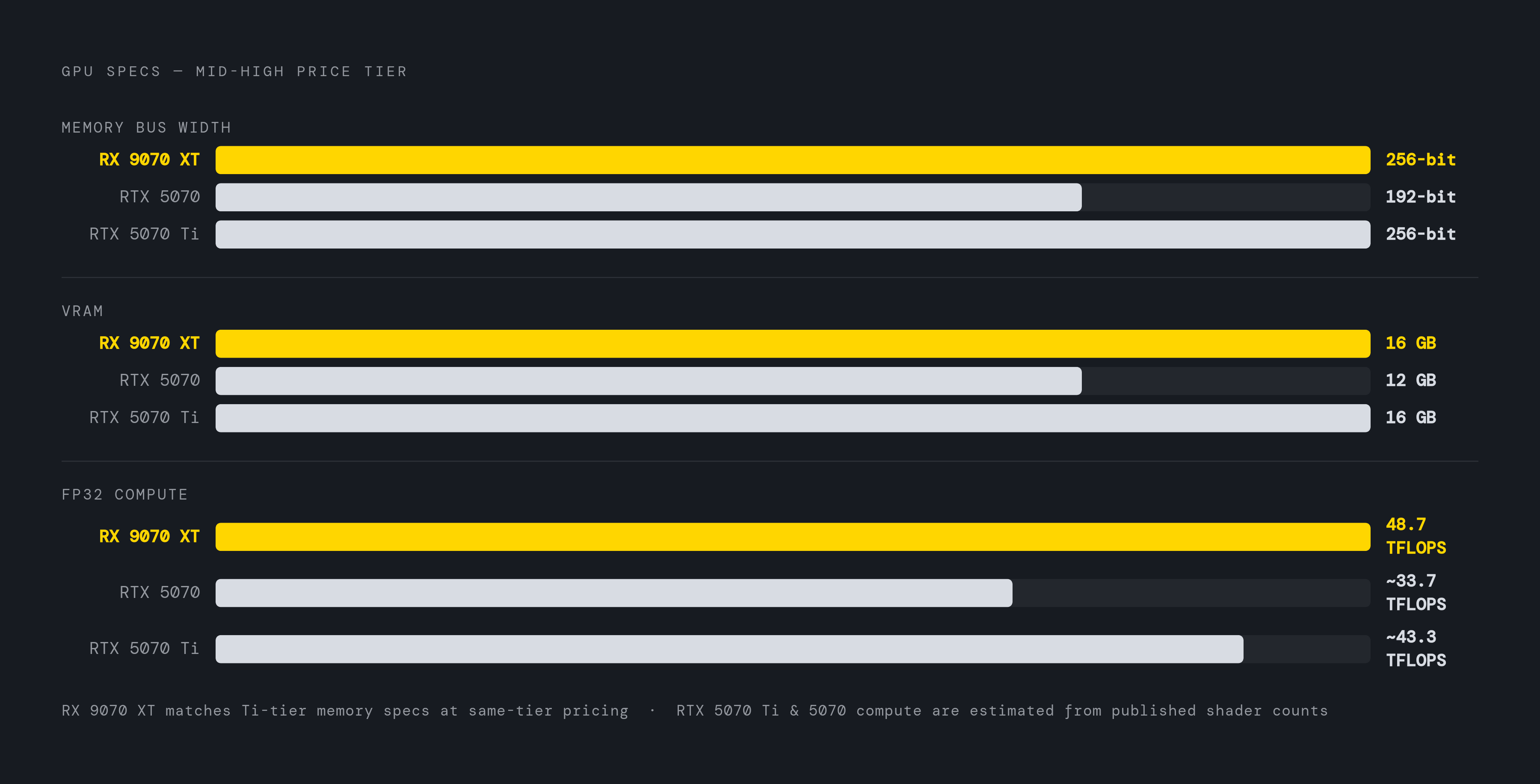
Start with the memory bus. The RX 9070 XT runs a 256-bit memory bus, against a 192-bit bus on the RTX 5070. A wider bus moves more data per cycle, and that advantage becomes visible on screen once resolution climbs into higher resolution territory. At 1440p and above, memory bandwidth becomes one of the main limits on frame rate in demanding titles, so the wider bus on the 9070 XT does real work exactly where mid-range builders spend most of their time.
The VRAM pairs with that bus to reinforce the same advantage. The card carries 16 GB of GDDR6 running at 640 GB/s, 4 GB more than the RTX 5070 offers and equal to what the more expensive RTX 5070 Ti carries. For a builder thinking about how long a card stays useful, that 4 GB gap matters more over time than it does on release day: texture packs, open-world streaming, and ray-traced lighting data all lean on VRAM capacity first, and a card that runs short starts stuttering and swapping assets long before its core compute runs out of headroom. The RX 9070 XT simply doesn't hit that wall as early as its nearest-priced NVIDIA rival.
Raw compute backs up both of those choices. AMD lists 48.7 TFLOPS of FP32 performance on the card, the highest raw compute figure of any GPU at this price tier. That throughput converts the wider bus and the extra VRAM into frame rate.
RDNA 4 also carries the 3rd Generation Ray Accelerators, and AMD's generational jump here is the largest improvement in ray tracing hardware since RDNA 2 first introduced hardware ray tracing support. That context matters before getting to where NVIDIA still leads, because the gap that remains is a gap that closed hard, not one that stayed static while AMD worked on other things.
The card also carries 128 AI Accelerators, confirmed directly on AMD's own product page, and those units are what run FSR 4's ML-based upscaling. FSR 4 is exclusive to RDNA 4 hardware. Older AMD cards don't get access to it even if their drivers get updated.
One more architectural detail matters for anyone actually building a system around this card: power delivery. AMD's reference design uses two 8-pin power connectors, though some AIB partners move to three 8-pin connectors or a 12V-2×6 connector instead. Standard 8-pin configurations don't carry the melting-connector risk that has shown up on several current-generation NVIDIA cards, which is a small thing on a spec sheet but a real one for anyone who has had to think about cable management and connector health in a tight case.
How the RX 9070 XT performs at higher resolutions against comparable cards
The architecture explains why the card behaves the way it does. The benchmarks are where that behavior becomes a number a builder can actually compare.
Across the most systematic and current independent testing available, the RX 9070 XT holds a performance lead at 1440p and higher resolutions large enough to decide most gaming workloads outright, not one that wins by a rounding error. The comparison against the RTX 5070 Ti is the one that makes this most visible, because the 5070 Ti costs more and still doesn't open a lead that matches its price gap. In a handful of titles, the AMD lead stretches well past typical margins: 007 First Light and Ark: Survival Ascended both show the kind of gap that changes which settings a builder can run, not just which frame counter ticks higher.
1440p native is where the card does its best work. With updated drivers, it holds high frame rates in demanding AAA titles at ultra settings, consistently, across the kind of game library a mid-range builder is actually running rather than a cherry-picked handful of lighter titles. With updated drivers, the card's effective ceiling has risen since launch without any change to the silicon underneath it, which is the kind of gain a builder gets for free just by staying current.
NVIDIA's Durable Edge in Ray Tracing and Upscaling
None of this means the RX 9070 XT wins everywhere, and the honest case for the card depends on naming the places where it doesn't. The ray tracing deficit and FSR 4's smaller game library are real weaknesses. They're narrow enough that they change the recommendation only for a specific kind of builder, not for most of them.
On ray tracing, the 3rd Gen Ray Accelerators mark AMD's biggest leap in this area, and the gap with NVIDIA has closed substantially as a result. In F1 24 with ray tracing enabled, the RX 9070 XT ties the RTX 5070 Ti exactly. In Black Myth: Wukong, it trails by only 6%. Across much of the current library, the RT gap has shrunk down to a margin that most players won't notice mid-session. The honest framing here matters: ray tracing performance is a dealbreaker only for builders whose primary games are heavy path-tracing showcases built around NVIDIA's strongest RT features. For the much larger set of AAA titles where ray tracing is one setting among many rather than the whole point of the game, the gap is minor enough to not drive the decision.
Upscaling is where the picture gets more complicated, and precision matters about what FSR 4 does and doesn't match. FSR 4 and AMD's newer FSR neural rendering technologies now run across a large and fast-growing library of games, a sharp jump from the title count available at launch. But DLSS 4, counting all its versions together, supports more than 400 titles, and DLSS Multi Frame Generation alone covers more than 250 of them on its own. NVIDIA also just launched DLSS 5, restricted at first to RTX 50-series cards, with RTX 40-series support planned for later in fall 2026. DLSS 5 has 15 announced titles so far, though only one, NBA 2K27, is actually live, having launched September 3, 2026. As that support matures, the RTX 5070 stands to pick up a further upscaling advantage over the 9070 XT simply because NVIDIA's software library is deeper and growing faster from a larger base. DLSS Multi Frame Generation also has a higher frame-multiplication ceiling than FSR Frame Generation, a gap that matters specifically for builders chasing high-refresh competitive performance.
The card's value outside of games is a separate question. For pure gaming performance, a large multi-game benchmark suite is the right measure, and that's the measure the RX 9070 XT wins on. But for mixed use, gaming combined with AI inference work, video encoding, or 3D rendering, NVIDIA's ecosystem advantages are real and widen quickly once the workload moves outside games. Reviewers have been direct about this: Tom's Guide found the card isn't suited to creator workload performance, and that verdict should stand without softening. A builder whose use case includes serious rendering or AI work on the side should weigh that fact heavily. A builder who's buying this card to play games should weigh it much less.
Cost and Value in Late 2026
The launch-price version of the value argument is over, and builders pricing this card out in late 2026 need the real number, not the one from the announcement. As of October 2026, the RX 9070 XT runs approximately $790 new on Amazon, a real premium over its original MSRP, with used units selling for slightly less.
That's a harder number to build a value case around than the launch price was, so the relevant question is whether the comparison still favors AMD once both sides are priced at what people are actually paying. It does, because NVIDIA's competing cards have been marked up even more aggressively over the same stretch. AMD's premium over its own MSRP is smaller than NVIDIA's premium over its MSRP on the cards that compete directly with the 9070 XT. The performance gap that would justify paying NVIDIA's asking price, mainly in ray tracing and upscaling library depth, hasn't grown to match the size of that price premium. The relative case holds even though the absolute price is no longer the headline number it was at launch. Builders working out a full parts list should run current prices across retailers before buying, since street pricing on both sides moves often enough that the gap narrows or widens week to week.
Choosing an AIB variant
Picking the right version of this card is where a sound GPU choice can turn into a frustrating build if the rest of the system isn't planned around it. The RX 9070 XT's physical size and power draw vary across AIB partners, so matching the card to the case and power supply takes deliberate planning.
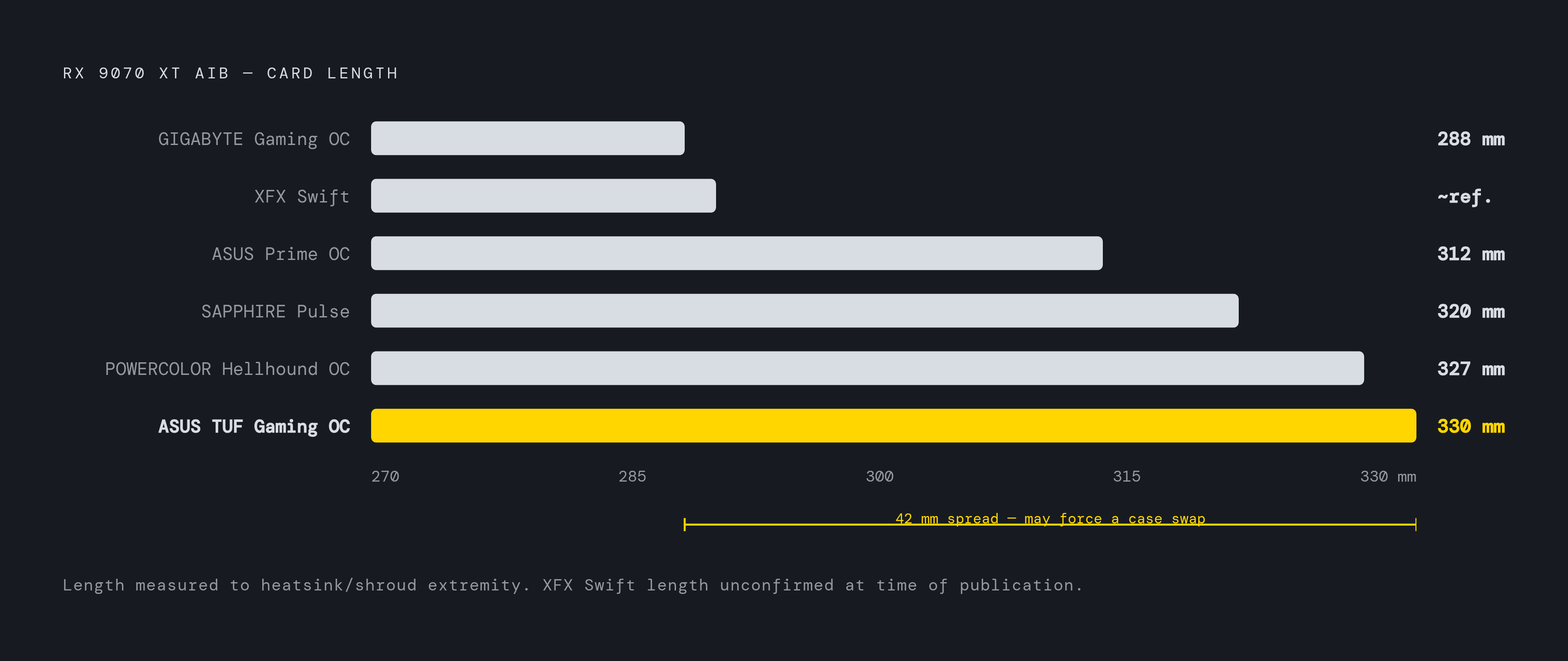
The GIGABYTE Gaming OC variant measures 288 mm in length (L=288, W=132, H=56 mm per GIGABYTE's own listing), among the more compact options on the market and a useful reference point for builders working in smaller cases. The XFX Swift sticks close to reference-class sizing and has been noted for running quietly at stock settings, a good fit for a build where noise matters as much as raw clocks. The ASUS Prime OC is 312 mm and stands out as a strong value alternative among AIB options. The SAPPHIRE Pulse runs 320 mm. The ASUS TUF Gaming OC is the longest of the group at 330 mm. The POWERCOLOR Hellhound OC is 327 mm.
Every one of those lengths needs to be checked against actual case clearance before ordering, since case clearance varies enough between a 330 mm card and a 288 mm card to require a case swap.
Power delivery needs the same attention. AMD's reference design calls for two 8-pin connectors, but several AIB cards move to three 8-pin connectors or a single 12V-2×6 connector instead, and a builder's power supply needs to match whichever configuration the chosen card actually uses. Checking the specific AIB model's connector requirements against the available cables from the rest of the build, rather than assuming reference-design power needs apply across the board, is the step that keeps a well-chosen GPU from becoming a mid-build surprise.