AMD Ryzen vs Intel Core CPU Comparison for Gaming Builds
AMD's cache advantage dominates gaming, but Intel competes where it matters most.

The gap between AMD and Intel in gaming performance for 2026 comes down to one architectural decision: how much cache sits next to the processor cores, and how AMD has built an entire product line around stacking more of it. That decision explains why the Ryzen 7 9800X3D beats Intel's best chip in frame rates, why Intel still wins real recommendations in other segments, and why the platform you choose now shapes what you can afford to do in 2027 and beyond.
The 3D V-Cache Gap: The Architecture Story for Gaming in 2026
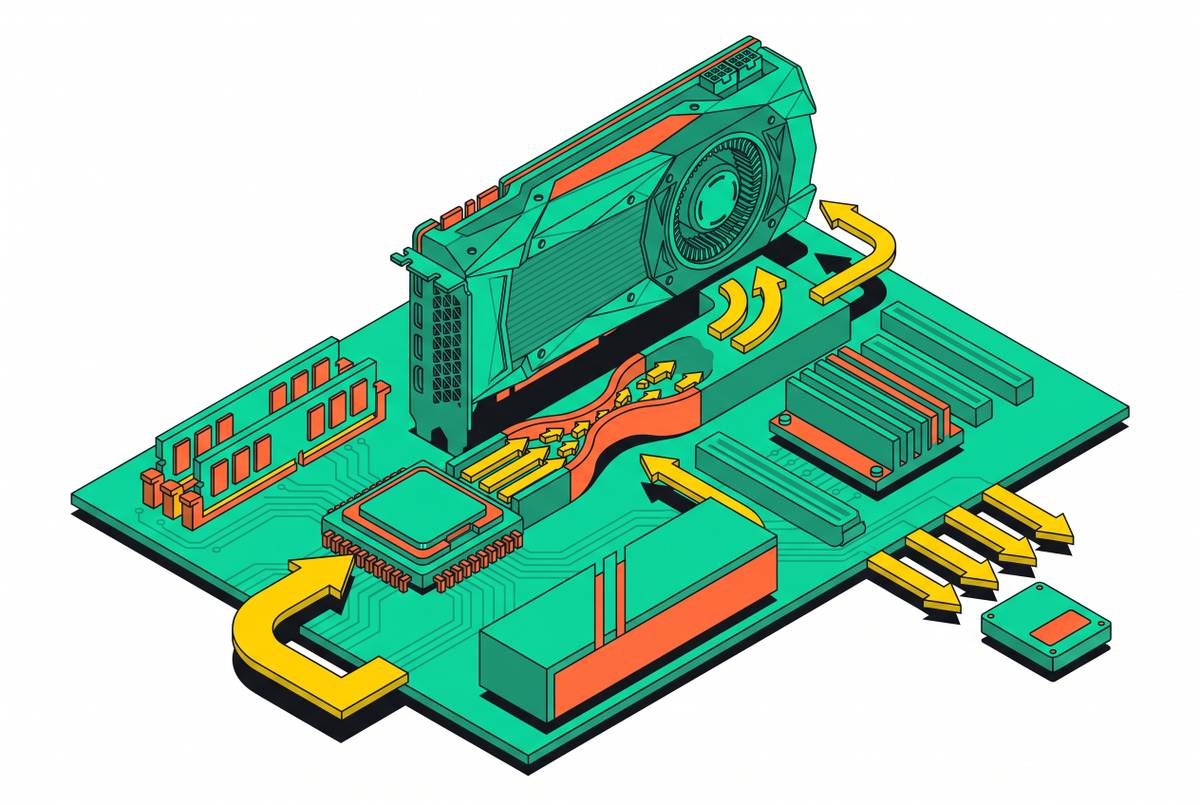
Frame-time spikes are what players actually feel when a game stutters mid-fight, and the usual cause is a processor waiting on data that lives too far away. Games hold huge amounts of active data (textures, physics states, entity positions) that need to stay close to the cores doing the work, and the farther that data sits, the more often the processor stalls waiting for it to arrive.
AMD's answer is to give the processor more room to keep that data close. Fewer stutters and steadier frame pacing appear in testing, not just a higher average FPS number on a chart.
Intel took a different path with Arrow Lake, and the industry knows it commercially as Core Ultra 200S. But cooler and more efficient doesn't mean faster in the specific scenario that defines gaming performance: it doesn't close the cache-latency gap that 3D V-Cache opened.
The asymmetry runs deeper than cache size alone. Builders comparing these chips need to weigh thread count on its own, because it shapes how each processor handles the heavier, multi-threaded portions of modern engines, not just raw clock speed.
Independent testing from GamersNexus, Hardware Unboxed, and Tom's Hardware all point the same direction: the Ryzen 7 9800X3D leads the Core Ultra 9 285K by a wide margin in 1080p, CPU-limited gaming scenarios. None of this holds at every resolution, though. Once a game moves to 1440p or 4K, the graphics card becomes the bottleneck instead of the processor, and the CPU brand stops mattering nearly as much. The rest of this piece's recommendations only make sense once the reader understands where the cache advantage appears and where it fades into the background.
Intel's Arrow Lake Refresh and the Raptor Lake Degradation Crisis
Two events from Intel's recent history shape how much confidence a builder should place in the platform today, and neither one is really about whether Arrow Lake itself is a bad chip.
The first is the Raptor Lake degradation crisis, a hardware problem that struck the 13th and 14th generation desktop chips. Intel responded by extending the warranty on affected Raptor Lake CPUs from three years to five, an acknowledgment of how serious the problem is. Intel's fifth microcode patch, numbered 0x12F and released in May 2025, added further mitigations for low-activity, long-uptime scenarios, but Intel stated that the patch "does not alter the root cause determination. The silicon itself still ages the same way; the fix manages symptoms, not the underlying mechanism.
This problem belongs to Raptor Lake, not to Arrow Lake. But the timing matters: the degradation crisis broke into public view just before Arrow Lake launched, and it colors how builders read every reliability claim Intel makes about its current lineup. A company's credibility doesn't reset cleanly between product generations, especially when the affected chips are still running in millions of existing desktops.
The second event works in Intel's favor, at least partially. The Arrow Lake Refresh, sold as Core Ultra 200S Plus, launched on March 26, 2026, and Intel claimed gaming performance up to 15% faster than the original Arrow Lake chips. What the refresh does not do is close the gap against AMD's X3D processors. Intel enters the 2026 buying season with a legitimately improved chip and a credibility deficit it has only partly repaired. The question for builders becomes where Intel's strengths, rather than its gaming numbers alone, actually line up with what they need.
AMD's Flagship and Upper-Mid Gaming Case
At the top of the market, the case for AMD isn't close. No Intel chip in a comparable price range can keep pace with AMD's 3D V-Cache lineup on pure gaming frame rates.
For most builders shopping this tier, the Ryzen 7 9800X3D is the practical pick. It runs 8 cores and 16 threads, carries that 96 MB of L3 cache, boosts to 5.2 GHz, and operates at a 120 W TDP with peak package power reaching up to 162 W. It delivers the gaming performance ceiling of the current generation without the cost or power draw of the larger chips above it. If you also render video, work in 3D applications, or run demanding multi-threaded workloads alongside gaming, you should pay more for the Ryzen 9 9950X3D. It packs 16 cores and 32 threads with 144 MB of combined cache, split so that stacked 3D V-Cache sits atop one of its two compute dies. That design lets it post elite gaming numbers while it also handles serious productivity work, and no single chip managed that convincingly in prior generations.
The strongest pushback against this entire tier is the same resolution caveat raised earlier: at 1440p and 4K, the graphics card becomes the limiting factor, and the CPU gap narrows to the point of near-irrelevance in many titles. That's a fair objection, and a build is rarely static for its whole life. A builder who keeps a CPU for five years and upgrades the graphics card once or twice during that span will eventually push resolution down or frame targets up, at which point the CPU becomes the limiting factor again. Buying for where the build will sit in three years, not just where it sits on launch day, is a reasonable way to think about a flagship purchase.
Power draw adds a real, measurable cost difference to this comparison. The 9800X3D peaks around 140 W under full gaming load, but Intel's Core Ultra 9 285K is rated up to 250 W under heavy load. That difference isn't just an electricity bill line item: it changes what cooler a builder needs, how much airflow a case has to move, and how loud the system runs under sustained load. Build Core's 3D configurator lets builders visualize the full thermal stack, including cooler clearance, case airflow, and radiator sizing, before any part ships. That is where the 9800X3D's lower heat output pays off in practical build planning.
Where Intel competes: the mid-range dual-purpose case
In the $200 to $350 range, Intel's Arrow Lake Refresh earns a genuine recommendation.
The clearest advantage is Quick Sync, Intel's hardware video encoding engine, which accelerates work in applications like Adobe Premiere Pro. Arrow Lake's dropped Hyper-Threading means the Core Ultra 9 285K carries 24 threads against the Ryzen 9 9950X's 32, so builders need to compare specific models against each other.
On pure gaming numbers, the gap narrows considerably once 3D V-Cache leaves the comparison. AMD's sweet spot is DDR5-6000 CL30, and pushing AM5 to DDR5-8000 usually requires a 2:1 mode that carries its own latency penalty. Neither platform handles extreme memory speeds without some compromise.
Intel's LGA1851 boards, especially those supporting DDR5 or DDR4 at budget tiers, are priced competitively in this range. Build Core's real-time price comparison tool surfaces the total platform cost, covering CPU, motherboard, and RAM together, so a builder can check whether the savings on an Intel board actually offset the CPU's price difference. Intel's mid-range value depends heavily on staying on the current socket, and that socket's future is shorter than AMD's.
The budget tier: AMD Ryzen 5 9600X vs Intel's entry options, and the DDR4 holdout case
In the budget segment, AMD's Ryzen 5 9600X is the strongest pure-gaming value available. The same 5 to 10% advantage over comparable Intel parts at 1080p that appears in the mid-range holds here too, making it the better choice for builders focused entirely on frame rates. At 1440p, that gap shrinks enough that the graphics card installed mostly decides it.
Intel's entry options, the Core Ultra 5 245K and Core Ultra 5 250K Plus, make a solid case for a different kind of budget builder. If you run light home server tasks or do occasional content work alongside gaming, these chips are the right fit.
DDR4 platform owners face a separate calculus, and you don't need to rip out a working system. If you're eyeing a secondhand or discounted Core i9-13900K or 14900K instead, you should weigh the Raptor Lake warranty situation described earlier before you buy, because that degradation risk follows the chip regardless of price.
Motherboard pricing complicates the budget calculation slightly. Build Core's compatibility checker and multi-retailer price comparison tool matter most at this tier, where a $20 to $40 difference in motherboard price can tip the entire build's balance one way or the other. Seeing the full platform cost laid out before buying is the practical, workable version of the total-cost-of-ownership argument builders hear about in theory.
Platform longevity: AM5's confirmed 2029 runway versus Intel's LGA1851 dead end
AMD formally extended support for the AM5 socket through 2029 at Computex 2026, locking in a drop-in upgrade path for Zen 6 chips on existing motherboards. A builder who buys an AM5 motherboard in 2026 can reasonably expect to drop a Zen 6 processor into that same board, with the same RAM and cooler, once Zen 6 arrives.
Intel's position looks different. LGA1851 carries both Arrow Lake and its refresh, but Intel's next generation, Nova Lake, is reported to require an entirely new socket, LGA1954. That means an LGA1851 buyer's next CPU upgrade will almost certainly come with a full platform swap: new motherboard, and potentially new RAM as well. Intel has signaled that it wants LGA1954 to last across multiple generations beyond Nova Lake, but that's a promise not yet delivered, set against AMD's seven-year AM5 track record that's already been kept.
This isn't a distant, theoretical concern. Intel is also reportedly preparing to raise CPU prices ahead of its March 2027 launch cycle, and if that holds, it would widen AMD's value advantage at the platform level even further. Every build decision made right now needs to account for the upgrade path, not just a hypothetical about next year.
Steam Hardware Survey data on how the builder community is voting
The Steam Hardware Survey's September 2026 data shows AMD gaining CPU market share at a pace the data itself describes as historically rapid. On Windows specifically, Intel held 52.59% and AMD held 47.41%, with Intel's share falling and AMD's rising by roughly matching margins month over month. Intel still holds the majority on Steam, and a meaningful part of that number reflects installed base inertia: millions of existing Intel systems that haven't been replaced yet, not a verdict on which chip a builder should choose today.
Intel sat near 69% in January 2025, so AMD has gained roughly 14 percentage points in about 18 months. Separately, eight-core processors overtook six-core chips to become the single most common CPU configuration on Steam for the first time in July 2026, and by August, eight-core chips held the largest share of any configuration among Steam users. That shift validates the 8-core design AMD chose for the 9800X3D as the new mainstream target.
Budget-Segmented Picks
Every CPU decision made in 2026 comes down to three questions: is the build for pure gaming, for mixed creator and gaming use, or is it budget-constrained above all else? The right answer differs for each, and platform cost and upgrade path belong in the decision alongside raw performance.
For a pure gaming build with no ceiling in mind, the AMD Ryzen 9 9850X3D or 9950X3D are the picks for builders who also run heavy productivity workloads and want a single chip that does both well. For budget-focused pure gaming, the AMD Ryzen 5 9600X is the best bang-for-buck gaming CPU you can get in 2026, with six cores that handle every current title without strain. If you're still running a DDR4 platform and don't want to replace a working motherboard and memory kit, look at the AMD Ryzen 7 5800X3D: it's the fastest DDR4 gaming CPU on the market and still beats the Core i9-14900K in gaming performance, so weigh it before you commit to a full platform rebuild. For a budget build leaning toward mixed use rather than gaming alone, the Intel Core Ultra 5 245K offers AV1 encoding, cool running temperatures, and a competitive price, the right call for anyone who won't spend most of their time gaming at 1080p on maximum settings.
A few platform reminders belong alongside every one of these picks. AM5 builders get a confirmed drop-in upgrade path to Zen 6 through 2029, with motherboard prices running lower than Intel's equivalents at most tiers. And the resolution reality check from earlier in this piece still applies at the moment of purchase: at 1440p and 4K, the graphics card is the primary limiter on frame rate, so overspending on CPU cache advantage makes little sense if the GPU budget is the actual constraint.
Build Core's 3D configurator lets you place the chosen CPU inside the full build, check cooler clearance against the selected case, confirm the thermal stack works with the chosen cooling setup, and see whether the finished build's look holds up, all before a single part ships. FPS performance estimates through 3DMark integration round out the picture, so you can confirm whether a chosen CPU and GPU pairing will actually hit the frame rate targets that matter at whatever resolution the build is meant to run.