Best Time to Buy a GPU Based on Price History
AI infrastructure demand has permanently broken the seasonal GPU pricing pattern.

GPU prices move in a repeatable arc across any product generation, and that arc has broken down in 2026 under pressure from AI infrastructure demand for memory. Understanding both the old pattern and why it stopped working is what separates a builder who can time a purchase from one who is simply hoping for the best.
How GPU prices normally move through a product generation
A new GPU generation launches at a price that nobody should expect to be the price for long. That launch premium is structural: add-in board partners face constrained supply in the first weeks of a release, and retailers know demand is at its peak right when inventory is thinnest, so margin gets optimized precisely when buyers have the least leverage. This is the predictable result of scarcity meeting hype at the same moment.
From there, the arc bends downward. As fabrication catches up and initial demand gets satisfied, street prices correct toward and sometimes below MSRP. That correction tends to continue until the cycle approaches its next inflection point, either a refresh or the next full generation announcement, at which point older stock needs to clear and retailers discount aggressively to make room. The worst time to buy on the secondary market sits right at the start of a new generation's launch: sellers see the hype around the new cards and reprice their used, previous-gen listings upward in anticipation, before the wave of new supply actually arrives to correct things back down. That mismatch between perception and supply is a short but real window where used prices often make no sense relative to what's about to happen.
The best Black Friday deals follow from this same logic. They are not concentrated on whatever just launched. They show up on cards that have been sitting on shelves long enough that retailers need to clear them before the next wave of inventory lands, and the research on seasonal pricing confirms this pattern directly. November, historically, has been the moment in the calendar when that clearance pressure peaks, giving buyers their best combination of discounted older stock and early price corrections on cards that launched earlier in the year. That November window is the sweet spot the old pattern reliably produced, year after year, generation after generation. That same moment broke in 2025.
November 2025: the last true buyer's window
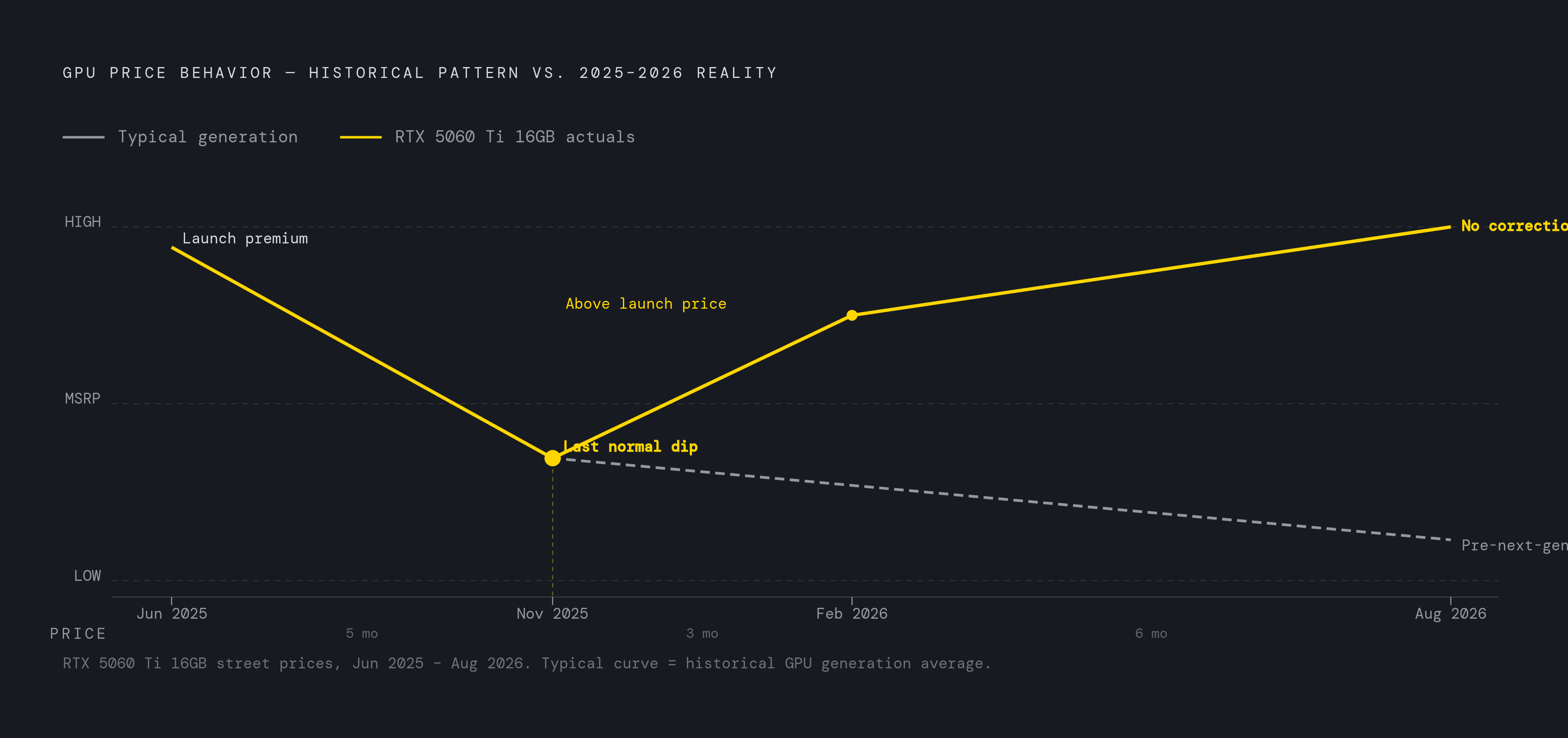
The November dip arrived again in 2025, right on schedule, exactly as the historical pattern would have predicted. It turned out to be the final performance of an old script. Prices dipped in November 2025 the way they always had. What didn't happen was the follow-through: the bounce-back-and-recover cycle that had defined every prior generation simply didn't occur.
The timeline shows how fast the old rules stopped applying. Cards that dipped in November 2025 had, by February 2026, climbed well above where they stood at their original launch back in June 2025. By August 2026, those same cards had climbed further still, with no sign of the correction that past generations would have produced by that point in the cycle. The 16GB tier shows this most starkly: the RTX 5060 Ti 16GB saw a dramatic jump in price between November 2025 and February 2026, and in some regions that increase ran far above the global average for the card. A buyer comparing listings in two different countries in early 2026 would have seen wildly different severities of the same underlying shock.
Anyone who bought a GPU in late November 2025, trusting the seasonal pattern that had worked for years, made the right decision, but for reasons that had nothing to do with why it actually worked out. The seasonal logic correctly predicted the dip. It could not have predicted that the dip would be the last one, because the force that reversed it afterward wasn't seasonal. It was structural, and it has not let go since.
The structural cause: AI data centers are outbidding consumers for memory
The 2026 GPU price crisis doesn't resemble a normal demand spike or a conventional supply shock, the kind that resolves itself once a factory ramps up or a backlog clears. It's a permanent reallocation of memory manufacturing capacity, redirected away from consumer hardware and toward AI infrastructure that pays more for the same fabrication lines.
Three companies, Samsung, SK Hynix, and Micron, control nearly all of the world's memory production. All three have been steering capacity toward the premium memory type built for AI data centers, because it carries higher margins than the standard memory type that goes into consumer graphics cards. A fab that can produce the premium memory type for a data center customer at a premium has little incentive to prioritize a wafer run for a modestly priced gaming GPU. That capacity decision, made at the manufacturing level, is the root of the price behavior documented above.
The GPU die and the VRAM attached to it together make up the large majority of the bill of materials on a high-end consumer card. One Nvidia board partner has stated that the chip and video memory combined account for 80% of a card's build cost. When memory pricing moves as sharply as it has, the finished card's price moves in close to lockstep, because there is so little room elsewhere in the bill of materials to absorb the shock.
MSI's own investor-facing disclosures back this up directly from the manufacturing side. MSI's general manager told investors the company estimates a 20% gap in Nvidia GPU supply, alongside a DRAM shortage driven by AI infrastructure demand, and that gaming hardware prices should be expected to rise through the remainder of 2026. A board partner, with direct visibility into its own supply contracts, is confirming the shortage from the inside.
The shortage is not confined to graphics cards. System DDR5 memory, SSDs, and other consumer electronics drawing on the same fabrication capacity have all moved higher through 2026. A builder pricing out a full system this year faces elevated costs on multiple line items, not just the one labeled "GPU." A proposed class-action antitrust filing, lodged in June 2026 in the Northern District of California, accuses Samsung, SK Hynix, and Micron of conspiring to restrict conventional DRAM supply. The allegations are unproven, and no defendant has been found liable. The structural argument above does not depend on that filing being correct: the capacity reallocation toward AI memory is sufficient on its own to explain the pricing behavior being observed.
How the shortage hits different cards differently
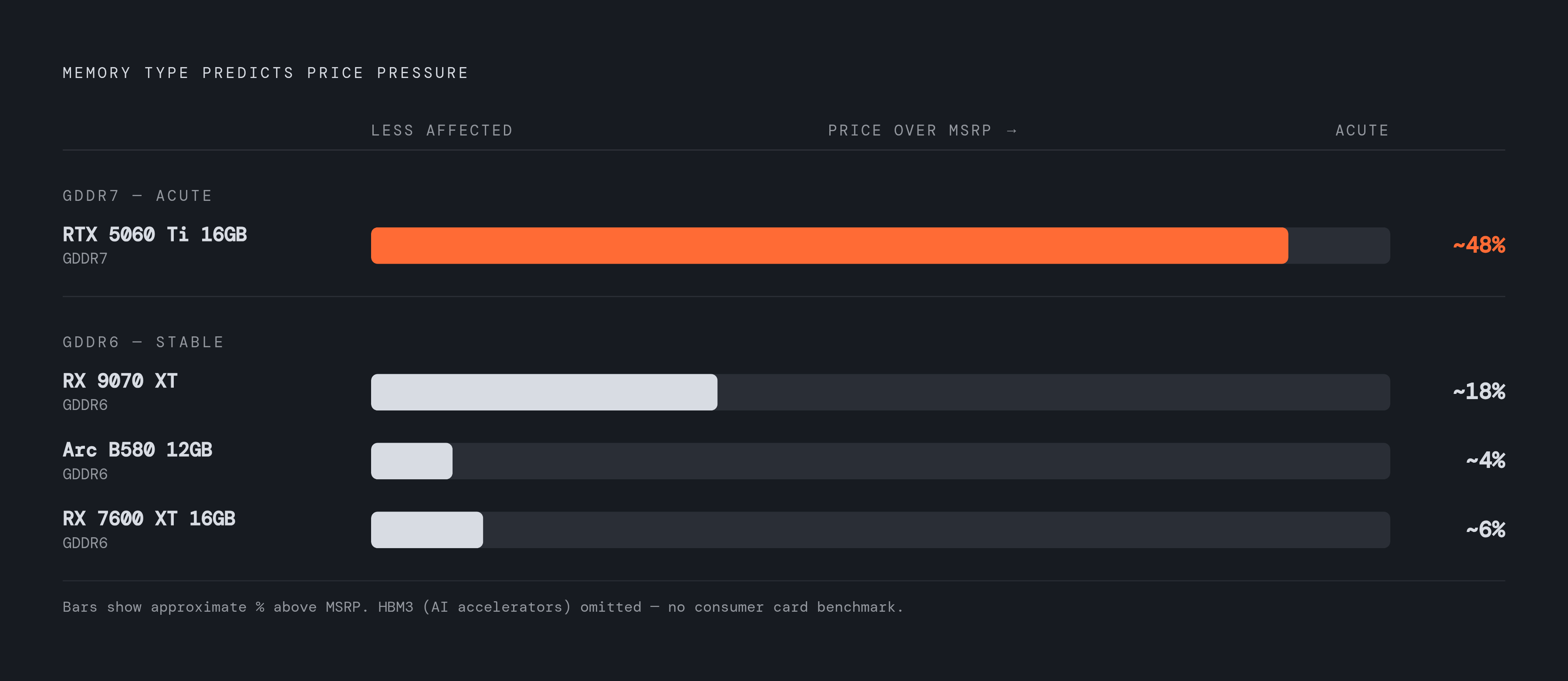
The shortage is concentrated in GDDR7 and HBM3, the memory types most closely tied to AI infrastructure demand and to the newest consumer GPUs. Cards built on older GDDR6 memory have been measurably less affected, which turns memory type itself into a purchasing signal rather than a line on a spec sheet nobody reads closely.
The clearest evidence sits in the mid-range. The RX 9070 XT, which uses GDDR6, was trading at a meaningfully smaller percentage over its MSRP than comparable Nvidia cards as of mid-2026. AMD's choice to stick with GDDR6 on that card gave it temporary shelter from a shortage concentrated in the memory type Nvidia's comparable cards depend on. It is a direct consequence of where each company sourced its memory.
A broader GDDR6 pocket exists across the market. The Intel Arc B580, with 12GB of GDDR6, along with other older-generation cards built on the same memory standard, sit on a structurally more stable supply chain, because the acute shortage is in GDDR7 and HBM3, not across every memory type in production. A builder comparing two cards at similar performance levels now has a real reason to check what kind of memory each one uses before comparing prices, because that detail predicts how stable the price is likely to stay over the following months, making memory generation a filter to apply before a single dollar figure gets compared.
Where the genuine value is right now: last-gen cards and the used market
New-generation cards remain priced well above their MSRPs across most of the market, but a quieter opportunity has opened up one tier back. The RTX 40-series and RX 7000-series used market has become the place where real value still exists, and the downward pressure on those prices has continued as adoption of current-gen cards grows and pushes last-gen stock further out of demand.
Among used Nvidia cards, the shift has been largest. In the research's September snapshot, the RTX 3060 Ti leads value at 1440p resolution, and the RTX 3070 fell meaningfully over that same period. Cards at this tier keep getting cheaper for a simple reason: they are two full generations removed from current hardware, carry no nostalgia premium the way some older enthusiast cards do, and face no new buyer pool competing to push their price back up.
On the AMD side, the RX 7800 XT, built with 16GB of GDDR6, and the RX 7900 GRE stand out as the strongest cases for builders who need more VRAM headroom than a budget card provides.
At the budget end, the RX 7600 XT is the named outlier in the research. It offers 16GB of VRAM at a price point where no Nvidia alternative comes close, an anomaly that exists because the GDDR7 shortage has concentrated its damage above this price tier.
The seasonal pattern that governed the market before the crisis still applies to this used tier, even if it no longer applies to new-generation stock. November and December remain the best window to buy used last-gen cards, with prices historically running noticeably below the annual average during those months. February and March remain the worst months to buy used, the same months when new-gen prices have been climbing hardest. For a builder who cannot act immediately, the research documents a meaningful gap between November pricing and the February peak for the same card. The seasonal signal still holds value even while the structural signal for new stock has turned unfavorable.
None of this makes last-gen hardware a free lunch. Last-gen cards offer no path to GDDR7-dependent features, and they will not benefit from future driver optimizations built specifically around current-gen memory bandwidth. For builders running professional workloads or planning to hold a system for many years without upgrading, that trade-off carries real weight and deserves honest consideration before the lower sticker price settles the decision.
What to watch for while waiting on new-gen prices
The usual mechanism that resets GPU pricing, a Super refresh or the announcement of the next generation, has been pulled from Nvidia's 2026 roadmap. Nvidia's own GeForce CES 2026 page stated that no new GPUs would be announced at the event, and for the first time in five years, Nvidia did not unveil any new graphics card at CES. That removes the single clearest historical signal that tells a builder when relief is coming.
A new MSRP announcement alone is not a signal worth acting on. MSRP and street price have decoupled so severely for current-gen cards that a fresh MSRP, without supply context attached to it, tells a builder almost nothing about what they will actually pay at checkout. Memory fab capacity commitments from Samsung, SK Hynix, and Micron, and whether any of that capacity gets redirected back toward standard consumer memory production rather than the premium type used for data centers, are the signals worth tracking instead. Until that redirection appears in reporting from the memory makers themselves, waiting for a new-gen price reset is a bet with no defined timeline attached to it, and the forecasts that assumed a 2026 correction have already been proven wrong once.
A practical decision framework by scenario
Reading GPU price history in 2026 doesn't produce one answer for every builder. It produces four distinct situations, each calling for a different response under the same market conditions: the builder who needs a GPU now and has flexibility on generation, the builder who needs a GPU now and insists on current-gen, the builder who can wait several months, and the builder planning a multi-year hold for professional or heavy workloads. Each of those four builders is reading the same price charts and should be reaching different conclusions from them.
Whichever situation applies, the same practical step holds before committing money: visualizing the entire build, case, cooling, motherboard, and GPU together, in a 3D configurator such as BuildCores surfaces compatibility problems and aesthetic trade-offs that a spec sheet by itself will never reveal. The real-time price comparison across retailers built into that kind of platform also makes it straightforward to see whether a given card's street price is moving toward MSRP or away from it, rather than trusting a single retailer's listing as the full picture. BuildCores's FPS performance estimates, delivered through 3DMark integration, matter directly here too: a builder weighing a last-gen card against a current-gen alternative can compare actual performance output against the real price premium being charged, rather than comparing paper specifications that don't account for what the shortage has done to pricing.
A good price in 2026 is relative to the memory type a card uses, where that card sits in its generation's life cycle, and what time of year it is being bought. A builder who ignores them is guessing, and guessing is the one strategy this market has stopped rewarding.