Mid-Range GPU Tier List for PC Builders
Three ecosystems and VRAM requirements reshape how to choose your next mid-range GPU.

The 2026 mid-range GPU market rewards a tiered decision. For PC builders, the right card follows from the target resolution, enough VRAM to sustain it, and an upscaling ecosystem that serves the actual game library. Price then decides which suitable card offers the strongest value.
How the 2026 mid-range GPU market became a three-ecosystem contest
NVIDIA Blackwell, AMD RDNA 4, and Intel Battlemage now compete across the same $249–$650 price band through the RTX 50 series, RX 9000 series, and Arc B series. These are three distinct ecosystems with meaningfully different performance and feature profiles, rather than interchangeable routes to the same result. That competition gives builders more choice, but raw rasterization performance no longer explains enough of the purchase. VRAM requirements, AI upscaling quality, and driver software depth can matter just as much.
Why VRAM capacity has become the primary axis for sorting mid-range cards
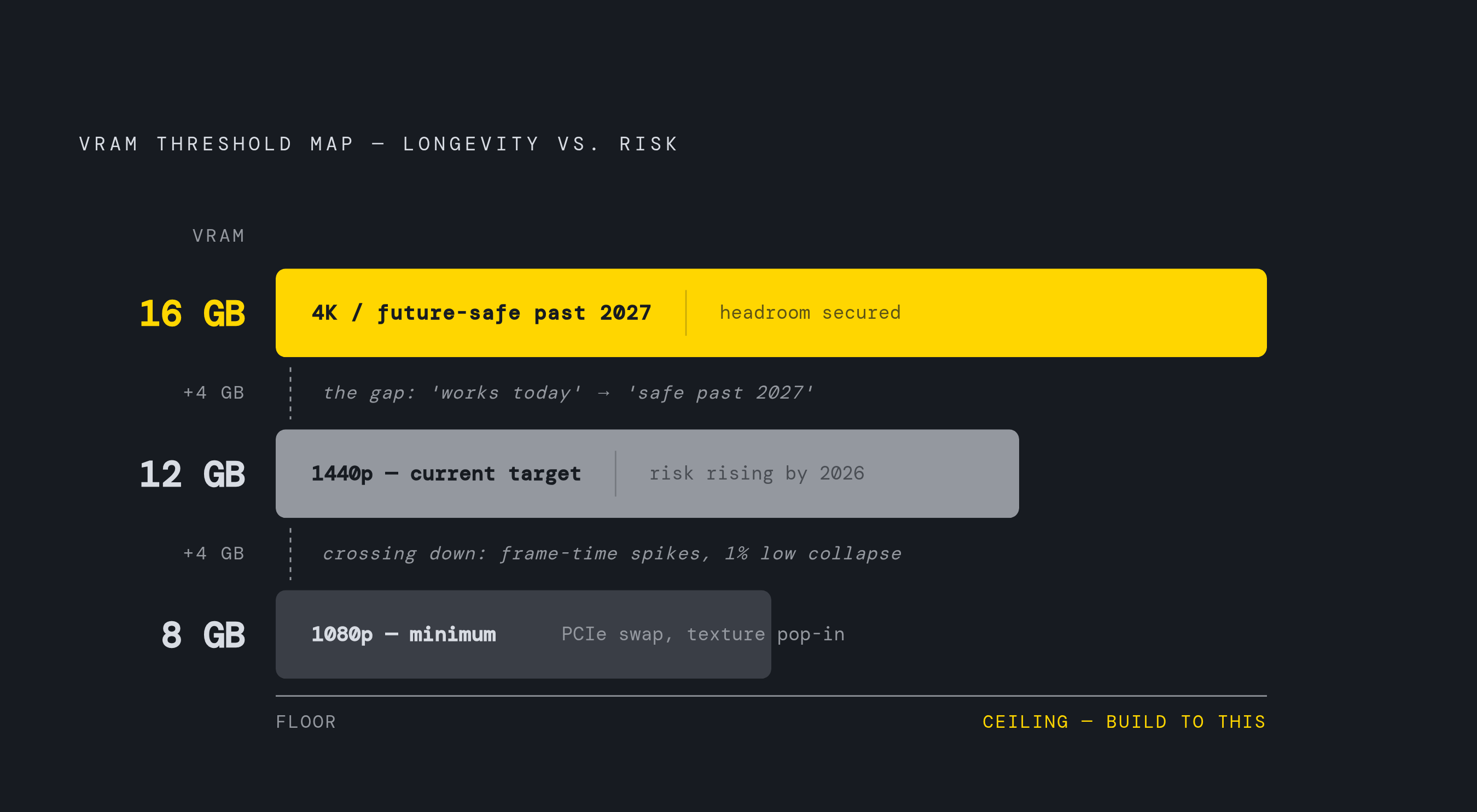
VRAM capacity is the first sorting criterion because it determines how a card behaves when a game's assets exceed its memory buffer. When those assets fit inside 8GB, the 8GB and 16GB versions of the same GPU perform essentially identically. But once a game needs more memory, the 8GB card starts swapping across the PCIe bus. The result can include texture pop-in, frame-time spikes, and collapsing 1% lows. This is a performance cliff with consequences beyond the small reduction in average frame rate that a builder might accept to save money.
The practical ladder is 8GB minimum for 1080p, 12GB as the current 1440p target, and 16GB as the safer choice for a build intended to last past 2027. That ladder establishes the framework for the tiers below, but it does not make 16GB a universal minimum. The Steam Hardware Survey shows that most cards have 8GB, and developers still optimize for those cards. Conservative settings can keep today's games within their limits, while manufacturers have an incentive to promote larger buffers at higher prices. Nevertheless, a multi-year purchase must account for the measurable cliff when settings are pushed, rather than treating today's workable settings as a guarantee of future headroom.
How AI upscaling ecosystems change what "performance" means for each tier
Once the memory requirement is clear, the next branch of the decision is the game library. DLSS 4 with Multi Frame Generation, AMD's FSR 4, and Intel's XeSS 2 change what a card's real-world output looks like, but they are not interchangeable. A builder whose games support NVIDIA's features has different reasons to buy from someone who plays older games, AMD-optimized titles, or emulators. For that second group, the RTX 5060 loses most of its main advantage. In a heavily DLSS-supported library, however, AMD's raw-raster value advantage narrows substantially.
NVIDIA makes DLSS 4.5 Dynamic Multi Frame Generation available from March 31, 2026, with the multiplier adjusting automatically to scene complexity. That changes the case for supported RTX 50 series cards without changing their native rasterization figures. Frame Generation also makes latency support relevant, so NVIDIA's Reflex and AMD's Radeon Anti-Lag 2 belong in the ecosystem comparison. AMD's supported-games page shows that Radeon Anti-Lag 2 works in 23 titles.
Full ML acceleration for FSR 4 requires RDNA 4 hardware, including the RX 9070, RX 9070 XT, RX 9060 XT, or RX 9060. The RX 9060 XT is the first mid-range card to support it natively. Builders who choose that ecosystem get a feature they cannot count on having with older AMD cards. These distinctions make library coverage a purchasing criterion.
Budget floor tier ($249–$299): Intel Arc B580 and the RX 9060 XT 8GB
The Intel Arc B580 is the budget-floor choice for 1440p builders because its 12GB buffer has more memory headroom than cards with 8GB. Its advantage is structural rather than a claim that it wins every frame-rate comparison. The strongest fit is a builder with a PCIe 4.0 system who does not stream. PCIe 3.0 systems lose a meaningful share of performance, while streaming and older DX11 titles remain weaker than on NVIDIA or AMD equivalents. Those constraints keep the B580's verdict specific, but they do not erase its appeal as the lowest-price route to 1440p VRAM headroom.
The RX 9060 XT 8GB takes the stronger position for 1080p high-refresh competitive gaming at its $299 MSRP. Its 8GB GDDR6 buffer suits that role better than demanding 1440p Ultra AAA gaming, where the 16GB version is the appropriate step up. AMD specifies 150W board power and a single 8-pin power connector. A compact cooler design also makes the card relevant to ITX builds. For builders considering the B580 in a small case instead, visualizing it in BuildCores' 3D configurator before buying is a practical way to bring physical fit into the decision.
The RTX 5060 at $299 MSRP earns its place only for a more narrowly defined buyer. It suits someone who primarily plays at 1080p and whose library is overwhelmingly DLSS-supported and NVIDIA-optimized. With Multi Frame Generation, that builder has a reason to choose it over the other cards. Its 8GB limit still exposes it to the same memory cliff in demanding 1440p Ultra games. The budget verdict is consequently clear, with the B580 serving memory-conscious 1440p builds, the RX 9060 XT 8GB serving competitive 1080p builds, and the RTX 5060 serving DLSS-heavy 1080p builds.
Mainstream mid-range tier: where the real value debate lives
In the mainstream tier, 16GB becomes the dividing line. The RX 9060 XT 16GB delivers most of the RTX 5060 Ti 16GB's gaming output at a meaningfully lower price. That makes it the stronger raw-gaming value choice for 1440p AAA builders who do not require DLSS-exclusive features. It also removes the 8GB version's defining memory constraint without requiring a move into the upper mid-range. For a builder comfortable with AMD's open FSR ecosystem, this is the clearest value argument in the range.
The RTX 5060 Ti 16GB answers with software depth rather than the lowest cost for rasterization performance. At its $429 MSRP, the case rests on DLSS quality, Ray Reconstruction access, and NVIDIA's longer demonstrated software support track record. Its 16GB GDDR7 buffer also places it on the safer side of the memory framework. Dynamic Multi Frame Generation strengthens its real-world output beyond what native rasterization numbers alone describe. The right buyer has a heavily DLSS- and NVIDIA-optimized library and can find the card near MSRP.
Current street pricing heavily favors AMD, which makes the price condition central to NVIDIA's recommendation. A feature premium that looks reasonable at MSRP becomes harder to defend when the retail spread widens. The bottom line is straightforward, with raw gaming value tilting AMD and feature-stack depth tilting NVIDIA. Builders should check live prices before they choose, since the price gap can change after launch. BuildCores' real-time multi-retailer price comparison provides a practical place to monitor that spread against the features the build actually needs.
Upper mid-range tier ($529 and up): the RX 9070 GRE, RX 9070, and RX 9070 XT
At the upper boundary, “mid-range” becomes a less useful description of cost. These cards deliver performance that was flagship-level two generations ago, but current street prices can put them in high-end territory. Spending more here therefore needs a resolution or longevity justification. A more expensive card with less headroom can be a poorer fit for a long-term target than its position in the range suggests.
The RX 9070 GRE illustrates that distinction at its $529 MSRP. Its 12GB buffer meets the practical 1440p target today, but it is the limitation relative to the RX 9070 and RX 9070 XT, both with 16GB. That difference matters for a multi-year 1440p Ultra build or an early move into 4K. The RX 9070 and RX 9070 XT provide the larger buffers that better match the longevity argument for moving up.
The RX 9070 XT combines a $599 MSRP with 16GB GDDR6 and a strong case for 1440p rasterization performance. It is best suited to builders who prioritize raw gaming value and do not need DLSS-exclusive features. NVIDIA's deeper software ecosystem remains the trade-off at this tier. The price in stores must also matter more when street prices in this tier reach high-end levels.
When upgrading to a 2026 mid-range card does not make sense
Owners of recent last-generation mid-range cards have the weakest reason to upgrade when their existing buffer still suits their games. For them, the case rests mainly on escaping a VRAM limit or gaining ecosystem access. Supply-inflated prices make that calculation less attractive.
RTX 20- and 30-series owners also need to distinguish upscaling quality from newer frame-generation features. DLSS 4.5 Super Resolution and Ray Reconstruction are available on RTX 20-series cards and newer, so access to that upscaling quality does not itself require a replacement. By contrast, an 8GB card from two or more generations ago can present an active problem for regular AAA gaming at 1440p Ultra or above. A proven card that is in stock near MSRP then offers a gain the builder can use now. Builders in that position can use the tiers above, then visualize the upgrade with BuildCores' compatibility checking to eliminate wrong-fit risk before buying.
How to use resolution target, VRAM, and ecosystem to pick the right tier
Start with the resolution and refresh rate the build must serve, then establish the memory requirement for today and two years ahead. For competitive 1080p gaming without a DLSS requirement, the RX 9060 XT 8GB is the direct budget choice. For 1080p medium-high settings in a DLSS-heavy library, the RTX 5060 at $299 MSRP makes its more specific case. For budget 1440p, the B580 provides 12GB headroom, provided the system has PCIe 4.0 and streaming is not a requirement.
Move to 16GB when the goal is a longer-lived 1440p AAA build. The RX 9060 XT 16GB is the value-led route, while the RTX 5060 Ti 16GB at $429 MSRP is the DLSS all-rounder when available near that price. Its Dynamic Multi Frame Generation and Ray Reconstruction access need to matter to the library for the premium to earn its place. Beyond that tier, weigh the RX 9070 GRE's 12GB against the RX 9070 and RX 9070 XT's 16GB before committing to a multi-year Ultra or early 4K target.
BuildCores has a 3D configurator, compatibility checker, and multi-retailer price comparison so builders can see how the chosen card fits inside their own case. That lets them check the fit of the PCIe slot and power connector while keeping an eye on live retail prices. The mid-range market rewards that care because the gap between the right card and the wrong one at similar prices is measurable, avoidable, and exactly what a visual planning tool exists to close.