Nvidia RTX 5000 Series Lineup Explained for Builders
Seven Blackwell GPUs from $249 to $1,999 cover every resolution tier and workload.

The RTX 5000 series is a complete, fully launched lineup of seven desktop GPUs built on Nvidia's Blackwell architecture, announced at CES 2025 and released across the first half of that year. Builders planning a new system today are choosing from a stable, reviewed set of cards rather than waiting for releases. Jensen Huang announced the lineup at CES on January 6, 2025, and the launch cadence unfolded in order across the following six months: RTX 5090 and RTX 5080 on January 30, RTX 5070 Ti on February 20, RTX 5070 on March 5, RTX 5060 Ti on April 16, RTX 5060 on May 19, and RTX 5050 on July 1. Every card except the RTX 5050 uses GDDR7 memory. The RTX 5050 uses GDDR6, a distinction that matters when comparing memory bandwidth across tiers. All cards use the 12V-2×6 power connector, are built on TSMC 4N (a 5nm variant), support DLSS 4 with Multi-Frame Generation, and connect via PCIe 4.0/5.0. If you are planning a build, BuildCores has a 3D configurator and compatibility checker that make this lineup tangible rather than abstract.
Full specs for all seven cards, side by side
The seven cards fall into three performance bands, and each band suits a different kind of builder. Knowing the raw specs, CUDA cores, VRAM, bus width, and TDP, is the prerequisite for every downstream build decision, and the bands are high-end (5090, 5080), enthusiast mid-range (5070 Ti, 5070), and mainstream (5060 Ti, 5060, 5050).
| Card | CUDA Cores | VRAM | Bus Width | TDP | MSRP | |------|-----------|------|-----------|-----|------| | RTX 5090 | 21,760 | 32GB GDDR7 | 512-bit | 575W | $1,999 | | RTX 5080 | 10,752 | 16GB GDDR7 | 256-bit | 360W | $999 | | RTX 5070 Ti | 8,960 | 16GB GDDR7 | 256-bit | 300W | $749 | | RTX 5070 | 6,144 | 12GB GDDR7 | 192-bit | 250W | $549 | | RTX 5060 Ti | 4,608 | 8GB or 16GB GDDR7 | 128-bit | 180W | $379 / $429 | | RTX 5060 | 3,840 | 8GB GDDR7 | 128-bit | 145W | $299 | | RTX 5050 | 2,560 | 8GB GDDR6 | 128-bit | 130W | $249 |
Each band has a different primary use case and PSU bracket. For builders who plan to run local AI workloads alongside gaming, the AI TOPS figures matter too: the RTX 5090 delivers 3,352 AI TOPS, the 5080 delivers 1,801, the 5070 Ti delivers 1,406, and the 5070 delivers 988.
What Blackwell actually adds for builders: DLSS 4, DLSS 4.5, and the features that are exclusive to this generation
Blackwell's biggest change for builders is not more CUDA cores but Multi-Frame Generation, an RTX 50-series exclusive that changes how you read and compare frame rates across generations. DLSS 4 Multi-Frame Generation (MFG) launched January 30, 2025, and in 4x mode it generates up to three AI frames for every one rendered frame. Only RTX 50-series cards get it. RTX 40-series still has single-frame generation.
The transformer model upgrade that improves Super Resolution, Ray Reconstruction, and DLAA is available to all GeForce RTX GPUs via the Nvidia App, so that part of DLSS 4 is not gated to the 50-series. DLSS 4.5, announced at CES on January 6, 2026, and pushed live March 31, 2026 via the Nvidia App, moves from a static 4x multiplier to Dynamic Multi-Frame Generation. This adaptive system continuously analyzes the gap between the GPU's base performance and the monitor's refresh rate, distributing resources to smooth frame rate jumps in demanding scenes and disabling unnecessary generation in less demanding ones. The result is up to 6x MFG on RTX 50-series cards.
DLSS 5, introduced in NBA 2K27 on September 3, 2026, adds neural rendering of lighting and materials, also exclusive to RTX 50-series. NV Reflex 2, with Frame Warp technology, reduces perceived latency by updating rendered frames based on the latest mouse input before they leave the GPU. RTX Neural Shaders use integrated AI networks to deliver film-quality shading and lighting in real time.
What each card actually does at 1080p, 1440p, and 4K
Which card is right depends first on target resolution and refresh rate, and the lineup divides cleanly into resolution tiers, but only when native and DLSS-assisted numbers are read separately. At 1080p, the RTX 5060 and RTX 5050 are the anchors. The RTX 5060 has 3,840 CUDA cores, 8GB GDDR7 with 448 GB/s bandwidth, a large memory bandwidth gain over the RTX 4060 on the same 128-bit bus. It handles 1080p high settings with headroom for DLSS-boosted frame rates. Tom's Hardware averages show the RTX 5060 at 59.8 FPS at 1440p Ultra without ray tracing, which situates 1080p performance accordingly. The RTX 5060 Ti 16GB is the better recommendation for builders who want high-refresh 1080p with a path to 1440p: Tom's Hardware averages show it at 73.4 FPS at 1440p Ultra, on par with an RTX 4070. The RTX 5050, with GDDR6 and a 130W TDP, is the entry point for budget-constrained 1080p builds only.
At 1440p, the RTX 5070 and RTX 5070 Ti carry the tier. Tom's Hardware averages put the RTX 5070 Ti at 116.8 FPS at 1440p Ultra without ray tracing and 66.2 FPS with it, so it leads the lineup for demanding 1440p with RT. You get 240+ FPS in competitive esports titles at 1440p and 60–120 FPS in demanding AAA games at max settings with ray tracing enabled. The RTX 5070's 12GB VRAM is considered tight at this price point in 2026 by reviewers, a flag for builders targeting demanding titles.
At 4K, the RTX 5080 and RTX 5090 define the tier. The RTX 5080 matches or exceeds the RTX 4090 in native 4K rasterization, and with DLSS 4 MFG it is the recommended default for 4K high-refresh builds. The RTX 5070 Ti handles most games above 60 FPS at 4K high settings with DLSS Super Resolution, capable 4K for builders who won't pay $999.
Power requirements and case constraints every builder needs to plan around
The RTX 5000 series spans a 445W TDP range from the RTX 5050 to the RTX 5090, and PSU sizing is not optional planning. The wrong PSU either throttles the card or causes system instability. Every card uses the 12V-2×6 connector.
The RTX 5090, at 575W TDP, needs a 1,000W PSU minimum with 1,200W recommended. The RTX 5080 at 360W needs 850W minimum and 1,000W recommended. The RTX 5070 Ti at 300W needs 750W minimum and 850W recommended. The RTX 5070 at 250W needs 650W minimum and 750W recommended. The RTX 5060 Ti at 180W needs 600W minimum and 700W recommended. The RTX 5060 at 145W needs 550W minimum and 650W recommended. The RTX 5050 at 130W sits at the bottom of the range.
Case considerations follow the same gradient. At 300W, the 5070 Ti can fit into more cases, including compact mid-towers. AIB partner cards usually cost 10–25% more than Founders Edition, and they are often physically larger, so both price and case fitment shift when you plan a high-end build.
The 8GB vs. 16GB RTX 5060 Ti decision and how VRAM affects CPU pairing
The RTX 5060 Ti's 8GB and 16GB variants are not interchangeable budget choices. They imply meaningfully different CPU pairing requirements and have different longevity profiles at 1440p. The 8GB version hits its VRAM ceiling in demanding 1440p titles before a modern CPU becomes the bottleneck, which means any modern 6-core CPU is adequate because the GPU caps out first.
The 16GB version removes that ceiling, allowing the GPU to push harder and longer. At that point, CPU selection matters more: the Ryzen 5 9600X is the sensible pairing for most RTX 5060 Ti 16GB builds, with the Ryzen 7 9800X3D being overkill at this GPU tier. If you already own a Ryzen 5 5600 or Core i5-12400F, you can likely keep it with either variant, especially at 1440p and moderate refresh rates.
A representative 16GB RTX 5060 Ti build pairs the card with an AMD Ryzen 7 9700X, 32GB DDR5, 1TB NVMe SSD, and an 850W 80+ Gold PSU. The 16GB choice at this pairing prevents texture stutter in demanding 2026 titles and extends the card's useful life at 1440p. The recommendation is unambiguous: for gaming in 2026, the 16GB version is the only one worth recommending.
Where each card sits on the upgrade path from RTX 30- and 40-series
The strength of an RTX 5000 upgrade depends almost entirely on which generation a builder is coming from. The case for upgrading is clear at some starting points and genuinely weak at others. RTX 4090 owners should think carefully: the RTX 5090 offers approximately 27% native rasterization gain, not a compelling upgrade for pure gaming. Content creators gain more: Blender render times drop about 35%, and DaVinci Resolve and Premiere Pro export times improve by 25–35%. RTX 4080 Super owners are better served by the RTX 5070 Ti at $749 than the RTX 5080, reviewers point out: same 16GB VRAM, $250 cheaper, and close enough in gaming performance that the price gap is the deciding factor. Nvidia itself acknowledged at CES 2025 that the RTX 5080 is only 18 percent faster than the RTX 4080 in non-DLSS, non-Frame Generation raster performance, so the 5080's value case is built on DLSS 4 MFG as a regular part of the workflow.
RTX 3080 and 3080 Ti owners targeting the RTX 5070 or RTX 5070 Ti make the strongest generational leap in the lineup. Any RTX 3060 or older is a clear upgrade at every tier. Even the RTX 5060 represents a large generational step in bandwidth and feature access. The RTX 5070 became the most popular current-gen GPU on Steam's hardware survey as of August 2025, evidence that it is reaching buyers even if critics note its native rasterization gains over the RTX 4070 Super are modest.
The honest case for and against DLSS 4 Multi-Frame Generation in a real build
DLSS 4 MFG is a genuine performance multiplier under the right conditions, but its benefits are uneven across use cases. Builders planning around it need to know where it helps, where it doesn't, and what DLSS 4.5's Dynamic MFG changes. The "fake frames" critique is technically accurate: MFG generates frames the GPU did not fully render. Where MFG works well is single-player titles where a solid base frame rate already exists, and competitive display setups where smoothness is the goal rather than reaction-time latency. In supported titles, Cyberpunk 2077, Alan Wake 2, Black Myth: Wukong, MFG can more than double effective frame rates.
Where MFG does not work well is competitive FPS play, where players prize latency over frame rate. MFG increases FPS output but latency either stagnates or regresses versus native rendering, reaching as high as 50ms in some scenarios. Frametime spikes in the base render pass through unchanged, and artifact risk around fast-moving objects or UI elements is real. Jensen Huang's CES 2025 claim that the RTX 5070 delivers "RTX 4090 performance" relies on DLSS 4 upscaling and MFG combined, not raw rasterization throughput, and that distinction matters when sizing a build around a specific performance target.
DLSS 4.5's Dynamic MFG, live since March 31, 2026, partially addresses the static-multiplier concern by adapting generation to scene demand. MFG amplifies good performance. It does not rescue poor performance. A builder targeting 4K with a card that can only hit 30 FPS natively will not get a smooth experience from MFG alone.
What the current supply shortage means for builders pricing a build today
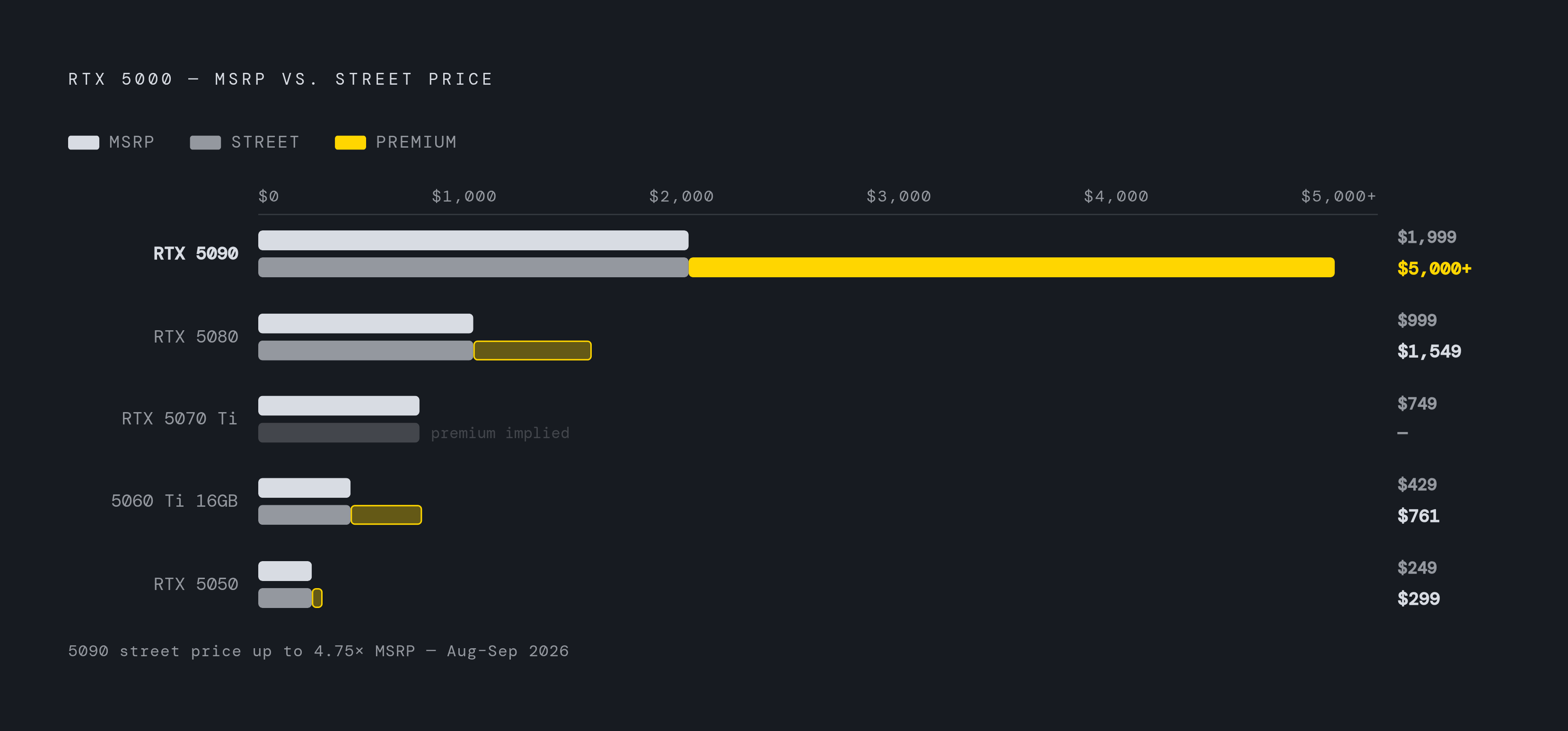
Data center demand is outpacing what memory makers can supply, so a GDDR7 shortage has pushed RTX 5000 street prices well above launch MSRPs across the entire lineup. The mid-cycle Super refresh that would have added supply has been canceled indefinitely. The price dislocation, as of August–September 2026, is severe at the top. The RTX 5090 sits at $5,000+ street versus a $1,999 MSRP. Tom's Hardware reported September 14, 2026 that first-party inventory had "almost completely evaporated," with third-party marketplace listings between $6,395 and $9,500, as much as 4.75x MSRP. The RTX 5060 Ti 16GB runs about 77% above its $429 launch price, which puts it near $761. The RTX 5080 is approximately 55% above MSRP at around $1,549. The RTX 5050 is the least affected, approximately 20% above MSRP at around $299.
The RTX 50 Super refresh, which would have added supply at mid-tier price points, has been canceled indefinitely with no confirmed date. Industry sources suggest a possible CES 2027 appearance, but it depends on the same memory economics that caused the delay. AIB pricing typically runs 10–25% above Founders Edition pricing even at MSRP, so you should add that on top of current street premiums when you budget. The flagship and 16GB mid-range cards are the most affected and require the most flexibility in budget planning.
Matching each card to a builder's resolution, budget, and use case
With specs, performance, power, upgrade context, DLSS trade-offs, and current pricing all established, the question is no longer which card is best in the abstract but which card fits this builder's specific situation. For 1080p high settings with budget priority, the RTX 5060 at $299 MSRP is the least price-dislocated option. For high-refresh 1080p or demanding 1440p, the best mainstream value is the RTX 5060 Ti 16GB at $429 MSRP. The 16GB variant is the only version worth recommending for 2026 gaming at 1440p. Pair it with a Ryzen 5 9600X for a balanced system.
For demanding 1440p with ray tracing, or capable 4K on a $749 budget, the RTX 5070 Ti is consistently cited by independent reviewers as the price-to-performance winner of the generation. For a 1440p DLSS-first workflow with a $549 ceiling, the RTX 5070 is the best choice for builders upgrading from RTX 3000-series or older, where the generational leap is clear. If you are on an RTX 4070 Super, evaluate carefully because the native rasterization gap is modest.
For a 4K high-refresh primary gaming machine on a $999–$1,200 budget, the RTX 5080 is the recommended default for 4K raster plus ray tracing plus DLSS 4. For 8K gaming, AI workloads, and content creation, the RTX 5090 is the only card for the use case, but the supply situation makes planning around it unreliable at current street prices. The sources checked for this guide are listed below.