Intel Arrow Lake CPU Performance for Gaming PCs
Refresh gains gaming performance through memory fixes, but still trails AMD for pure gaming builds.

Intel Arrow Lake CPU performance for gaming computers has improved substantially since its troubled launch, but the recovery does not make it the best choice for every builder. Arrow Lake Refresh belongs in a PC that shares its time between gaming and serious threaded work. For a new build used mainly for games, AMD is still the better choice, especially when the cost of a motherboard and future upgrades matter.
Why Arrow Lake's launch stumbled: architecture choices that hurt gaming from day one
Arrow Lake launched October 24, 2024 with trade-offs in its architecture that hurt gaming even before the BIOS problems. Intel chose to remove Hyper-Threading from the Lion Cove P-cores to make them more efficient. That choice hit games optimized for high thread counts, so the regression was not something firmware alone could undo. The design had changed what those cores could offer.
Meanwhile, the Skymont E-cores had much higher IPC than the earlier Gracemont cores, so they could do more work per clock. That helped with threaded productivity, but it did not fix the latency problems on the paths games rely on. More work completed across many cores is not the same thing as less time spent waiting for data. Arrow Lake therefore arrived with a real productivity strength that could coexist with weaker gaming results.
Memory sensitivity: how much Arrow Lake's gaming scores depended on DRAM tuning
The memory layout compounded those trade-offs because Arrow Lake placed its memory controller on the SoC tile, separate from the cores. That separation imposed a round-trip latency penalty, making memory speed and bandwidth tuning more consequential than on earlier monolithic designs. Typical DDR5 configurations could therefore leave the chip well short of its better gaming results.
At launch, the Windows 11 thread scheduler also sent tasks to the wrong core types, adding a software problem to the hardware delays. How well it ran out of the box thus depended heavily on how mature the BIOS was, support for XMP/EXPO profiles, and whether the builder knew to push memory clocks. This sensitivity to variables outside most buyers’ control when choosing a processor gives the Refresh’s memory changes practical significance.
What Arrow Lake Refresh actually changed and why the Ring Bus fix matters
Arrow Lake Refresh, sold as Core Ultra 200S Plus, arrived in early 2026 with its most important correction in the Ring Bus and the connection between chiplets. The D2D frequency rose by up to 900MHz, shortening data trips between P-cores, cache, and the separated memory controller. That change accounts for most of the gaming uplift. Rather than asking more cores to compensate for waiting, the Refresh reduced the wait itself.
The Core Ultra 7 270K Plus has 24 cores, split into 8P + 16E, matching the 285K’s core count. It reaches a 5.5 GHz max boost and carries 125W / 250W power ratings. The Core Ultra 5 250K Plus has 18 cores split into 6P + 12E, and its max boost is 5.3 GHz with power ratings of 125W / 159W. Both have four more E-cores than their non-Plus predecessors, and those cores help with productivity while the main gaming fix comes from elsewhere.
Memory support also moves forward, with official DDR5-7200 CUDIMM support and up to DDR5-8000 through the Boost BIOS profile. CUDIMMs use onboard clock-driver ICs and cost more than standard UDIMM kits, so the headline speeds come with a surcharge. Intel claims 15% higher 1080p gaming performance for the 270K Plus over the 265K, using a geomean of 38 games. The iBOT feature operates without emulating another processor architecture, and its title coverage is selective.
Where the Refresh lands in real gaming performance and where AMD still leads
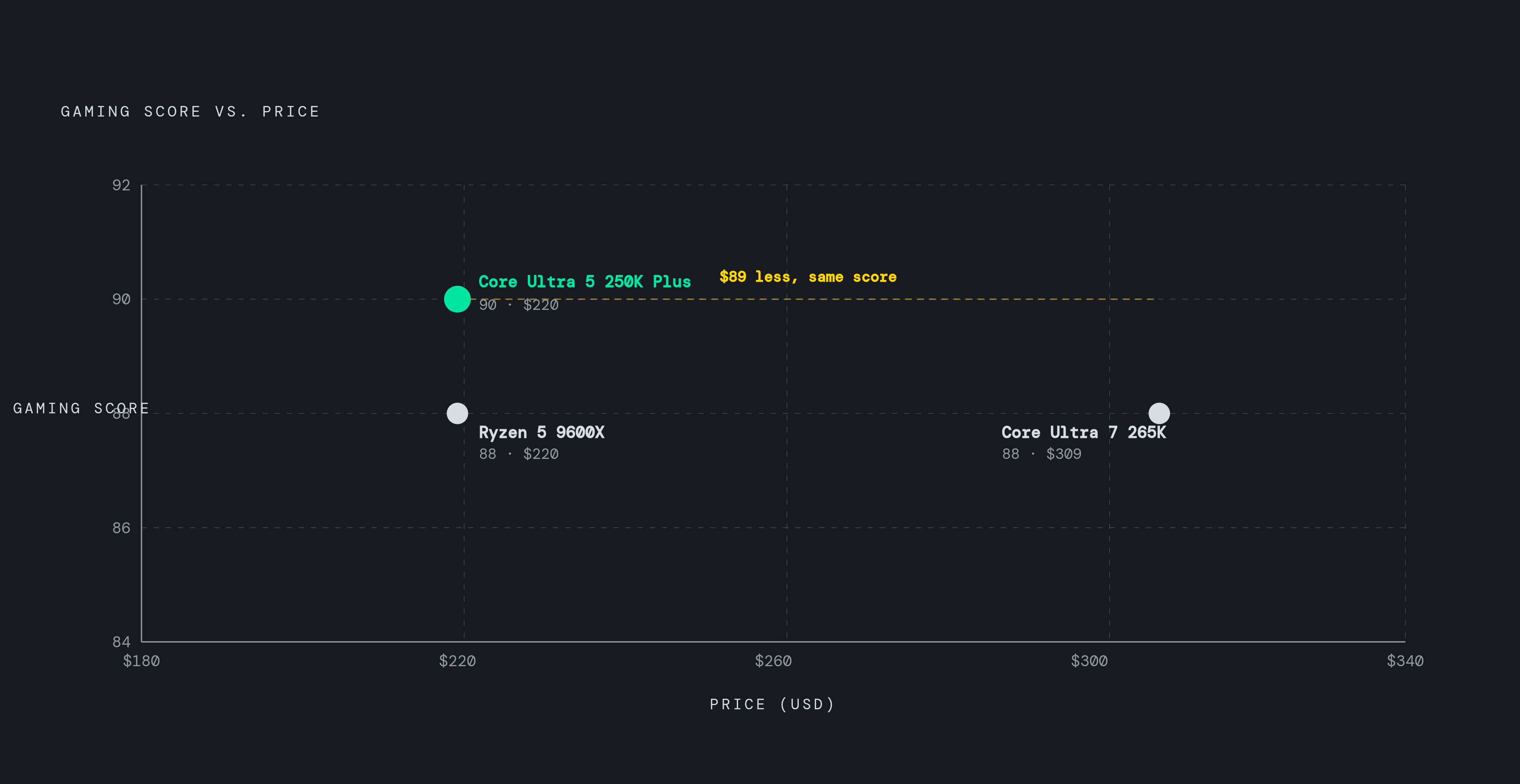
The Refresh’s gaming improvement is genuine, but it does not erase AMD’s advantage with 3D V-Cache. On the supplied 0–100 gaming scale, the Core Ultra 5 250K Plus scores about 90 at about $220. The Ryzen 5 9600X scores about 88 at about $220, while the original Core Ultra 7 265K scores 88 with a listed price of about $309. Those results show a useful recovery in Intel’s gaming value from launch performance.
The harder comparison is against the Ryzen 7 9800X3D, whose lead comes from its architecture. Its 3D V-Cache reduces memory latency in the workloads games repeatedly hit, and neither a faster Ring Bus nor more E-cores overcomes that advantage. However, the difference matters most at 1080p and 1440p when frame rates are CPU-bound. At higher resolutions, the gap collapses as the GPU becomes the bottleneck.
Price adds another limit to Intel’s case because the Ryzen 5 9600X nearly matches the 270K Plus in gaming for around $90 less. It also sits on a platform with a longer upgrade path. The Refresh is therefore a good gaming chip without being the obvious purchase for someone buying primarily gaming performance.
Where Arrow Lake genuinely wins: the mixed-workload and productivity case
The balance shifts when video editing, streaming, code compilation, or other threaded work shares a substantial part of the PC’s workload. Arrow Lake Refresh offers a productivity-to-price ratio that AMD’s gaming-optimized parts do not match. The 270K Plus delivers roughly 18–22% more multi-threaded throughput than the 265K, while the 250K Plus gains roughly 25–30% over the 245K. Here, the extra E-cores do useful work.
Intel’s QuickSync adds a separate practical advantage by handling encoding and transcoding on the integrated Xe-LPG graphics tile. That leaves the discrete GPU available, which matters for single-PC streamers using OBS who would otherwise face GPU contention. KF variants cost modestly less and omit integrated graphics, but they also lose QuickSync. Having a discrete graphics card does not make that trade irrelevant.
Power efficiency is another genuine architectural win. The Core Ultra 9 285K draws around 150W in all-core workloads where the 14900K consumed over 250W, giving quiet and small-form-factor builds more thermal and power headroom. Those gains give Intel more appeal for people who do production work often. They do not reverse the recommendation for someone who games the vast majority of the time and only occasionally edits a video.
The budget end of Arrow Lake: where the platform struggles most
The recovery is much less convincing at the bottom of the range, where the Core Ultra 5 225 remains Arrow Lake’s only chip below $200. It has 10 cores split into 6P + 4E, and its max boost is 4.9 GHz with power ratings of 65W TDP / 121W max. Its 20MB L3 cache is part of its 42MB total L2+L3 cache. Those specifications do not translate into competitive value at about $180.
The 225 is slower than the last-gen Ryzen 5 7600X in games and slower than the Ryzen 5 9600X in multithreaded applications. B860 motherboards also carry a premium over AMD’s B650 equivalents, so the CPU price understates how much the platform costs. With the 250K Plus at about $220, the 225 has little room to justify itself. A drop into the $130–$150 range would change the calculation, but its current price leaves Intel’s budget gap open.
Platform costs and upgrade path: what LGA1851's socket dead end means for a new build today
Even where the processors are competitive, LGA1851 has a harder problem than frame rates. The Core Ultra 200S Plus parts are the last processors this socket will take. A new buyer is entering a closed platform rather than buying a motherboard with another CPU generation ahead of it.
Intel’s leaked roadmap places Nova Lake mass production in Q4 2026, with initial 28-core desktop chips landing in Q1 2027 and the full lineup staggered through mid-2027. Mass production is not the same as desktop availability, so those dates should not be collapsed into a 2026 arrival. AMD, by contrast, has a published AM5 commitment through at least 2029, with current Ryzen 9000 parts and future generations sharing the socket. Its upgrade runway is a concrete part of the comparison.
The initial motherboard bill also matters. At launch, Z890 boards from major vendors ranged from about $199 for the ASRock Z890 Pro-A WiFi to about $499 for the MSI MPG Z890 Carbon WiFi. The entry price for a competent Arrow Lake board was higher than for equivalent AM5 B650 platforms. Intel’s productivity advantage must justify both that expense and the closed upgrade path.
How to plan an Arrow Lake build today: cooling, memory, and board choices that determine actual performance
For builders who accept that trade, cooling, memory, and motherboard choice are performance decisions. The Core Ultra 7 270K Plus and Core Ultra 9 285K have 125W / 250W max ratings. A 280mm or 360mm liquid cooler is required to avoid throttling under sustained all-core workloads, where air coolers will limit these chips. Arrow Lake’s efficiency improvement over older Intel parts does not remove the need to size cooling for the chosen processor.
Memory needs its own place in the budget because LGA1851 supports DDR5 only, with no DDR4 option. For a 2026 gaming build, 32GB is the practical minimum. Faster CUDIMM kits carry a premium that belongs in the total build cost, rather than being treated as a free route to headline performance. For content creators who need more memory, the Refresh supports 4R CUDIMMs with up to 128GB per DIMM on 800-series boards that support them.
The ASRock Z890 Pro-A WiFi at about $199 offers PCIe 5.0, DDR5 overclocking to 9066+ MHz, and Thunderbolt 4. Its use with a Core Ultra 5 245K supports its suitability for reliable 1080p/1440p gaming without VRM concerns. The MSI MPG Z890 Carbon WiFi adds 5Gbps LAN and Thunderbolt 4 as a higher-tier option. B860 boards serve non-K chips such as the 225, but their premium over B650 still needs to enter the calculation.
These choices are best planned before any part is bought. A 3D build configurator with real-time compatibility checking and component pricing can help show how cooling, memory, and board choices interact. That makes the full cost visible before components ship, instead of leaving the builder to discover the compromise after a disappointing benchmark run.
Who should build on Arrow Lake today and who should look elsewhere
For a late-2026 build, Arrow Lake Refresh makes the most sense when gaming genuinely shares the machine with video editing, streaming, or compilation. The 270K Plus combines useful threaded throughput with QuickSync at a price below comparable productivity chips. It also offers a cost-efficient upgrade for owners of an LGA1851 Z890 or B860 board moving from a 245K or 265K, through a BIOS flash and a drop-in replacement. Builders who want better efficiency than 13th/14th gen Intel parts offer also have a good reason to choose it.
A fresh build devoted mainly to games should lean toward AMD AM5 instead. The Ryzen 7 9800X3D is better for CPU-bound gaming, while the Ryzen 5 9600X offers near-270K-Plus gaming for those who have less to spend on a processor. AM5 also makes more sense when future CPU upgrades without a motherboard replacement are a priority. Intel’s recovery does not cancel those advantages.
Do not wait for Nova Lake if a system is needed now. Desktop Core Ultra 400 chips are not expected until Q1 2027 at the earliest, the flagship 52-core parts arrive later, and LGA1954 will require another motherboard investment. Buy for the work the PC will actually do. Arrow Lake Refresh is fairly priced for its strengths and belongs in a mixed-workload build, but it is not the default gaming platform for 2026.