New GPU Launch Day Availability and Pricing Reality
Memory shortages and AI demand are pricing flagship GPUs far above launch prices indefinitely.

GPU launch pricing no longer tells builders what a new graphics card will actually cost, or whether they can buy it. In October 2026, memory is hard to find, wholesale prices keep rising, and stock can disappear before a human can check out. Planning a build now means treating the advertised price as a reference and solving compatibility before a realistic buying window opens.
Why the GPU launch ritual — MSRP announcement, review embargo lift, day-one buy — no longer works the way builders expect
A builder plans around an announced GPU, fits its launch price into the budget, and waits for reviews. When sales open, the card is either gone or priced beyond recognition. The benchmarks may still show how well it performs. But the purchase those reviews appeared to support is no longer available on the advertised terms.
The old launch cycle depended on a reasonable expectation that MSRP, the manufacturer's suggested retail price, and shop prices would roughly converge within weeks. That expectation has broken down. Nvidia warned in its own forums before launch, “We expect significant demand for the GeForce RTX 5090 and 5080 and believe stock-outs may happen”. This was not simply a retailer running short unexpectedly.
Why memory, not GPU design, now sets what a graphics card actually costs
The explanation begins with what a graphics card costs to make. On some high-end cards, VRAM now accounts for more than four fifths of the bill of materials. The GPU die is no longer the biggest component expense. The memory package soldered next to it is, which gives the memory market an outsized influence over the finished card's price.
Capacity makes that exposure easy to understand. The RTX 5090 has 32GB of GDDR7, so a given increase in the cost per gigabyte hits its memory bill about twice as hard as an RTX 5080's. A higher-capacity card absorbs more of every increase before retail pricing even enters the picture. That helps explain why the flagship has moved further and faster than the rest of the stack.
Board partners also pay for a bundle containing the chip and GDDR memory. Higher wholesale costs therefore enter the card's price before it reaches a shelf. GPU architecture still determines what the hardware can do, but it no longer provides a useful explanation on its own for what builders must pay.
How AI data-center demand captured the memory supply chain that consumer GPUs depend on
Samsung, SK Hynix, and Micron control the overwhelming majority of global DRAM production. All three have a strong reason to favor AI workloads. High-bandwidth memory, or HBM, and server DRAM offer far higher margins than consumer GDDR, so production capacity is being redirected toward those products. Gaming hardware must compete for the remainder.
The scale separates this shortage from the crypto-driven spike in 2021. Thousands of new data centers are planned alongside the thousands already running, and the largest cloud companies are spending money to build them over the long term. This is not just another rush to buy gaming cards. It gives the memory industry another buyer for what it makes, with plans to keep spending well beyond a consumer GPU launch.
AMD skipped the high-end RDNA 4 tier entirely, with no RX 9080 or 9090, and RDNA 5 will not arrive before mid-2027 at the earliest. Builders facing inflated flagship prices have no new AMD high-end RDNA 4 alternative to turn to.
How three rounds of wholesale price hikes in 2026 turned a supply problem into a pricing spiral
Nvidia and AMD passed through three rounds of wholesale price increases in 2026, with each round stacking on the last. A builder who waited for the first price rise to fade found that later stock cost more because wholesale prices had risen again. This was an accumulating series of price increases.
On its September 30, 2026 fiscal earnings call, Micron said its own DRAM prices had risen sharply again during the fiscal Q4 that had just ended. Together, however, they pointed toward continued pressure heading into October.
October then brought a fourth GDDR6 increase at the partner level, before cards reached retailers. The frequency is the key point for purchase timing, because a card returning to stock need not return at its previous price. Waiting for replenishment and waiting for a discount have become two distinct bets.
What these price increases look like tier by tier, and which segments are worst affected
The distortion is sharpest at the flagship end, where large memory packages create the greatest exposure to rising GDDR costs. The RTX 5090 is the clearest example. Its 32GB capacity makes memory increases particularly expensive, while constrained supply adds another obstacle to buying it. Nvidia's SVP of personal computing, Jeff Fisher, told Taiwanese media at the RTX Spark launch event in Taipei on October 16, 2026 that reports of its discontinuation were untrue, while acknowledging supply chain capacity was “indeed somewhat constrained”.
High-VRAM mid-range cards are also heavily exposed, even without a flagship label. The RTX 5060 8GB and RTX 5060 Ti 8GB are among the most consistently available options near their original prices, with their smaller memory allocation helping spare them the worst increases.
Cards at their original launch prices are now rare enough to draw people to an event. Nvidia sold RTX 50-series GPUs at those prices from its booth at QuakeCon 2026, held August 6–9 at the Gaylord Texan Resort in Grapevine, Texas. The notable feature was access to MSRP at all, limited to a specific place and event.
How bots and scalpers capture the inventory that does exist before human buyers can act
Scarce supply is only part of the launch-day failure. Scalping bots monitor stock in real time and complete purchases in milliseconds, while AIO, or All-in-One, bots automate nearly every step of buying. Operators coordinate through Discord and Telegram “cook groups” that share alerts, distribute scripts, sell aged accounts, and provide guides for bypassing retailer security.
One community member running a bot that checked Nvidia's site every five seconds reported that the RTX 5090 page went “straight from coming soon to out of stock around 2:30pm”. Listings with massive markups appeared immediately after launch on eBay, StockX, and Facebook Marketplace. Low initial allocations across U.S. Micro Center locations and automated capture compound each other, so increasing stock alone would not necessarily put those cards into human builders' hands.
Why relief is not arriving in 2027 and what the 2028 timeline actually means
With so much of the memory producers' output already promised to buyers, there is little reason to expect shopping to return to normal in 2027. SK Hynix had sold out its DRAM, NAND, and HBM production for 2026, and its 2027 DRAM and HBM capacity was sold out by August 2026. The shortage outlook extends well into 2028. That timeline provides a planning horizon while leaving the timing of retail price resets uncertain.
There is a credible argument for a faster correction. Concentrated DRAM production has drawn antitrust scrutiny, and cooling AI capital spending could weaken demand, just as the collapse in crypto mining demand did in 2022. But the comparison has limits. With money still going into thousands of planned data centers, a sudden drop in demand is less likely than it was during the mining boom.
For a builder, “wait for normal prices” is a plan with an uncertain endpoint. A later architecture launch also does not guarantee cheaper memory or sufficient stock. Waiting remains a choice, but its possible duration belongs in the decision just as much as the hoped-for saving.
Which GPUs are actually available near their intended prices right now, and how reviewers have rebuilt their recommendations around availability
Useful recommendations now start with what builders can buy, and AMD's RDNA 4 mid-range and Intel's GDDR6-based Arc cards are good places to start. The RX 9070 and Intel Arc B580 give builders options that can handle their chosen resolution without the extra cost of a flagship. On Nvidia's side, the RTX 5060 8GB and RTX 5060 Ti 8GB stand out for consistent availability near original prices.
Intel's Arc B-series uses GDDR6, giving it less exposure to the AI-driven memory squeeze than GDDR7 or HBM and helping street prices stay near MSRP. October's GDDR6 increase still prevents calling it insulated.
Reviewers now base their recommendations on what buyers can find in stock as well as how well a card performs. A card's intended price cannot establish its value if buyers cannot get it there. Used hardware does not automatically fix that problem either, because paying near-original MSRP for a card one or two generations old, without a warranty, replaces one poor buying condition with another.
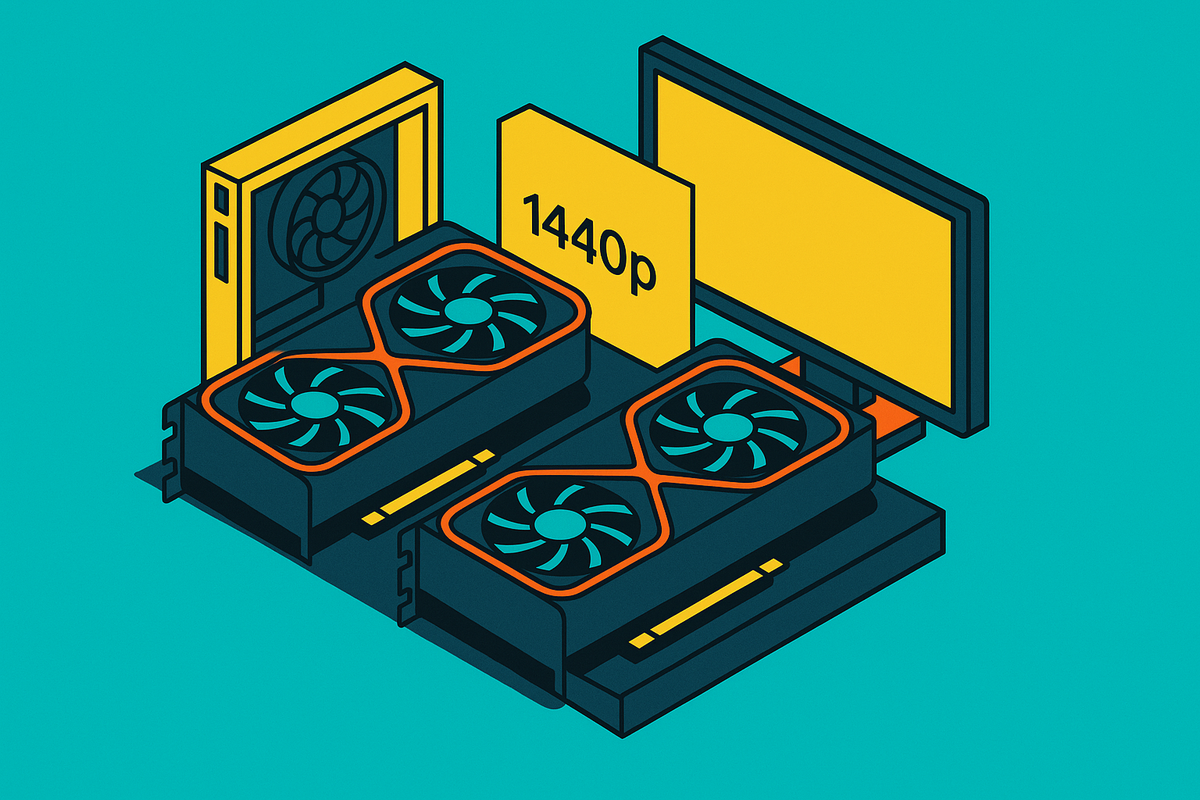
The guidance remains 8GB as a minimum for 1080p, 12GB recommended for 1440p, and 16GB or more for high-resolution gaming with high textures. Pricing pressure should not push a builder toward a memory capacity that fails the target workload.
How to plan a build in a market where GPU pricing is a moving target rather than a fixed input
The practical response is to separate build design from the purchase decision. Compatibility, PSU sizing, case clearances, and VRAM requirements can be settled before an acceptable GPU offer appears. A builder who starts researching dimensions when an alert arrives may lose the opportunity before reaching checkout.
A 3D configurator can help lock in the case, cooling layout, PSU wattage, and component dimensions around the intended GPU. A 575W TDP card changes power supply selection and airflow needs, and can change the required case size. Visualizing the layout before buying components exposes conflicts while they are still inexpensive to resolve.
Monitoring tools and price trackers then complement the finished plan. The recommended approach is to set an alert for a specific SKU at a target price, with compatibility already settled. For a fixed budget today, VRAM per dollar is still a useful guide, and builders can weigh cards such as the RX 9070 and Arc B580 against the resolution they want to use. The relevant price is the one available at checkout.
Other design work need not wait for memory prices to settle. RGB layout, cable management, and airflow visualization can be worked out while the purchase remains open. A visually resolved build is easier to execute when components become available. That leaves the uncertain part where it belongs, in the GPU buying decision rather than scattered across the whole build.