New Motherboard Chipsets and What They Mean for Build Planning
Chipset choice sets platform limits that belong in build planning before CPU selection.
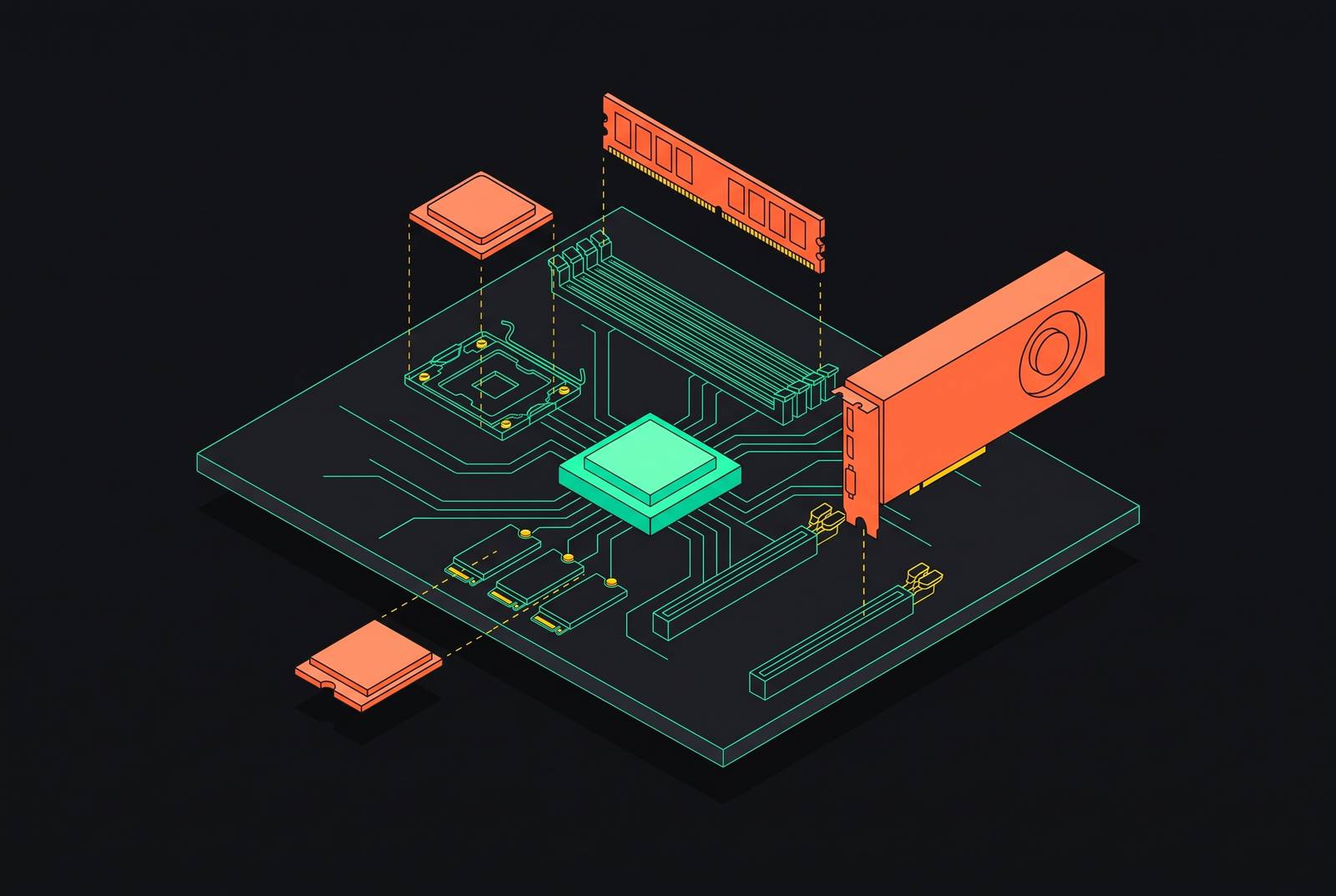
New motherboard chipsets set limits on upgrades, expansion and tuning, which shape plans for a build before any parts are bought. The right choice is the platform and tier that support the intended build without charging for features that will sit unused.
Why motherboard chipsets are a build decision, not a spec detail
A builder buys an LGA1851 board expecting to move to Nova Lake later. That upgrade will require another motherboard and socket, leaving the original board as a sunk cost for the planned upgrade. A board can support the chosen CPU perfectly and still be wrong for the build’s intended life.
That is why chipset selection belongs before the final CPU and GPU choices. The platform sets which CPU upgrades are possible, while the chipset tier limits expansion and tuning. The board then determines how those features reach actual slots and ports. Memory behavior adds another constraint because a faster kit is not useful if the platform cannot use its intended speed.
The two-platform landscape every builder faces in late 2026
AMD and Intel occupy different points in their platform cycles in late 2026. AMD’s AM5 socket has support through 2029, and Zen 6 is expected to fit without a board swap. Intel’s LGA1851 path includes Arrow Lake Refresh, then ends before Nova Lake. One platform is extending an existing socket’s life. The other is approaching a break between generations.
Nova Lake is expected to be formally announced at CES 2027, with a Q1 launch anticipated. Its incoming 900-series lineup includes B960, Z970, Z990, Q970 and W980, replacing the 800-series generation. Z890 boards began reaching the market in late 2024, with the rest following in early 2025. Those dates put current Intel boards close to another platform transition.
The older Intel market has a separate wrinkle. GIGABYTE BIOS updates across its B760 and H610 lineups suggest LGA1700 may receive additional processors in 2027. That possibility complicates used-market choices without extending LGA1851’s path to Nova Lake.
What chipset tiers actually control — and what they don't
If CPU multiplier overclocking is part of the plan, current Intel platforms require a Z-series chipset. If it is not, that particular reason to pay more disappears. AMD allows Precision Boost Overdrive tuning on most AM5 chipsets, including B850 and B650, but not B840 or A620. Memory tuning has its own gate. The leaked Intel 900-series specification table shows that Q970 is the only tier without memory overclocking.
Expansion follows the same decision tree. If several NVMe drives and multiple GPUs will use chipset connections heavily at the same time, more lanes and a wider DMI link between chipset and CPU can help. If the build uses one GPU and two drives, that wider link will not make it faster. Higher tiers also provide more high-speed USB and storage connections.
The primary GPU slot’s CPU-direct lanes come from the processor. A flagship chipset does not raise the CPU’s base clock or make games run faster on its own with the same CPU and GPU. For a build without multiplier overclocking or much expansion, paying more buys room to add hardware. It does not buy faster gaming by itself.
Intel's 900-series chipset tiers: what each unlocks and forecloses on Nova Lake
The important incoming Intel split is between Z970 and Z990. Under the leaked specifications, Z970 offers multiplier overclocking with PCIe 4.0 chipset lanes, while Z990 adds BCLK overclocking and 12 PCIe 5.0 chipset lanes. That creates a more precise buying decision. A builder who only wants multiplier tuning no longer has the same reason to choose the flagship.
Shipping records from Vietnam in late September 2026 list the ASRock Z970 LiveMixer WiFi and Z970 Pro-A WiFi, which show that Z970 boards are being made. Those records give the tier more substance than a name on a leaked table. They do not, however, turn every incoming specification into a settled retail feature. Nova Lake’s formal announcement is still ahead in this late-2026 picture.
Z990 fits builds that need its faster chipset lanes or BCLK controls, while Z970 fits builds that need less room for expansion and have plans for multiplier tuning. B960 belongs in the incoming lineup, but the available details here do not establish its exact limits. Q970 presents a clearer exclusion. Its lack of memory overclocking makes it a poor match for a build that depends on overclocked memory profiles, despite its performance-mainstream positioning for managed and commercial deployments.
AMD's 900-series AM5 chipset: evolutionary update or meaningful upgrade from X870E
For an AM5 buyer, the question is whether to buy X870E now or wait for X970E. This is not Intel’s socket-reset problem. The most meaningful change described for the X970E and Zen 6 pairing is full CUDIMM support, and the current limitation sits in the CPU’s memory controller. Existing AM5 boards can run those modules with EXPO 1.2 and AGESA updates only in bypass mode, treating them as standard UDIMMs at around 6,000 MT/s.
That makes the processor upgrade central to the decision. An X870E owner is not leaving significant performance unused relative to X970E before a Zen 6 CPU enters the socket. Buying X870E now and adding Zen 6 later is therefore a route to most of the expected CUDIMM benefit without paying for an X970E board. The new chipset label alone is not the reason to wait.
There is still a board-level uncertainty. X970E may need new board designs and have validated memory profiles and better signal routing that BIOS updates cannot give older boards. That gives builders who want the new memory tier a reason to wait. It is not proof that every existing X870E board will fall short, nor that every future X970E feature can be reproduced on it.
PCIe lane allocation as a compatibility trap, not a future-proofing checkbox
A chipset name does not describe a board’s wiring. Two boards with the same label can put PCIe 5.0 in different places, including the GPU slot, an M.2 slot only, or no consumer-facing slot at all. CPU-direct lanes provide PCIe 5.0 to the primary x16 slot on most current AM5 and LGA1851 boards. Chipset-sourced connections still depend on the tier and board design.
One Q970 board has two PCIe 5.0 x16 slots, but one runs more lanes than the other, while its x4 slots are wired with only two lanes. Slot length is not an electrical specification. On other boards, a second physical x16 slot may run at x4, and adding an NVMe drive can leave another slot with fewer lanes.
The buying check is therefore specific to the board. It should establish which slot is electrically x16 PCIe 5.0, which M.2 and PCIe slots share lanes, and what changes when those M.2 slots are occupied. Current discrete graphics cards do not saturate PCIe 4.0 ×16 in gaming workloads. A PCIe 5.0 GPU slot is a hedge for future graphics cards and resale value.
Memory sweet spots differ by platform and chipset tier in ways that affect kit selection
The platform guides the choice of memory more than the highest speed printed on the box. DDR5-6000 EXPO is the platform-validated sweet spot for AM5, where going substantially faster can introduce divider-related latency penalties that offset part of the bandwidth gain. Intel LGA1851 behaves differently at that boundary. On Z890 and B860, DDR5-6400 with XMP 3.0 profiles is well-supported without the same latency cliff.
CUDIMM adds clock-driver logic to improve signal integrity at higher DDR5 speeds. Full support on AM5 needs Zen 6, so an AGESA update alone cannot let an existing X870E or X670E board with a current Ryzen processor run at the intended speed tier. For builders buying memory now, that separates a current DDR5 sweet spot from a future CPU-dependent capability.
Capacity introduces another board-specific choice. ASRock’s B850M Challenger WiFi, shown at CES 2026, provides four DDR5 slots in microATX form, demonstrating that a mid-range, smaller board can accommodate a four-slot layout. That gives builders who want 64 GB a way to get it without having to buy a larger board or move to a flagship tier. A 32 GB build has more flexibility, while targets of 64 GB or higher make slot count and memory topology more prominent constraints.
Form factor choices that change what a chipset's lane count can actually deliver
A chipset’s maximum connection count is not a promise that every board exposes it. Board designers trade away slots and ports to fit smaller layouts. A Z990 Mini-ITX board cannot fit all the PCIe slots, M.2 slots and USB ports that an ATX board can have. The chipset can have capacity that the board cannot physically deliver.
That distinction changes the value of paying for a higher tier. A smaller board’s physical x16 slot may be wired at x4 because of routing choices. For a small-form-factor build, boards should be compared by the connections each one has.
The MAXSUN MCIO ITX case, announced at Intel Connection 2026 in June 2026, points toward a different approach. It demonstrates MCIO cabling for PCIe routing where conventional slot placement is impractical. That is an emerging route for small-form-factor workstations. Size remains a functional constraint even when newer connectors offer ways around conventional layouts.
Aesthetic differentiation has become a chipset-tier signal, not just a marketing choice
Appearance is a legitimate part of a build plan. Manufacturers now use board design to distinguish chipset tiers as well as to decorate them. Onboard displays, iridescent finishes and elaborate heatsinks remain flagship-tier differentiators. For a themed build, those details may be part of what the buyer is paying for, rather than an incidental bonus attached to extra ports.
White B850 boards exist, and B-series aesthetic options are available on both platforms. An all-white build therefore does not have to use X870E. The distinction is between paying for a particular visual feature and assuming that a considered-looking build requires a flagship chipset. The first can be a choice to pay for a look. The second can spend money on hardware features the build will never use.
Turning chipset knowledge into a concrete build decision for each builder type
For a gaming build with one GPU, 32 GB of DDR5 and no planned multiplier overclocking, B850 covers the AM5 requirement. It offers PBO tuning and suits DDR5-6000 EXPO, with the board’s CPU-direct GPU connection still worth checking. B860 fills the equivalent current Intel role with DDR5-6400 XMP support. On Nova Lake, Z970 is the incoming mid-range option, adding multiplier tuning even if this builder does not need it.
A content creator with several NVMe drives has a different expansion requirement. X870E is the AM5 option for the broader connection budget and PBO tuning, while Z890 supplies current Intel multiplier and BCLK overclocking. For Nova Lake, Z990 fits a need for BCLK tuning and 12 PCIe 5.0 chipset lanes. Z970 is still an option when multiplier tuning is enough and it has room to connect the planned devices.
For a high-end build expecting a CPU upgrade in 1–2 years, AM5 is the stronger structural bet because of its socket support through 2029 and Zen 6 path. LGA1851 does not lead to Nova Lake. For a compact or appearance-led build, form factor comes first, followed by the chipset features the chosen board actually exposes. A B850 microATX board may have everything the build needs without the cost of lanes that cannot fit in it.
The practical order is socket longevity, overclocking access, then PCIe lane requirements. Visualizing occupied slots, case fit and the board’s appearance before buying turns those constraints into a complete plan. Nova Lake at CES 2027 and Zen 6 on AM5 will change the available choices again.