SSD Price per Gigabyte Trends Over Time
AI demand redirected chip capacity, ending a decade of falling SSD prices.
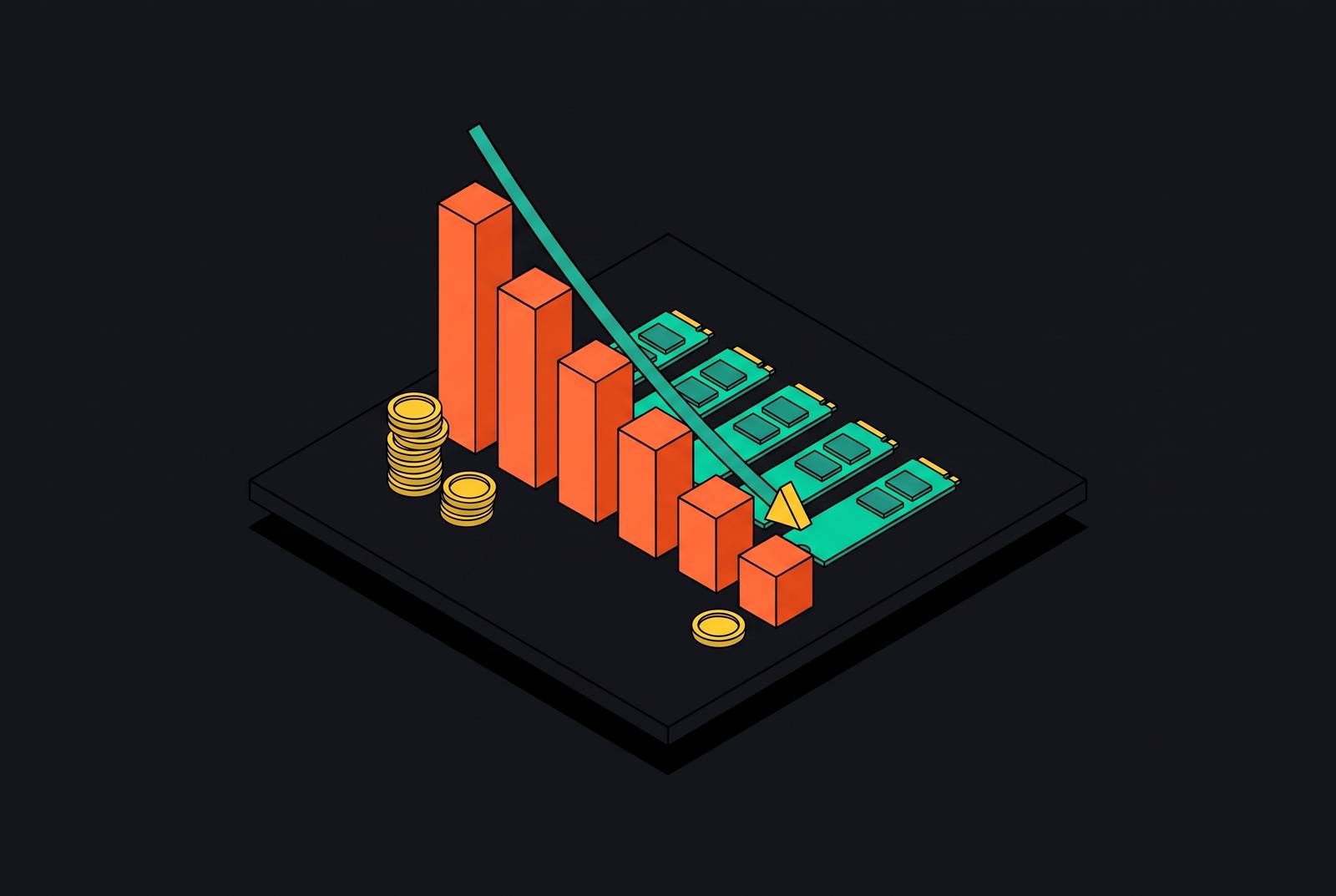
SSD price per gigabyte trends tell a different story now than they did in 2023. After years of falling costs, prices rose sharply as demand for AI led chipmakers to make more for data centers. For builders, the conclusion is blunt. Buying around today’s competitive capacity tiers makes more sense than waiting for the old lows to return.
How SSD prices fell for roughly 12 years — and why that matters now
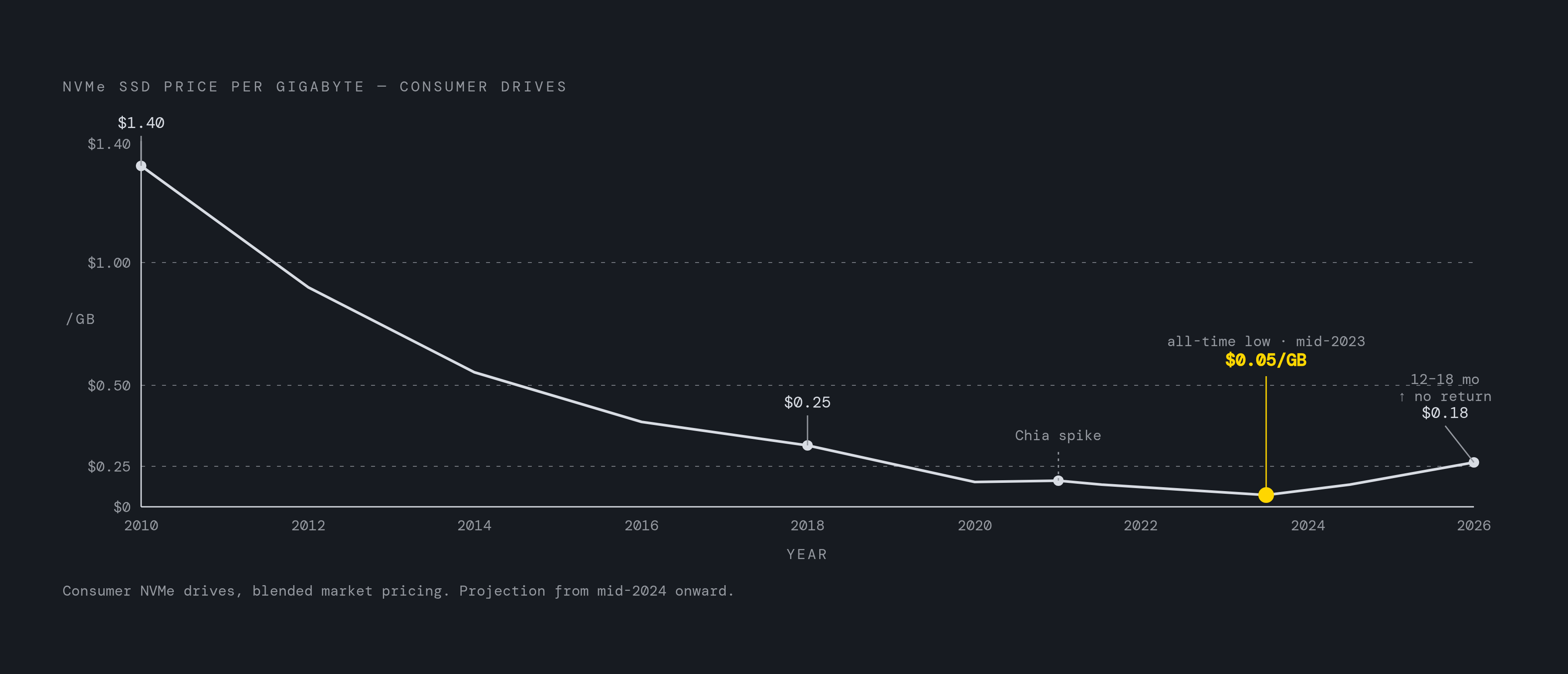
For years, waiting to buy storage usually paid off. The same budget bought more space, and a capacity that once felt extravagant became an ordinary choice for a gaming PC. That expectation had a solid foundation. SSD prices fell from roughly $1.40/GB in 2010, dropped sharply by 2015, and fell further by 2018 and 2020. Each step made a larger SSD easier to justify.
Manufacturing improvements did much of the work. Denser NAND layers let the chips hold more storage, while making more drives spread the costs across them. Competition among Samsung, Western Digital, SK Hynix, Micron, and others kept pressure on prices. Together, those forces made costs roughly halve every few years, often enough to make further savings feel inevitable.
The decline was not an unbroken straight line. Prices rose during the 2021 pandemic and Chia spike before falling again, so there had already been setbacks that did not last. Even so, mainstream NVMe prices reached an all-time low of roughly $0.05/GB in mid-2023. A builder who bought a 2TB NVMe drive then timed the market about as well as anyone could have.
Why prices stopped falling and reversed sharply starting in late 2025
The late-2025 reversal came from a different pressure. AI data centers were consuming supply while chipmakers redirected production capacity toward more profitable memory products. Consumer SSDs had less claim on that capacity even as manufacturers waited for cheap inventory to clear.
The key constraint is allocation. Capacity devoted to High Bandwidth Memory, or HBM, for Nvidia GPUs is capacity unavailable to support cheap consumer storage. Samsung and SK Hynix, which together control roughly half of global NAND supply, were cutting NAND output while shifting capacity toward HBM. Its higher profit margins gave them a reason to prioritize that business. Consumer demand could weaken without automatically bringing the displaced supply back.
SK Hynix said during its October 2025 earnings call that its HBM, DRAM, and NAND capacity was sold out through 2026. Phison CEO Khein-Seng Pua made the shortage plain in November 2025. “Every NAND manufacturer told us 2026 sold out. All the capacity sold out.”
Long-term contracts tightened the squeeze further. Microsoft, Google, AWS, Meta, and Oracle locked in NAND supply, with some negotiations already reaching into 2027 allocations. Those commitments meant consumer SSD makers were competing for production that large buyers had already claimed.
How fast and how far prices actually climbed — what the data shows
The shock reached retail shelves unevenly. NAND contract prices climbed faster than the prices consumers paid because SSD brands absorbed part of the increase. That distinction prevents a misleading comparison. A sharp rise in the cost of flash does not translate directly into the same percentage increase for a finished drive.
The Samsung 990 Pro 1TB climbed steeply from its 2023 bottom, reached a high by June 2026, and rose further by September. The WD Black SN850X 1TB also moved from a mid-2023 low to a substantially higher price by March 2026. Both drives were familiar shopping choices in the mainstream consumer market.
Budget NVMe drives still cost less than mainstream models in September 2026, but even the cheapest options cost far more than at the 2023 low. Availability also complicated the picture. Micron stopped making the Crucial T500 2TB in February 2026, so the drives still listed for sale came from stock that would run out.
After steep increases in the first two quarters of 2026, retail prices plateaued in the third quarter, with tracking showing flat to slightly lower prices from August to September. Individual models could still rise during that broader pause.
Who got hit hardest — enterprise buyers, budget builders, and OEM laptop buyers
Enterprise buyers helped use up supply, but they also had to pay the higher costs that followed. A budget builder had less room to absorb them. Laptop manufacturers, meanwhile, could manage increases by changing the amount of storage included in a machine.
A laptop can cost the same as before but come with less storage, so the price shock can show up as less capacity.
For desktop builders, the pain also depended on size. The 4TB and 8TB segments saw steeper per-gigabyte increases than 1–2TB drives because they use more NAND per unit and attract enterprise crossover demand. The 1–2TB range remained the most competitive, with the widest in-stock selection.
Even the old SATA-versus-NVMe price rule became unreliable. SATA was no longer automatically the cheaper choice, and some NVMe options could match or undercut SATA pricing. Slower did not reliably mean better value.
HDDs as the untouched alternative — and why the comparison is more complicated than it looks
Hard drives escaped the NAND shortage because they use a different supply chain. As of early 2026, they remained dramatically cheaper per gigabyte than mainstream SSDs, and that gap had widened significantly since mid-2025. For bulk storage of 8TB and above, HDDs remained the clear value choice. That gives builders an alternative, but not an interchangeable one.
The intended job changes the comparison completely. An HDD’s low cost does not make its performance trade-off acceptable as the primary drive in a gaming or productivity build. Cold storage and media are different uses, where capacity can take priority over speed. The practical response is therefore a two-drive setup, with an NVMe SSD for the operating system and active games, plus a high-capacity HDD for bulk storage.
The strongest objection to the “permanent repricing” thesis — and why it doesn't fully hold
The strongest objection is that NAND has done this before. Oversupply pushes prices down, manufacturers cut production, supply tightens, and prices recover. Eventually, the balance changes again. That cycle explains the correction after the 2022–2023 glut, so skepticism about claims of permanent scarcity is reasonable.
Retail prices also give less cause for alarm than contract prices on their own. Brands absorbed some of the cost shock, and the later plateau showed that consumer prices did not have to rise indefinitely. A partial retreat remains possible. Calling every increase permanent would go further than the evidence allows.
Capacity is being redirected toward HBM, a higher-margin product backed by longer commitments. IDC put SK Hynix’s HBM revenue share at a majority in the first quarter of 2026, showing the scale of that business. Even if consumers start buying more again, that alone will not change what chipmakers put first.
New factories offer relief, but their schedules are slow. YMTC’s third Wuhan fab was set to begin mass production in the second half of 2026, with capacity ramping through 2027 and into 2028. Meaningful volume was not expected before late 2027. For a build planned within the next 12–24 months, a plateau or partial retreat is plausible, while a return to 2023 lows is not the base case.
Where the market stands as of late 2026 and what the near-term trajectory looks like
By late 2026, the steepest part of the climb appeared to be over. When prices stopped rising, they were still well above the historic low and the bargains builders remembered. That distinction separates stabilization from recovery. A price can stop rising and still be poor value against its own history.
The Samsung 9100 Pro 1TB, a Gen 5 drive, was priced roughly level with or marginally above the older Gen 4 990 Pro 1TB. Remaining stock can keep older models expensive. The Samsung 870 EVO 1TB SATA drive stood at $329.70, still high relative to its 2023 low.
Other choices were more competitive. The Kingston NV3 2TB ranked among the strongest mainstream NVMe options on price per terabyte. The Crucial P310 remained available at competitive prices in both 1TB and 2TB, but only from remaining stock after Micron’s consumer exit.
These are snapshots of prices that move daily, and live tracking will give a more current figure than a published article. YMTC’s expansion and Micron’s next factory coming online in 2027 may change how much supply there is over time, but they will come too late to help with a build planned in Q4 2026.
How to read price-per-GB benchmarks and pick the right capacity tier right now
For a buying decision, price per gigabyte puts different capacities on the same cost basis. Divide the drive’s price by its capacity in gigabytes, then compare that result with current alternatives. A figure from a 2023 or 2024 buying guide describes a market that no longer exists.
An HDD can win on price per gigabyte without being suitable for the job of a primary SSD. The same care is needed when comparing old SSD stock with newer drives that cost about the same. A low total price and a good capacity deal are not necessarily the same thing.
The 2TB tier currently offers the best per-gigabyte value. By contrast, 500GB drives have a disproportionate per-gigabyte premium, while 4TB and 8TB models combine steeper increases with thinner inventory. That makes 2TB a useful starting point for comparison rather than a reason to buy capacity without considering need.
Counterfeit SSDs remain a problem, particularly on third-party Amazon marketplace listings. An unknown brand at an implausibly low price is almost certainly fake or defective. The buying guidance is to stick with reputable brands such as Samsung, WD, and Kingston, especially when shopping below the market average.
When to buy, when to wait, and how to build smart under current market conditions
For a build needed now, the recommendation is to buy strategically within Q4 2026. The sharpest increases have paused, but meaningful supply relief is not expected before 2027. Competitive 1–2TB NVMe models could flatten or pull back modestly during Q4. The 4TB and 8TB segments have less reason to ease while enterprise crossover demand remains strong.
If the build cannot wait for Black Friday, target a reputable 2TB NVMe drive at or below the current market average per gigabyte. Avoid 4TB and 8TB models unless that storage volume is a hard requirement. This capacity decision keeps the purchase in the market’s most competitive range.
Waiting is more defensible when the build itself can wait beyond Q4 2026. Industry expectations put the first meaningful structural relief in 2027 as new capacity begins ramping, though substantial volume takes longer. Prices are unlikely to return to 2023 lows within 12–18 months.
For builders who need both speed and space, the widened HDD-to-SSD price gap strengthens the case for separating active storage from bulk storage. The old habit of waiting for every SSD capacity to become cheaper is no longer a sound buying plan.