Amazon vs Newegg vs Micro Center PC Parts Pricing Comparison
Shop each component separately across stores to find your best PC build total price.
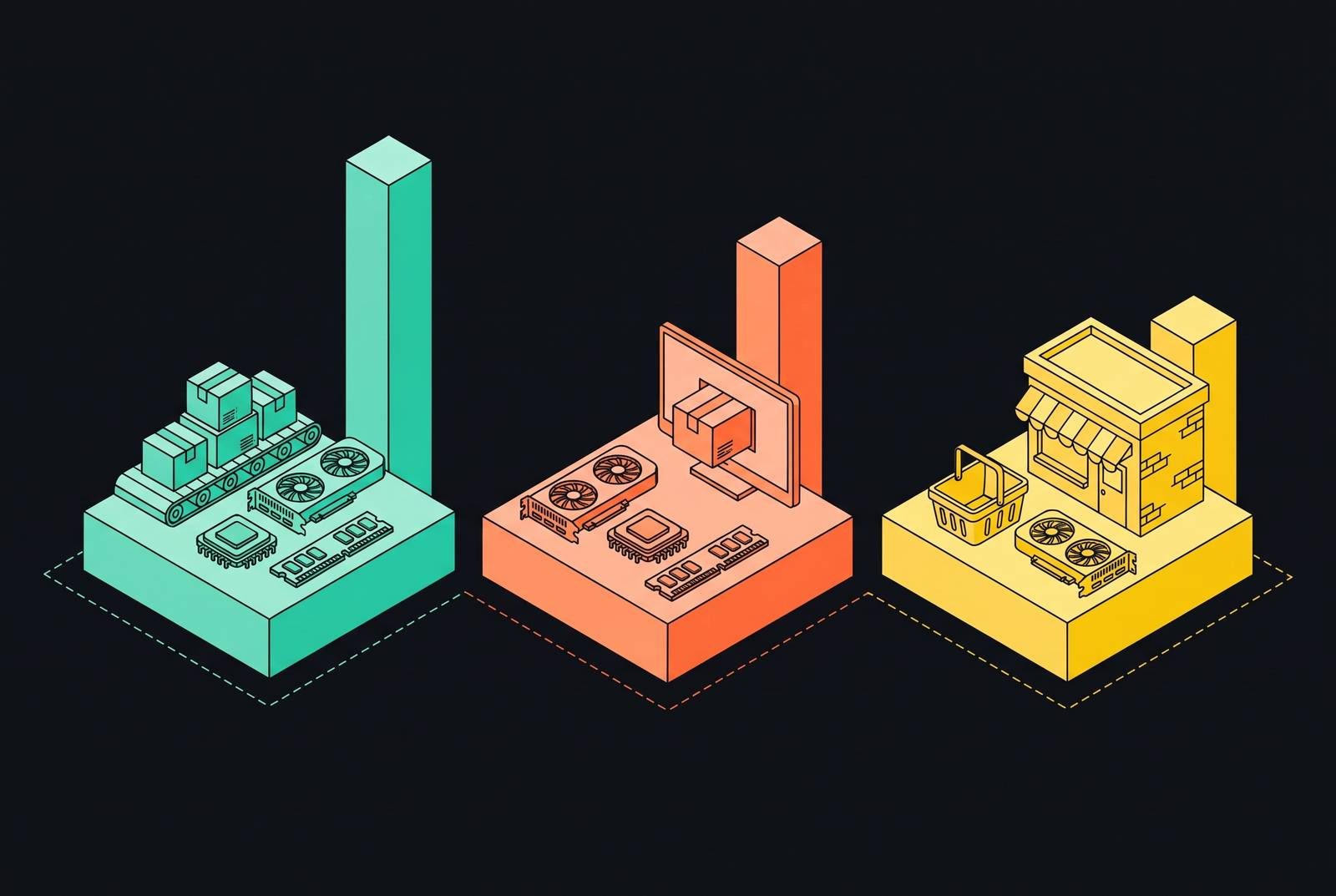
Amazon vs Newegg vs Micro Center PC parts pricing is not a contest with one winner. The cheapest sensible build in 2026 usually uses parts from more than one store, because each has better deals on different components. Micro Center leads on accessible in-store bundles, Newegg competes through combos and timed sales, and Amazon makes smaller purchases fast and convenient.
Why no single retailer wins every PC parts category in 2026
A store that discounts processors heavily does not necessarily offer the best deal on the rest of the build. Its advantage comes from how it sells those processors. That distinction is easy to miss at checkout. Filling one cart out of habit can mean paying more for components that another retailer sells on better terms.
In 2026, that habit has become more expensive. Memory and GPU prices have gone up sharply, so differences in what stores charge are harder to shrug off. The useful comparison is therefore between offers for each component, including any qualifying bundle. Retailer loyalty is not a pricing strategy.
How each retailer's pricing model actually works
Micro Center has in-store loss-leaders and bundles that make some parts much cheaper to buy. Its biggest discounts come with a requirement to buy qualifying components together in a store. That restriction is central to the deal. The online price of a single part does not capture the value of its in-store checkout total.
Newegg, founded in 2001, sells mostly online and has no traditional retail stores. Its two main discount mechanisms are Combo deals and Shell Shocker flash sales. Combos automatically discount eligible pairings, including CPUs with motherboards or GPUs with PSUs, while Shell Shocker offers rotate daily with email-subscriber early access. Timing does the work here. Newegg has no formal blanket price-match policy, but its catalog also reaches into niche cooling hardware, fan sizes, PSU cable kits, and case accessories that general retailers skip.
Prime shipping gets parts such as fans, RAM, cables, and storage delivered in one to two days, while its liberal return window reduces risk on smaller purchases. Convenience is the selling point. Amazon has no CPU-and-motherboard bundle deals or formal price-match policy, and listings from third-party sellers on Marketplace need a closer look.
B&H Photo deserves a brief honorable mention for a different reason. Its Payboo card effectively returns sales tax as store credit for most states, which can make a large order especially competitive in a high-tax state. That benefit changes the total purchase calculation. It does not replace the category-by-category comparison among the three main retailers.
CPU and motherboard bundles — where Micro Center's in-store model is hardest to beat
Micro Center has the clearest advantage when a builder needs a processor, motherboard, and memory together. Its qualifying bundle discount applies automatically at checkout, without a coupon or rebate form. The savings attach to the combination. Buying the same categories separately online can miss the main reason the store is competitive.
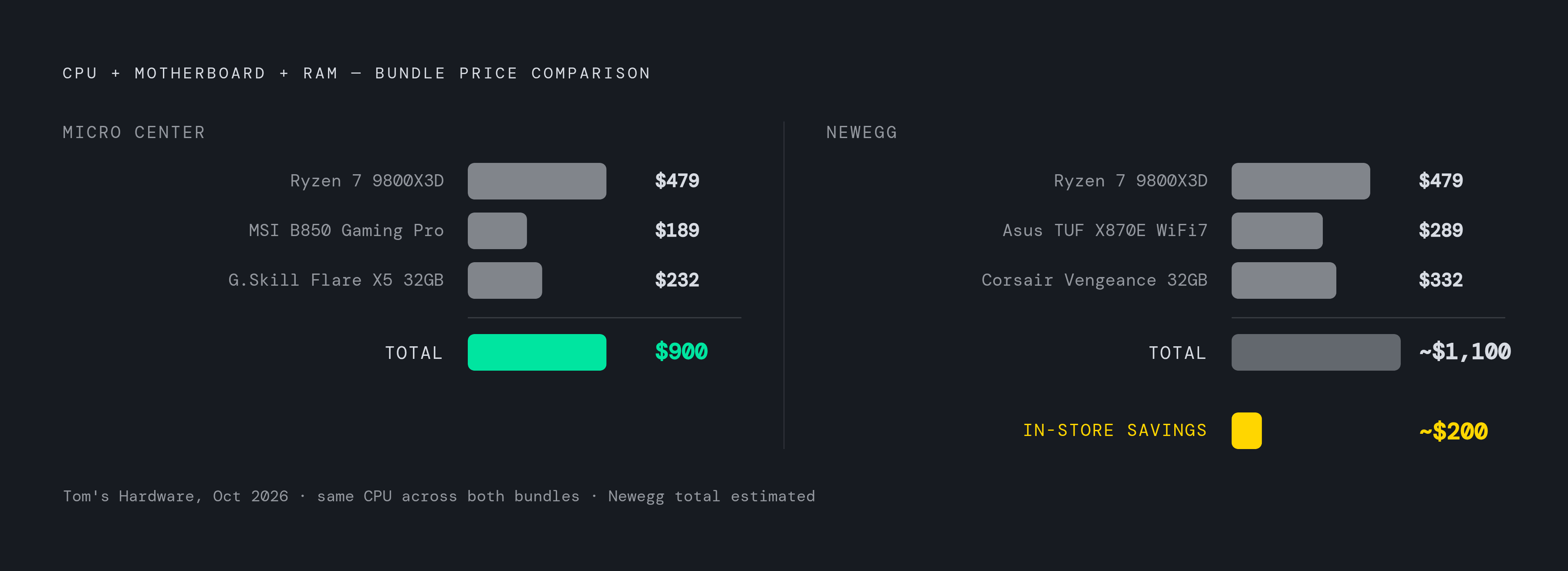
Tom's Hardware's October 2026 bundle table provides a concrete comparison. Micro Center offered an AMD Ryzen 7 9800X3D, MSI B850 Gaming Pro WiFi6E AM5 motherboard, and G.Skill Flare X5 Series DDR5-6000 32GB for $899.99. Newegg's closest comparable combo paired the same processor with an Asus TUF Gaming X870E-Plus WiFi7 and Corsair Vengeance RGB DDR5-6000 32GB, at a noticeably higher total. The boards were not identical, which limits the comparison. Even allowing for Newegg's higher-tier motherboard, the difference in price was still large.
For a builder who can reach a store and needs all three parts, the lesson is to prioritize that bundle comparison. Micro Center also tends to offer individual processors at or near MSRP when online stock is scarce. Access remains the hard condition. Bundles are in-store only, limited to one per customer, and tied to roughly 30 U.S. locations.
Without that access, Newegg combos are the strongest online fallback because they typically reduce the cost of buying the CPU and motherboard separately. Amazon makes shipping easy, but has no such bundle deals.
GPUs — why retailer choice and seller identity are unusually consequential
GPUs turn a straightforward price comparison into a higher-stakes purchase. A bad choice can mean paying well above MSRP, getting a fake card, or finding out after opening the box that the return terms are strict. The seller is part of the product decision. A listing on a familiar website is not necessarily a sale by that retailer.
Most builders are shopping for mid-range GPUs. Still, the high end shows how far online and in-store pricing can diverge. In October 2026, the cheapest RTX 5090 for sale online was listed by a third-party seller on Amazon Marketplace for far more than the card's original MSRP. Micro Center listed both the Asus GeForce RTX 5090 ROG Astral and MSI GeForce RTX 5090 Suprim in-store at $5,029.99, below that online offer.
Some Micro Center deals in mid-2026 offered a mid-tier RTX card at or below MSRP while prices online were much higher. That makes local stock worth comparing when online supply is constrained. It does not make every in-store GPU cheap.
For online purchases, the safest Amazon choice is explicitly sold and shipped by Amazon.com. Newegg also requires attention before purchase because an opened, non-defective GPU return can incur a restocking fee under the item's policy. A compatibility test can therefore become an expensive experiment.
RAM and storage — categories where sale timing beats retailer loyalty
Memory and storage have no permanent retail winner. Their prices depend heavily on sale timing, and the 2026 supply environment makes that timing especially consequential. DRAM and NAND flash producers have shifted more of what they can make toward high-bandwidth memory for AI data center hardware. Newegg's second-quarter 2026 results showed that memory and flash were in short supply and that prices were under pressure across the industry.
A 32GB DDR5-6000 kit that was affordable in early 2025 had become dramatically more expensive by late 2026. DDR4 kits also went up sharply in price from late 2025 into 2026, so sticking with older memory may still mean paying more to upgrade. Buyers should monitor RAM sales across all three retailers. The best offer can move quickly.
For storage, Amazon Lightning Deals and Prime Day take first place, followed by Costco for 2TB-plus capacity without waiting for a sale, then Newegg Shell Shocker. Black Friday is still the best time of year to buy, whichever store a buyer chooses. A builder who can access Micro Center and needs a CPU, motherboard, and memory together should prioritize its bundle over an individual online RAM offer.
For an existing DDR4 build, there is another way to avoid an expensive transition. A GPU upgrade or a CPU upgrade within the same socket may extend the platform without taking on the cost of moving to DDR5.
PSUs and cases — the low-drama categories where Amazon and Newegg share the lead
Cases are a simpler decision than GPUs or memory. Amazon leads with its range of cases, free Prime returns, and helpful photos in reviews, while Newegg comes next with a wide range and detailed specifications for which parts will fit. Local pickup offers no meaningful savings in this category. The in-store advantage that makes a processor bundle compelling does not translate to a case.
Power supplies also leave less room for retailer games. Brand track record and warranty length deserve more weight than a marginal price difference because a failing PSU can damage other hardware. Amazon and Newegg share the lead here, with convenience and availability helping settle the purchase. The framework that demands close attention on a GPU adds little to a routine case purchase.
The geography constraint that changes everything for roughly half of U.S. builders
Micro Center has too few stores for many builders to make use of its best deals. A useful comparison has to reflect stores a buyer can actually reach.
The bundles of comparable parts from Micro Center and Newegg differed in price by roughly $200. For an online-only buyer, though, the inaccessible offer cannot be the purchasing plan. Newegg becomes the primary source for CPU-and-motherboard combos and specialist parts, while Amazon handles fast-turnaround smaller components and cables. For a large order in a high-tax state, B&H is another store to consider because Payboo gives back the sales tax.
Best Buy adds a national pickup option. Its Price Match Guarantee, updated in May 2025 and September 2026, covers new items sold and shipped directly by Amazon and excludes Newegg as a qualified competitor, while its open-box GPU grades start at Excellent-Certified and extend downward, with discounts from new prices and manufacturer warranties preserved on higher grades. Same-day in-store pickup at nearly every U.S. location is especially useful when a machine is down. In that situation, availability can decide the purchase.
Retailer trust and return policy — what the fine print costs on a bad purchase
A discount loses its appeal when returning the part consumes the savings. This is especially important for expensive components that a buyer might open to test compatibility. Return flexibility has a real financial value. The relevant terms belong to the individual item.
An incident involving a hardware review outlet led Newegg to change its return policy. That change should be acknowledged rather than treating the company's policy as frozen in the past. It was not a blanket removal of fees. The policies for individual graphics cards, motherboards, hard drives, and televisions can still charge a restocking fee if the item has been opened and is returned without a defect. Buyers should read those terms before opening the box.
Amazon's more liberal item-level return policy offers a different trade-off, but Marketplace sellers are not interchangeable with Amazon itself. Buyer protection varies by seller and item. Amazon ended inventory commingling of stock with matching barcodes on March 31, 2026, so purchases from a specific vendor using Fulfillment by Amazon now draw from that vendor's own stock. That removes one source of uncertainty about provenance. Continued community reports of counterfeit or substituted high-value components leave it an open question whether the change fully eliminates that risk.
How to plan a build across multiple retailers without creating a compatibility mess
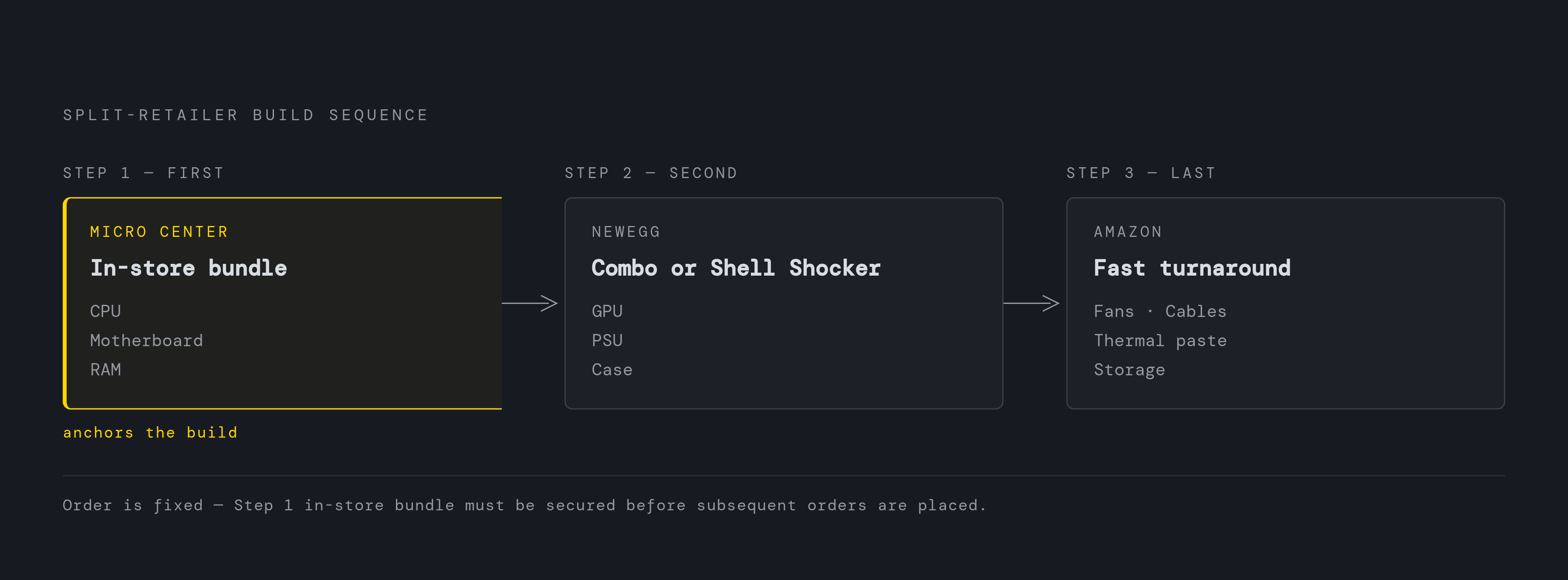
The practical workflow starts with finalizing the complete parts list and confirming compatibility before ordering, then assigning each component to its cheapest suitable source. This order prevents a discount from dictating incompatible choices. Otherwise, a return fee or a machine that will not post can wipe out the savings.
The board's socket and chipset must match the CPU, and the memory generation must suit the board and its validated list. DDR5 slots reject DDR4 sticks. M.2 and PCIe slot counts must accommodate the planned storage and GPU configuration, while PSU wattage must clear peak draw with headroom. The case must also have clearance for GPU length, cooler height, and radiator size.
Knowing which kit the board validates makes it possible to assess included bundle RAM or a Shell Shocker offer before the sale window closes. Delivery order comes after those decisions. Secure the Micro Center components first through the required store visit, place Newegg combo or Shell Shocker orders second, and leave fast-turnaround Amazon items such as fans, cables, and thermal paste until the other parts are in hand. The result is a coordinated build rather than three unrelated shopping carts.