GPU Price Drop After New Generation Launch Patterns
Previous-gen cards drop fastest in the upper-mid tier, not across the board.
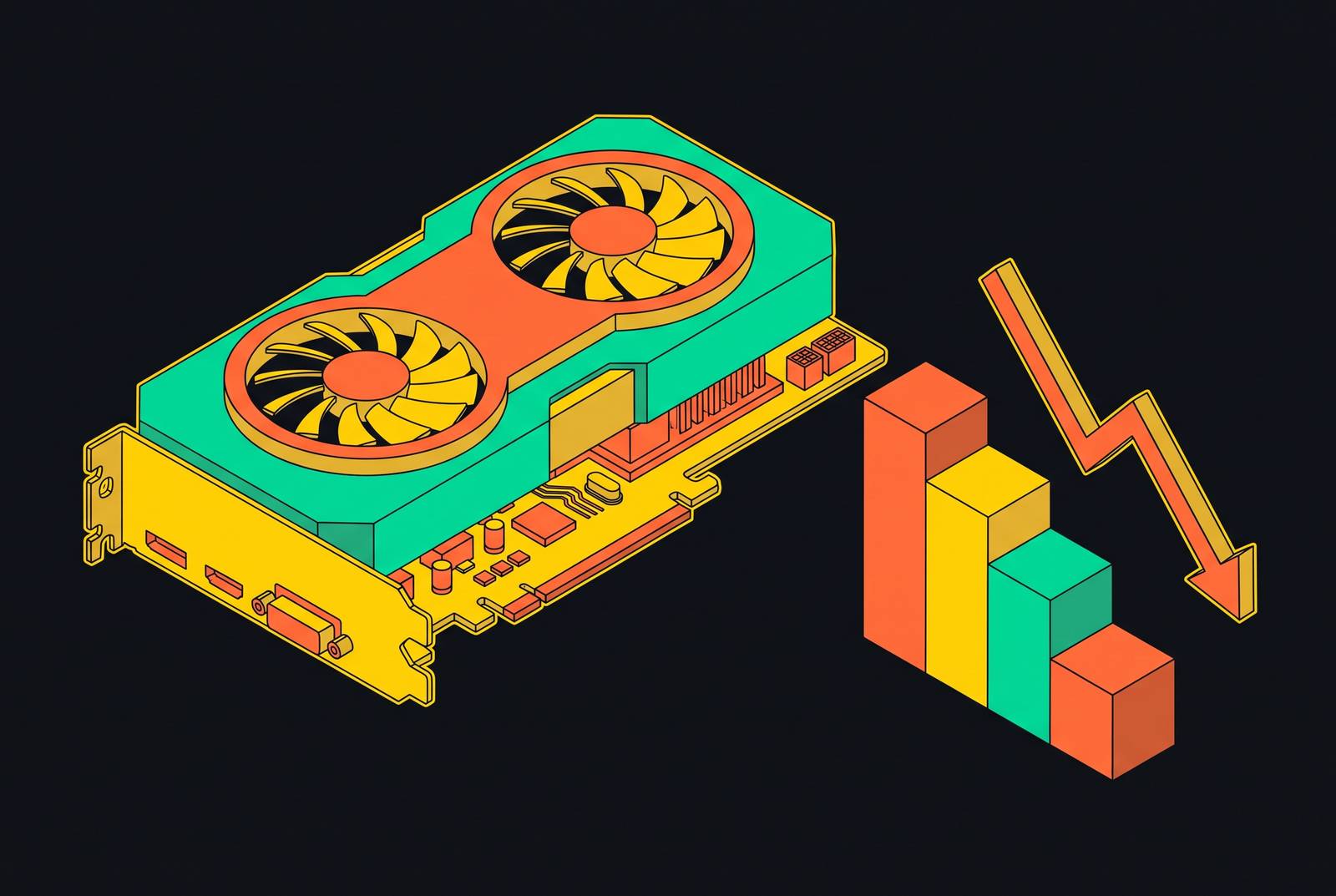
A new GPU generation does not reset the market the way most builders assume it will. The old mental model says a launch triggers a broad, immediate price correction across the whole stack, previous-gen cards fall fast, and the budget tier gets cheap within weeks. That pattern does not match what recent launch cycles actually show. The rule of thumb used to be a 20-40% retail drop on previous-gen cards once a new generation shipped, a figure formed in a market with different supply conditions than the one builders are buying into now. Builders who plan a purchase around that old assumption end up in one of two bad positions: buying a new-generation card too early at an inflated price, or waiting for a stackwide discount that never arrives and missing the best window on the card they actually wanted.
Three structural forces that have permanently dampened the launch-day price cascade
The slower, narrower price movement is not a temporary wrinkle in this particular cycle. It comes from three forces that have each independently raised the floor under GPU prices, and none of them are going away on their own schedule. AI memory demand has pulled high-bandwidth memory production away from consumer GPUs: Samsung and SK Hynix have redirected capacity toward HBM, Micron has exited 2GB GDDR7 production entirely, and GDDR7 is projected to stay in shortage at least through the fourth quarter of 2027. TSMC's capacity on its leading nodes, 4nm and 3nm, remains constrained, so even a manufacturer with strong demand for a given card cannot simply flood retail channels to bring prices down. Supply cannot outrun the memory and fab bottlenecks that cause it.
The third force is a choice, not a shortage. Nvidia's VRAM segmentation strategy splits a single GPU into an 8GB and a 16GB version, and that split pushes buyers who actually need the larger framebuffer into paying the higher price rather than letting the budget segment settle downward on its own. None of this means prices never move; it means the move happens on a schedule and in a shape set by memory supply and chip segmentation, not by launch-day competitive pressure, and the next section lays out what that shape looks like.
How price movement after a launch unfolds in tiers
Price relief after a launch arrives in tiers rather than across the board at once, and those tiers move on different timelines. The previous generation's upper-mid tier moves first and moves the farthest. The new generation's budget tier moves next, constrained by the VRAM segmentation described above.
The RTX 4070 shows the pattern cleanly: it now sells for substantially less than its original launch price, it remains a capable 1440p card, and it faces no meaningful restock pressure holding its price up. The RX 9070 XT shows the opposite end of the same curve. It's a competitive card, but it took eight months to consistently reach its launch MSRP. A builder chasing the new mid-range card at launch paid a premium that a previous-gen buyer simply avoided. The pattern holds across tiers: the older card clears its price floor fast, the newer equivalent takes most of a year to settle, and the flagship tier takes longer still.
The previous-generation upper-mid tier: where the biggest price relief lands
The RTX 4070 example from the previous section fits this slot directly: a 1440p-capable card with a price that has already moved and no supply squeeze keeping it artificially high.
The Intel Arc B580 adds a useful second data point because it shows what happens when genuine competitive pressure from a new entrant pushes into the budget segment, even though it didn't follow the same previous-gen pattern. The B580 settled at a low price point and stayed in stock, which is the kind of downward pressure the structural forces in section two otherwise suppress.
The RX 9070 XT comparison from the prior section raises an obvious objection: why not just buy the new mid-range card instead of waiting on the previous generation? The new card does have real advantages, a longer useful life ahead of it and more VRAM at the baseline, a trade-off that deserves to be weighed, but a builder who waited for the previous-gen equivalent spent less money for comparable performance, and spent it earlier in the cycle, while the RX 9070 XT was still eight months from reaching its own MSRP. Tracking where a specific card sits against its launch price and its current trajectory, using a live price history tool rather than a gut estimate, is the practical way to catch that upper-mid window while it's actually open.
Why the new-generation flagship tier moves last
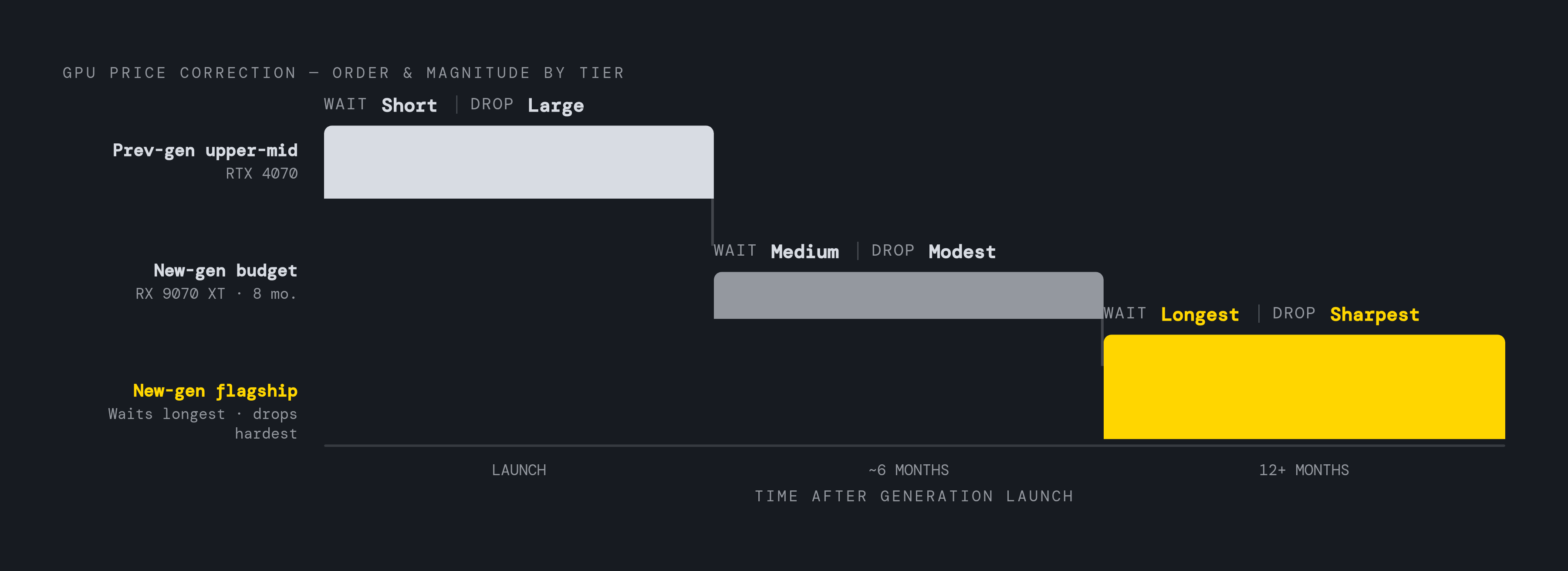
Flagship cards run on a completely different curve than the mid-range tier. They launch into the highest point of scalper and enthusiast demand, which keeps them above MSRP longer than any other tier in the stack. Then, once that initial demand burns off, they correct sharply rather than drifting down gradually the way a mid-range card does. That shape makes patience more valuable at the flagship tier than anywhere else in the lineup: the builder who waits out the correction captures a bigger single drop than the builder who waits at any other tier, simply because the flagship starts from a higher, more inflated peak.
This is the inverse of the upper-mid pattern described above. The previous-gen mid-range card gives up its premium fast and evenly. The new flagship holds its premium stubbornly and gives it up all at once, later. A builder set on owning the top card in a generation gets a more predictable outcome by watching for that late correction than by trying to catch the card anywhere near its launch date.
The VRAM floor shift and previous-gen bargain hunting
Everything said so far about the previous-gen upper-mid tier comes with one real condition: the card has to clear the VRAM floor that the market has now set, and that floor moved up in 2026. A low price on an 8GB card is not automatically a good deal anymore, and the RTX 5060 Ti 8GB controversy shows why. Hardware Unboxed testing found the 8GB variant delivering just 67 FPS in The Last of Us Part Two at 1080p, well behind the 16GB model's output, and Indiana Jones and the Great Circle crashed outright on the 8GB card at 1080p Ultra settings. A Hardware Unboxed community poll went on to name the RTX 5060 Ti 8GB the worst GPU of 2025.
That result sets a practical minimum for anyone shopping the previous-gen tier: 12 to 16GB of VRAM is the correct floor for a new purchase, and an 8GB card at an attractive price still carries a real longevity risk for a builder who doesn't plan to upgrade again for several years. Newer budget cards have already started shipping with that higher floor built in. The RX 9060 XT and the RTX 5060 Ti both now offer 16GB configurations, and that shift is a forward-looking signal to weigh against an older 8GB card at a similar price point.
At the other end of the VRAM spectrum, cards with large buffers have stopped depreciating the way the rest of the market does. The RTX 3090, with 24GB of VRAM, has held its value in a way 8GB cards simply have not, because AI inference demand keeps pricing propped up on high-VRAM consumer cards independent of how well they play games. The practical filter for any previous-gen bargain is whether the card has at least 12GB, and whether that price actually reflects where the card currently sits in the VRAM tier.
What community purchasing data reveals about when most builders pull the trigger
Steam's Hardware Survey data shows that most builders aren't timing launches. Instead, they're holding onto aging hardware well past the point where price and performance would argue for an upgrade. That pattern is a direct result of sustained premium pricing across both the RTX 40-series and RTX 50-series launches: builders priced out of new hardware at each step simply kept running what they already had rather than stretching for a card at an inflated price.
That same signal appears in real time in community hardware surveys that track what builders are actually selecting and configuring, complementing the Steam data's lag by showing current purchasing behavior. The practical read for anyone watching these signals: when the Steam survey shows a previous-generation mid-range card's share plateauing, the used market for that card is likely near its floor. That plateau functions as a timing signal in its own right, not just a snapshot of what people already own.
Translating the tiered pattern into a purchase timing decision
Everything above, the tier sequence, the VRAM floor, the community data, collapses into one practical question for a builder actually ready to buy: is this the right three-to-six month window, or is it smarter to wait one more cycle? Three questions get a builder to that answer.
Which tier does the build actually need? Budget, mid-range, and flagship each move on different timelines, and the answer changes the whole plan. A build that needs flagship-level performance should wait, since the correction there comes late but comes sharply. A build that targets the previous-generation upper-mid tier is likely looking at a window that's open now and will narrow as stock depletes.
Does the card under consideration clear the VRAM floor? Twelve to sixteen gigabytes is the established minimum for a new purchase in 2026, and a card below that line needs a real reason to justify the risk, not just an attractive price tag.
Where does this specific card sit on its own price curve? Checking a tracked price against its launch price and its trajectory since then is the fastest way to tell whether a card has already bottomed out or still has room to fall.
A builder working through those three questions needs to see the current best price alongside the build context that price has to fit into: PSU headroom, socket compatibility, case clearance. Tools that combine real-time compatibility checking with multi-retailer price comparison let a builder answer all of this inside one planning session instead of jumping between a spec sheet, a price tracker, and a compatibility checklist separately. The entire argument here has been about reading the curve with precision, not about reacting to a countdown clock. A builder who understands which tier moves first, where the VRAM floor sits, and what the current price trajectory actually shows is making a planned decision. That's a materially different position than buying out of fear of missing a moment that, in most tiers, was never going to close as fast as it seemed.