How Tariffs and Supply Chain Events Move PC Part Prices
Stock buffers at each supply layer mean tariff impacts reach retail weeks or months later.
Tariffs and supply chain events move PC part prices through a series of business decisions. That is why increases arrive at different times, hit some parts harder than others, and can linger after the original shock eases. Builders who understand that chain can plan around the delays instead of mistaking today’s price for tomorrow’s cost.
Why PC part prices don't move the way builders expect them to
A builder checks a part after a tariff headline and finds the price unchanged. A month later, the same part costs sharply more. The first price was not proof that the tariff had no effect, and the later increase was not necessarily a new shock. Stock bought at the old cost may have kept the price down until the next shipment came in. The headline and the checkout price were showing different stages of the same event.
A policy change can take weeks or months to reach retail, and each component category moves on its own timetable. Nor does an increase have to disappear when the policy changes again. The useful pattern is a sequence of stock, costs, and decisions that gives builders clues about what comes next.
The supply chain layers a tariff or disruption must pass through before hitting retail
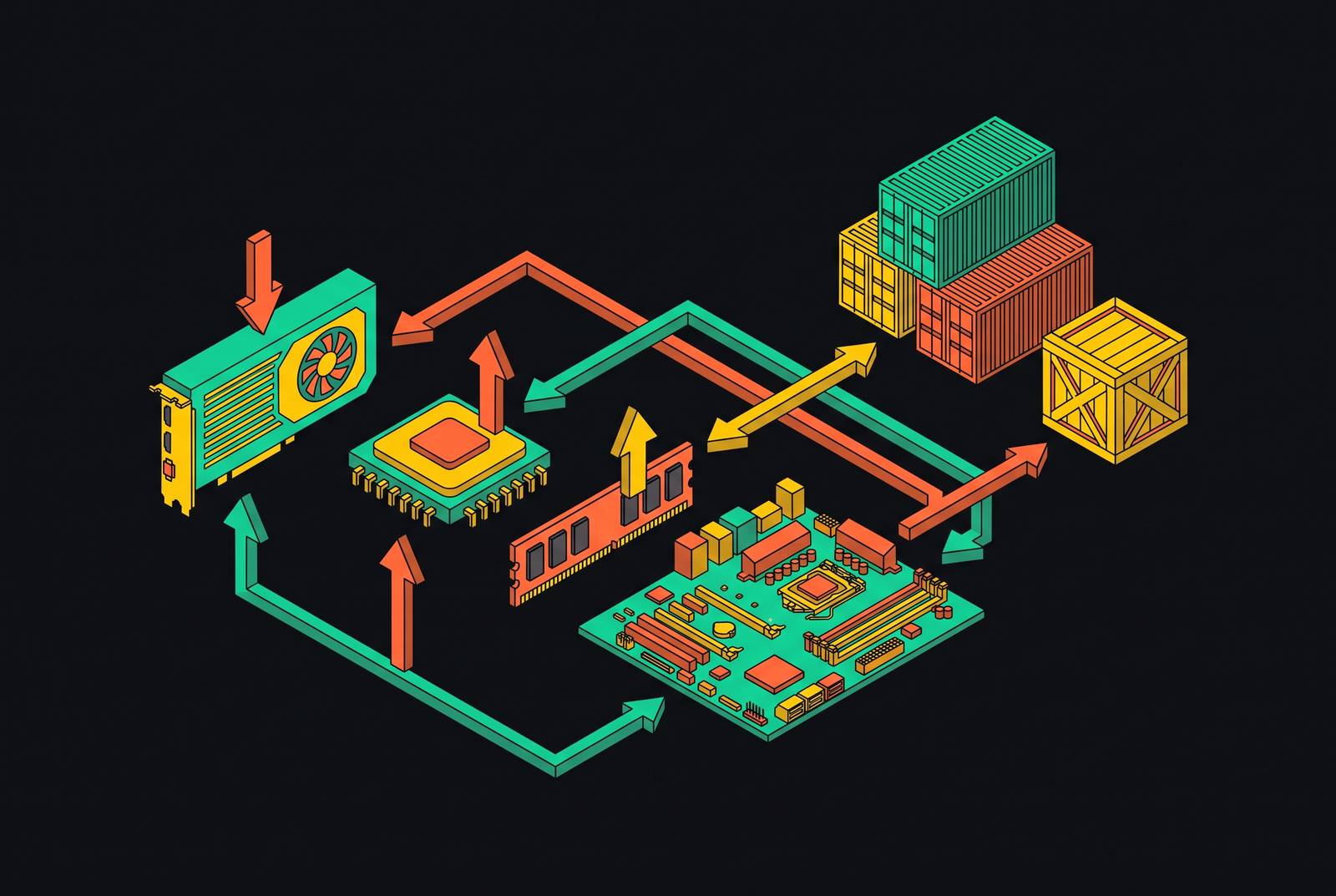
Parts pass from the manufacturer to the importer to the distributor to the retailer. Manufacturers can have finished stock on hand to sell at the old cost for weeks. Importers can stockpile hardware before an announced tariff takes effect. Distributors add another buffer by choosing how much of the extra cost to pay themselves and how much to pass on. Retailers then work through existing stock before reordering at new prices.
The company also stockpiled hardware to manage shortages and delay increases. Its approach built a multi-week lag between a cost change and what customers would pay.
The important consequence is that the first retail increase is rarely the full or final one. One retailer may change its price while another still has older stock, and the supplier may charge more again for a later shipment. A quiet price today says something about the stock being sold today, but less about the cost of replacing it.
Why different component categories absorb and transmit cost shocks at different rates
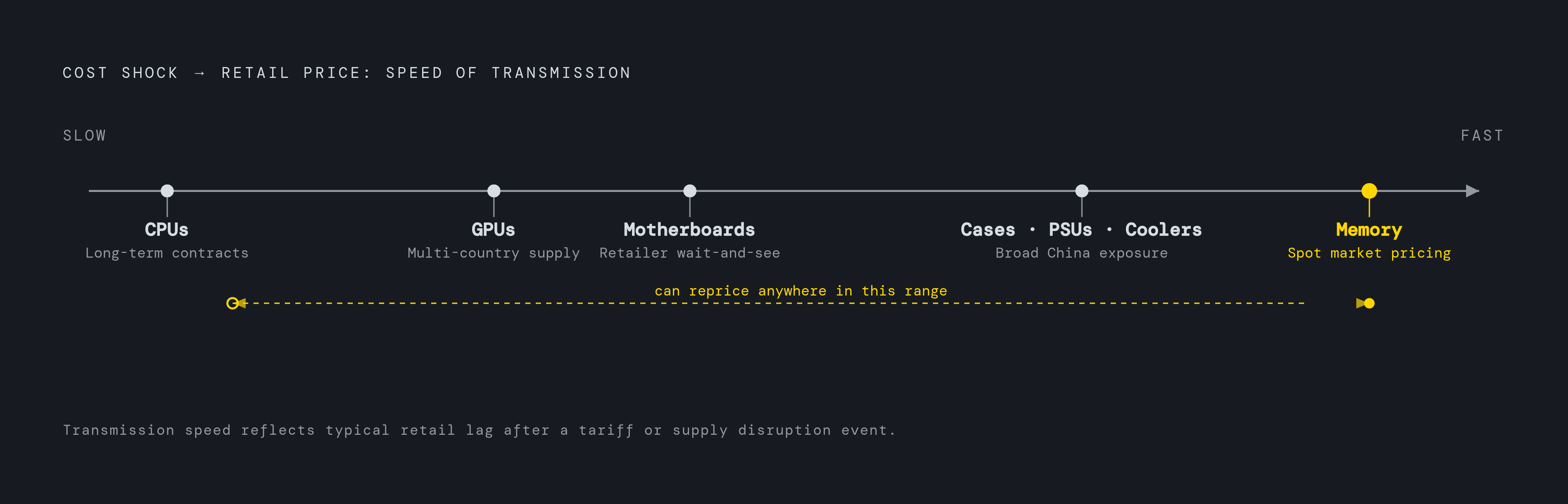
Within that chain, the speed depends on where the shock lands, how concentrated production is, and how much stock is available. A useful mental map puts cases, PSUs, and coolers among the fast movers, GPUs and motherboards in the middle, and CPUs among the slower movers. Memory is a separate case because its prices are set in spot and contract markets. These groups offer a general guide to exposure.
Cases, PSUs, and coolers have broad manufacturing exposure to China, making them sensitive to tariff changes affecting that supply. GPUs have a more layered cost structure, with supply chains spanning Taiwan, South Korea, China, Japan, and other countries, and Vietnam emerging as an assembly location. Assembly, printed circuit board fabrication, and component sourcing can each encounter different tariff rules. ASRock illustrated the delay involved in changing that structure when it announced plans to move some GPU card manufacturing away from China. ASRock stated, “we need some time to transfer the manufacturing to other countries”.
Motherboards occupy a middle position because sourcing spans multiple countries and retailers have waited for clarity on upstream pricing. Memory can react faster than almost any other category because spot and contract markets set its underlying prices independently of retailer inventory cycles. A builder can therefore see the price of one part rise while another stays the same. The unchanged part is not evidence that the whole market has absorbed the shock.
When a second, independent shock hits the chain at the same time as tariffs
In 2025–2026, tariffs are only one source of pressure. Demand for AI infrastructure is using up semiconductor capacity while trade costs hit other points in the chain. The two shocks have different causes and do not have to ease together. Their combined effect can therefore be larger and harder to reverse than either would be alone.
Samsung, SK Hynix, and Micron control the dominant share of global DRAM production and have shifted capacity toward HBM and server-grade memory. That leaves less capacity for conventional DDR4/DDR5 used in PCs. Counterpoint analyst David Naranjo identified memory as “the first and the hardest hit” category when AI infrastructure demand and rare-earth constraints intersected, before the full memory repricing of 2026.
The pressure also extends beyond the chips themselves. Printed circuit board lead times have lengthened dramatically, while Kingboard Laminates Group has raised prices on PCB laminates and prepreg. STMicroelectronics has raised semiconductor prices, and Murata Manufacturing has raised prices on passive components. As a result, even a part not directly hit by a tariff can carry higher upstream costs. Even after a tariff dispute ends, factories can still lack the capacity to make enough parts, and materials can still cost more for other reasons.
How manufacturers and retailers decide when — and whether — to pass costs on versus absorb them
Faced with those pressures, companies still have choices about how much to pass on and when. An unchanged selling price can mean a business is absorbing the increase. A statement that costs are being absorbed for now is therefore a warning about a limited window. It can precede repricing within weeks.
Maingear CEO Wallace Santos said tariffs have a “direct impact on our cost structure” and described suppliers halting production in China, leading to scarcity and rising costs. Santos estimated a 20 to 25% price rise for Maingear’s systems as a result. Puget Systems also flagged a different behavior, namely suppliers using tariff uncertainty to justify increases beyond the actual impact on their costs. A higher price can reflect both genuine pressure and a decision to take advantage of the uncertainty.
Framework showed how those decisions can change as policy changes. During the April 2025 tariff round, it paused U.S. sales of some Framework laptops, resumed them with updated pricing, and adjusted prices again when tariffs were reduced. That sequence shows that reversals are possible, but not that they are automatic or complete. SilverStone put the imbalance plainly, saying price reversals happen “more slowly than it is to raise prices” because businesses must be careful about reductions across their product lines. That is the ratchet effect builders have to account for.
Why prices rarely fall as fast as they rose, even when the original shock eases
The ratchet matters because waiting is often seen as safe and free of cost. In practice, the commercial incentives favor urgency when costs rise and caution when they fall. A reduction at one point in the chain does not require every business after it to cut prices immediately. When one shock eases, the others can still raise the cost of new stock. The route back down is not simply the route up played in reverse.
There is a serious objection to that argument, especially for memory. Manufacturers overbuilt after the shortage in the late 2010s, and the resulting oversupply led to a price crash. A similar correction could happen again, so high prices should not be treated as permanent. But the current allocation of capacity gives manufacturers a different incentive. AI demand pays dramatically more per wafer than consumer electronics, making HBM and server-grade production attractive even if consumer demand weakens.
The distinction is between recognizing that prices can fall and building a purchasing plan that depends on them falling soon. The first is reasonable uncertainty. The second is a bet on timing. For builders, “waiting for prices to normalize” can cost months of elevated pricing and carry the risk of further increases as upstream manufacturers reprice.
Which components are most and least exposed right now, and what that means for build planning
A build budget should allow for some parts to change in price more than others. DDR5 is among the most exposed categories because AI infrastructure demand has absorbed enormous DRAM capacity, and mainstream kits have repriced dramatically from 2025 baselines. Micron CEO Sanjay Mehrotra said the company expects memory and storage supply-demand conditions to be much tighter in fiscal 2027 and 2028 than in 2026. Planning around current memory prices is therefore more defensible than assuming near-term relief.
Cases, PSUs, and coolers also belong on the volatile side of the budget because of their manufacturing exposure. SilverStone said almost everything it sells is affected, including cases, power supplies, and coolers. Puget Systems documented approximately 20% increases for CPU coolers and fans after the early 2025 tariff rounds. These are not necessarily the parts builders expect to disrupt a budget, but their cost can move quickly.
The practical response is to anchor the budget on relatively stable components such as CPUs and leave room for movement in GPUs, memory, and storage. A GPU budget based on MSRP or launch price can fall well short of its actual street price. A 3D configurator with real-time price comparison across retailers can make that gap visible, so the build reflects available prices.
When GPU, memory, and storage prices rise together, the same budget can buy roughly one tier less machine than it did a year earlier. A constrained budget has less room to absorb those changes without changing parts. Holding some budget in reserve and allowing substitutions follows directly from that exposure.
How to read the signals that precede a price move and act before it arrives at retail
The first signs of a coming price rise often come from what manufacturers tell their channel partners. AMD’s mid-September 2026 communication to GPU and motherboard partners about Q4 price increases is an example of an upstream warning before retail tags change. Such announcements identify pressure that has entered the chain but may not have reached the buyer. They are more useful for planning than assuming an unchanged store price will last.
What a system integrator says can also give warning, especially when it says it is covering higher costs for now. Puget Systems urged customers to say what they would need soon and buy early if they could. At retail, thinning stock in a volatile category without restocking can signal repricing on the next shipment. Tariff pauses, exemptions, and reinstatements also matter because they can produce price movements within weeks. Read together, these signals show both the likely direction and how far the change has traveled.
However, buying immediately after a headline can be poorly timed if manufactured urgency and panic buying push prices above the actual cost impact. Puget Systems’ warning that suppliers were raising prices by more than their costs had risen gives builders reason to check whether a warning of higher costs is sound or just a sales pitch.
For a build planned over weeks or months, a parts list with live pricing is more useful than a static spreadsheet. It turns one snapshot into a price history and makes movement visible before it breaks the budget. Real-time comparison also shows which retailers are further along in selling their older stock. Builders cannot control the tariff or the factory allocation, but they can track the chain, adjust the parts list, and act before every price has caught up.